Advancing AI Evaluation: Fine-Grained Benchmarks for Foundation Models
Discover FLAME, a groundbreaking framework that generates comprehensive, fine-grained benchmarks for foundation models. Move beyond aggregate scores to pinpoint AI strengths and weaknesses, enhancing model selection and development for enterprises.

The Challenge of Evaluating Modern AI: Beyond Simple Scores
The landscape of Artificial Intelligence has been rapidly transformed by the emergence of foundation models. These powerful AI systems demonstrate remarkable capabilities across diverse domains, from generating human-like text to solving complex scientific problems. As these models become increasingly sophisticated and widely adopted in enterprise applications, the methods used to evaluate their performance must evolve. Traditional evaluation often relies on broad, aggregate scores from a limited set of benchmarks, which provide only a coarse understanding of a model’s true capabilities. This approach leaves critical gaps, making it difficult for businesses to select the right AI model for specific tasks or for developers to identify precise areas for improvement.
The pace of foundation model development has far outstripped the creation of effective evaluation tools. Existing benchmarks, while contributing valuable challenges to probe the limits of AI, often suffer from several structural limitations. They typically consist of small, sparsely sampled problem sets that, despite being individually difficult, fail to cover the full spectrum of competencies within a domain. This means large areas of a model's potential strengths and weaknesses remain unexplored, presenting an incomplete picture of its true profile. Furthermore, these benchmarks frequently yield only a single aggregate score, lacking the rich metadata needed to pinpoint performance to specific skills, concepts, or reasoning abilities. Consequently, while a benchmark might indicate one model is "better" than another, it cannot explain why or in what specific areas that superiority lies.
Addressing Key Limitations in AI Benchmarking
Beyond the issues of coverage and granularity, existing benchmarks face significant challenges, particularly data contamination. As foundation models are continuously trained and fine-tuned on vast datasets, there’s a risk that benchmark tasks themselves become part of the training data. This compromises the validity of performance measurements over time, as models might simply "memorize" answers rather than demonstrating true understanding. The traditional process of creating high-quality benchmarks is also time-consuming and expensive, relying heavily on manual curation by human experts. Such manual processes cannot scale effectively to keep pace with the rapid advancements in AI technology. These factors highlight a critical need for new, more robust, and efficient evaluation methodologies.
The "Fine-grained, LArge-scale Model Evaluation (FLAME)" framework, as introduced by Mohammed Saidul Islam et al. in their paper "Fine-Grained Benchmark Generation for Comprehensive Evaluation of Foundation Models" (Source), proposes a transformative solution to these challenges. FLAME is designed for automated, comprehensive benchmark generation, grounded in external knowledge sources like textbooks and technical references. This framework aims to overcome existing limitations by systematically generating evaluation tasks from authoritative materials with well-defined topical and conceptual structures. This approach enables the creation of benchmarks that offer broad and verifiable coverage of a domain’s competency space. Each generated problem is linked with detailed, structured metadata, allowing for fine-grained evaluation that can precisely identify a model's strengths and weaknesses at the level of individual competencies.
How FLAME Works: From Knowledge Sources to Precise Evaluation
The FLAME framework operates through a two-stage pipeline: source curation and preprocessing, followed by task generation. In the initial stage, domain experts carefully select a collection of external sources, typically textbooks, that together offer comprehensive coverage of the target domain's knowledge. They then review these sources to identify relevant sections for problem generation. Crucially, a two-level taxonomy of competencies is constructed in consultation with the expert. This taxonomy, often mirroring the organization of textbooks into major parts and individual chapters, serves as the structural backbone of the benchmark. Every problem generated is then linked to a specific competency and area, allowing for evaluation at various levels of granularity. This meticulous process ensures that the evaluation is thorough and contextually rich, providing valuable insights into specific skill sets.
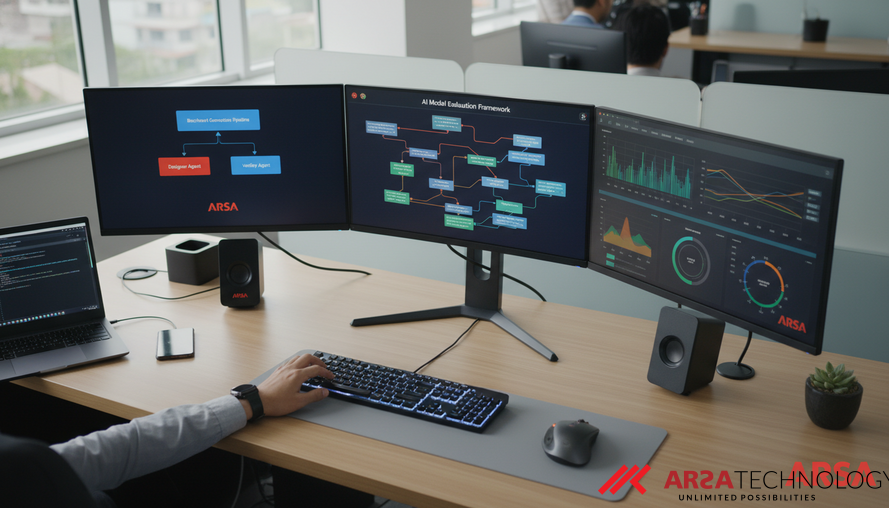
Following source curation, the task generation pipeline takes over. Using the preprocessed chapter text and the structured competency taxonomy, FLAME automatically produces multiple-choice questions (MCQs). The MCQ format is a deliberate choice, as it facilitates deterministic and automated evaluation without relying on subjective human or AI judges, thus avoiding inconsistencies that can plague open-ended assessments. The system employs a multi-agent architecture, where specialized "designer" and "verifier" agents collaborate to generate questions and ensure their quality. A sophisticated solution-graph-driven strategy is implemented to significantly improve the reliability of the ground truth solutions. This automated approach ensures that benchmarks can be constructed reproducibly and at scale, and can be regenerated periodically to effectively mitigate risks associated with data contamination. For businesses deploying AI, this means reliable and up-to-date performance metrics, crucial for informed decision-making and risk management.
The Practical Impact of Fine-Grained AI Evaluation
The implications of fine-grained benchmark generation are substantial for both AI developers and enterprise users. For developers, FLAME provides an invaluable tool for understanding precisely where their models excel and where they need improvement. Instead of general feedback, they receive targeted insights into specific competencies, accelerating the development cycle and leading to more robust and capable AI systems. For enterprises, this level of detail is paramount for strategic AI adoption. Imagine a company deploying an AI system for financial analysis; instead of knowing it performs "well" overall, FLAME could indicate its strong grasp of corporate finance regulations but a weaker understanding of personal investment strategies. This enables highly informed model selection, ensuring the chosen AI aligns perfectly with the application’s specific requirements.
ARSA Technology, with its expertise in deploying practical AI solutions across various industries, recognizes the importance of such rigorous evaluation. Our AI Box Series for edge AI systems or custom AI Video Analytics solutions require precise validation to ensure optimal performance in real-world scenarios, where specific competencies matter. By providing benchmarks with deep coverage and rich metadata, frameworks like FLAME empower solution providers to deliver AI systems that are not only powerful but also transparently evaluated, ensuring high accuracy, reliability, and compliance with industry standards. This ability to meticulously assess AI capabilities underpins the trust that enterprises place in cutting-edge technology.
Ultimately, frameworks like FLAME move the industry beyond superficial evaluations, fostering a deeper, more actionable understanding of AI capabilities. This shift from aggregate scores to fine-grained insights marks a significant step forward in ensuring that foundation models can be developed, deployed, and optimized with unparalleled precision. The open-sourcing of such frameworks and curated benchmarks also promotes transparency and collaboration within the AI community, contributing to the overall advancement of the field.
Ready to explore how advanced AI solutions can transform your operations with proven and precisely evaluated technology? Discover ARSA Technology’s comprehensive AI offerings and request a free consultation to discuss your specific needs.