Advancing Autonomous Driving: How Commonsense Reasoning Corrects AI Perception Gaps
Explore how automated commonsense reasoning enhances autonomous vehicle safety by correcting deep learning misclassifications in complex scenarios, paving the way for SAE Level 5 autonomy.

The Unsolved Challenge of Autonomous Driving: Beyond Deep Learning
The promise of fully autonomous vehicles (AVs) capable of navigating any road scenario, often referred to as SAE Level 5 autonomy, remains an elusive goal despite significant advancements. Extensive research has poured into this field, primarily leveraging sophisticated machine learning technologies like deep learning. While these systems excel at pattern recognition in predictable environments, their heavy reliance on data-driven models presents critical limitations when confronted with rare or ambiguous road conditions. Such anomalies can lead to dangerous misclassifications, hindering the development of truly safe and reliable self-driving cars.
The core challenge lies in building an AV system that not only "sees" but also "understands" the driving environment with human-like contextual awareness. Accidents, though rare, underscore the need for perfection in such safety-critical systems. This pursuit of flawless perception and decision-making is what drives innovations beyond traditional deep learning, integrating methods that can reason through unforeseen circumstances, much like an experienced human driver would.
The Critical Gap: Why Pure Machine Learning Falls Short
Autonomous vehicle systems require impeccable accuracy to handle the myriad uncertainties of real-world driving – from sudden obstacles and pedestrians to unusual road layouts not present in training data. A single error in object classification can have catastrophic consequences, emphasizing the high stakes involved. While deep learning has revolutionized perception, enabling AVs to identify objects and track movements, its inherent weakness lies in situations where data samples are insufficient for robust training.
This limitation is often framed through the lens of System 1 (fast, intuitive, pattern-matching) and System 2 (slow, deliberative, reasoning-based) thinking. Deep learning excels at System 1 tasks, efficiently processing visual data to detect patterns. However, advanced driving scenarios—especially those involving complex decision-making, understanding intent, or reacting to novel situations—demand System 2 reasoning. Current deep learning-centric AVs often fall short here, leading to potential misinterpretations or "hallucinations" similar to those observed in Large Language Models that lack true contextual comprehension. For businesses, this translates to unacceptable risks and a barrier to widespread adoption of autonomous solutions. For example, ARSA provides advanced AI Video Analytics that transform CCTV into intelligent surveillance, but truly autonomous decision-making requires more than just high-accuracy perception.
Introducing Automated Commonsense Reasoning for AVs
To bridge this critical gap, a new paradigm is emerging: the integration of automated commonsense reasoning. This approach aims to imbue AVs with a form of human-like intelligence, allowing them to not only perceive objects but also reason about their context and potential implications. Commonsense reasoning, often implemented through logic programming, can model the default rules and exceptions that humans use to navigate the world. For instance, a common driving rule is "drivers stop at a red light," but commonsense also acknowledges exceptions, such as "irresponsible drivers don’t always stop."
By layering a logic program on top of a base deep learning model, the system can detect inconsistencies in the initial object classifications. If the deep learning model flags a traffic light as green while all surrounding vehicles are braking, the commonsense reasoning layer can identify this as a potential anomaly. This hybrid model corrects misclassifications, providing an explanation for the perceived issue and allowing the AV to adjust its behavior accordingly, significantly improving overall accuracy and safety. This sophisticated approach moves beyond simple pattern matching to a more profound understanding of the driving environment. Solutions like the ARSA AI Box Series, which offers edge computing capabilities for real-time analytics, could potentially host such hybrid reasoning components locally, enhancing both privacy and response times.
Real-World Scenarios: Where Commonsense Makes the Difference
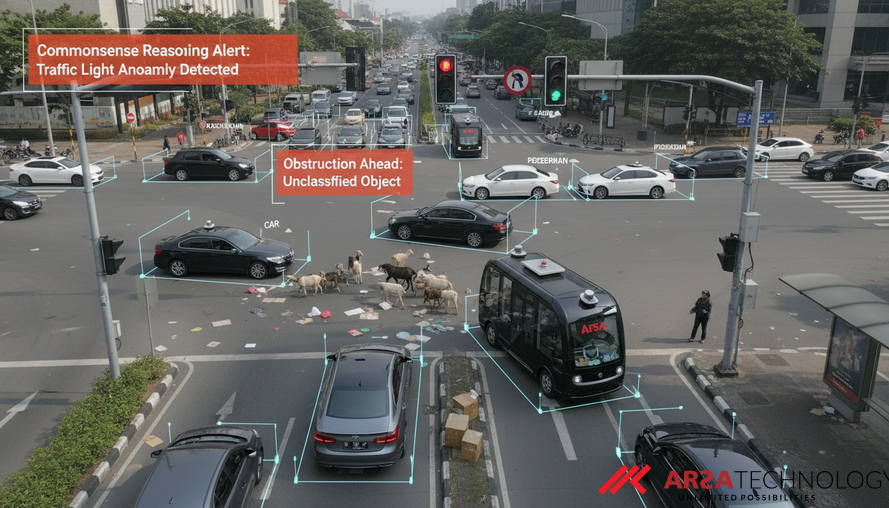
The research highlights two compelling real-world scenarios where automated commonsense reasoning proves invaluable. First, consider an intersection with a malfunctioning traffic signal. A deep learning model, trained on typical traffic light patterns, might misclassify a flickering or incorrectly phased light. However, by observing the collective behavior of other vehicles (e.g., multiple cars slowing down or stopping despite the perceived signal), the commonsense reasoning system can infer that the light is malfunctioning and alert the AV to proceed with caution or take an alternative action.
Second, imagine an unexpected obstruction on the road, such as animals or debris, which might not be sufficiently represented in the deep learning model's training data. While a standard perception model might struggle to correctly classify this "out-of-distribution" object, the commonsense layer can deduce its presence by observing other vehicles slowing down, steering away, or signaling. This collective behavior acts as a crucial contextual clue, allowing the AV to accurately detect the obstacle and react appropriately, even if the primary perception model fails. This ability to handle novel situations, previously a major stumbling block for deep learning, is a significant step towards full autonomy. ARSA's expertise, experienced since 2018, provides real-time solutions for various industries, demonstrating the practical application of AI in complex environments.
A Pathway to Safer Autonomy: Hybrid Models and Uncertainty Management
The integration strategy proposed involves leveraging the strengths of both deep learning and commonsense reasoning. Deep learning models, while efficient for initial perception, can also quantify their own uncertainty. This uncertainty can be categorized into aleatoric uncertainty (due to inherent randomness or noise in data) and epistemic uncertainty (due to unfamiliar, out-of-distribution objects). By measuring this uncertainty in the computer vision model's output, the system can efficiently invoke commonsense reasoning only when truly needed, focusing its deliberative System 2 thinking on ambiguous or high-risk scenarios.
This hybrid approach not only corrects object detection misclassifications but also provides a more robust and explainable framework for AV decision-making. Instead of blindly trusting a black-box AI, the system can identify why it's uncertain and then apply logical rules to reach a safer conclusion. This pathway to improving AV perception is crucial for building trust, enabling regulatory approval, and ultimately realizing the vision of fully autonomous vehicles that can operate safely and reliably in any environment. This advanced capability aligns with the needs of smart city initiatives, where solutions like AI BOX - Traffic Monitor already provide intelligent vehicle analytics.
Beyond Research: The Business Impact of Advanced AI Perception
For businesses considering the adoption of autonomous technologies, this research offers significant implications. Enhanced object detection and contextual reasoning translate directly into reduced operational risks and improved safety records. Industries such as logistics, mining, and smart transportation, which rely heavily on vehicle fleets, stand to gain immensely from AVs that can handle edge cases with human-like intelligence. Reduced accidents mean lower insurance costs, minimized downtime, and greater public confidence in autonomous operations.
Furthermore, the ability to deploy AI that can adapt to unforeseen circumstances reduces the cost and complexity of extensive data collection for every possible scenario. This makes AI-powered digital transformation more accessible and scalable. Companies can invest in autonomous solutions with greater assurance of reliability and a clear pathway to achieving higher levels of automation, thereby unlocking new efficiencies and revenue streams.
Ready to explore how advanced AI and IoT solutions can transform your operations? Contact ARSA today for a free consultation.