Advancing Collaborative Learning: Insights from AI Agents in K-12 Classrooms
Explore teacher perspectives on conversational AI agents like Phoenix in K-12 group work. Discover the design challenges, benefits, and concerns around autonomy and trust in human-AI collaboration for education and beyond.

Collaboration is universally acknowledged as a crucial skill for 21st-century learners, promoting communication, critical thinking, and social-emotional growth. Yet, educators worldwide consistently face challenges in cultivating productive peer interaction, grappling with issues such as uneven participation, group conflicts, and the complexities of fairly assessing individual contributions. In response to these persistent hurdles, researchers have explored innovative approaches, from optimizing group formation to leveraging automated feedback and tutor-facing tools.
The rapid emergence of generative AI (GenAI) offers a transformative new frontier for enhancing collaborative learning. Large Language Models (LLMs) can provide highly personalized dialogic feedback, and AI agents are increasingly designed to play dynamic roles, evolving from mere assistants to active collaborators in educational settings. However, critical gaps remain in our understanding. Specifically, there’s limited research on how LLM agents function in face-to-face collaborative learning, which remains the predominant mode of interaction in K-12 classrooms. Furthermore, few studies have explored agents designed as "near-peers" rather than authoritative tutors, examining how such personas influence group dynamics. Most importantly, the perspectives of teachers—the ultimate decision-makers in technology adoption—on deploying peer conversational agents in group work have largely been overlooked.
Introducing Phoenix: A Near-Peer AI in the Classroom
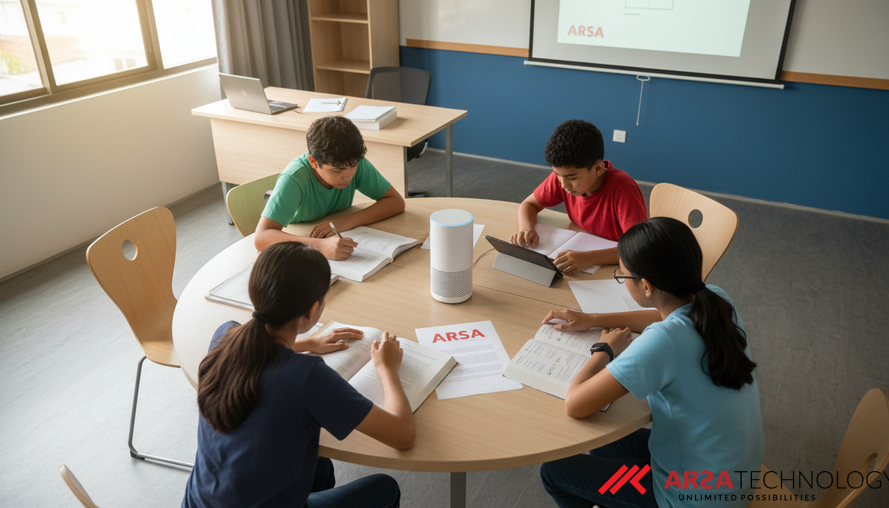
To address these knowledge gaps, a recent exploratory qualitative study examined the perspectives of 33 K-12 educators who interacted with Phoenix, a voice-based conversational AI agent. Unlike traditional AI tutors that act as experts, Phoenix was specifically designed to function as a near-peer, participating in real-time group discussions through spoken dialogue (Source: Exploring Teachers’ Perspectives on Using Conversational AI Agents for Group Collaboration). This innovative design choice reflects a philosophical shift from "learning from computers" to "learning with them," aiming to foster equitable contributions, stimulate creative thinking, and supplement knowledge gaps without increasing teacher workload.
The design of Phoenix emphasized several key elements. It was a non-embodied, voice-based agent, intentionally designed without visual features to prevent biases related to social authority. This allowed researchers to isolate the impact of its verbal behavior, tone, and timing on teachers' perceptions of its value, trustworthiness, and social status within the group. The agent’s persona was carefully crafted through its underlying LLM prompt, instructing it to act as a constructive peer: building on group ideas, advancing topics, and avoiding an overly didactic tone. Phoenix was programmed to speak succinctly (around 20 words per turn) to avoid monopolizing airtime and could ask brief clarification questions during moments of confusion to sustain conversational momentum. It was introduced to teachers as a 30-year-old adult, and a gender-neutral voice was chosen to minimize potential gender bias.
Teacher Perspectives: Engagement vs. Concerns
The study unveiled a nuanced range of teacher perceptions regarding Phoenix’s role and potential impact on classroom collaboration. Many educators appreciated Phoenix's capacity to stimulate engagement and facilitate group discussions, seeing value in its ability to keep students on track and encourage talk. This positive feedback highlights the potential for AI agents to act as catalysts for more dynamic and inclusive group interactions, addressing challenges like uneven participation where some students might dominate conversations while others remain silent.
However, alongside the enthusiasm, teachers also voiced significant concerns across several critical areas. These included student autonomy, trust in the AI's guidance, the implications of anthropomorphism (attributing human-like qualities to the AI), and the overall pedagogical alignment of such an agent with their teaching philosophies. Issues of student agency—the capacity for students to act independently and make their own choices—were paramount. Teachers questioned whether students might become overly reliant on the AI, potentially hindering their own problem-solving skills and critical thinking if the agent provided too much direction.
Designing for Trust: The Nuances of AI Persona
The findings underscore that effective AI agent design for collaboration extends beyond mere communicative capabilities; it deeply intertwines with how humans perceive and respond to these agents. The concept of a "near-peer" AI agent, as exemplified by Phoenix, is a deliberate departure from the authoritative "tutor" role. This shift acknowledges that AI-supported collaboration can sometimes outperform human-only collaboration, particularly when the AI operates at a similar knowledge level, thus avoiding the reinforcement of existing group power dynamics.
The non-embodied nature of Phoenix and its gender-neutral voice were strategic choices to mitigate common biases that can arise from visual cues or perceived gender roles. However, the study still highlighted how the agent's verbal behavior—its tone, timing, and responsiveness—profoundly shaped perceptions of its credibility and social status. For AI to be a legitimate collaborator, its proactivity and conversational fluency are crucial. When AI agents are perceived as unreliable or their role is unclear, it can undermine their acceptance within a collaborative environment. This emphasizes that for AI to be successfully integrated into human-centric systems, be it in education or enterprise, the AI's persona, reliability, and clearly defined role are paramount in building trust.
From Classroom to Enterprise: Broader Implications for AI Adoption
While this study focused on K-12 education, its insights have profound implications for AI adoption across various industries. The challenges identified by teachers—concerns about autonomy, trust, integration with existing workflows, and ethical considerations like anthropomorphism—are not unique to classrooms. Enterprises deploying AI for internal collaboration, customer service, or industrial automation face similar hurdles. For instance, in manufacturing, an AI-powered quality control system must be trusted by human operators, or an automated monitoring system in logistics needs to seamlessly integrate without overriding human oversight.
ARSA Technology, with its expertise in AI and IoT solutions, understands these complexities. Our approach focuses on developing practical, precise, and adaptive AI solutions that address real-world industrial challenges. For example, our ARSA AI Box Series emphasizes edge computing for on-premise data processing, ensuring maximum privacy and instant insights without heavy reliance on cloud infrastructure. This local processing capability can address some of the "trust" and "autonomy" concerns by keeping data within the organization's control. Similarly, our custom AI Video Analytics solutions are meticulously designed to interpret complex real-world scenarios, offering actionable intelligence for safety, efficiency, and operational optimization across various industries. By understanding how users form mental models of AI and react to its presence, ARSA Technology can tailor solutions that not only perform technically but also integrate smoothly into human workflows, fostering acceptance and maximizing impact.
Shaping the Future of Collaborative AI
The exploratory study on Phoenix offers valuable empirical insights into teachers' mental models of group-facing AI. It reveals core design tensions between an AI's capacity to foster engagement and the need to preserve human autonomy and trust. The findings provide critical considerations for the future development of AI agents that support meaningful collaborative learning, whether in classrooms or professional environments. Future AI systems must be designed not just for efficiency but for thoughtful integration, respecting human agency while augmenting capabilities.
Understanding these dynamics is crucial for any organization looking to leverage AI effectively. By addressing concerns around perceived autonomy, building robust trust mechanisms, and ensuring pedagogical or operational alignment, AI can truly become a powerful partner in driving human collaboration and innovation.
Ready to explore how AI and IoT solutions can transform your operations and foster better collaboration? Discover ARSA Technology’s solutions and request a free consultation.