Advancing Engineering: How AI Generates Physically Consistent and Executable Models
Explore a new AI framework that rethinks scientific modeling, enabling large language models to generate physically consistent and simulation-ready code for complex structural engineering tasks.

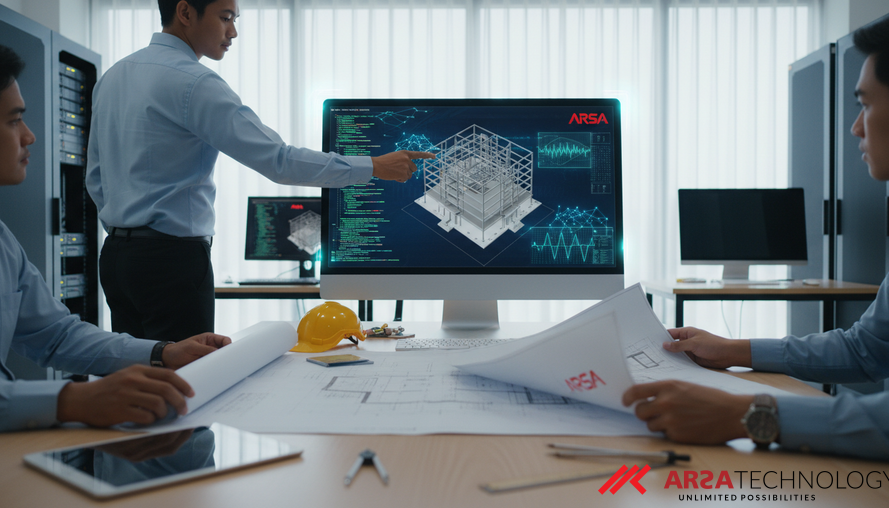
The Evolution of Scientific Modeling: Beyond Manual Limitations
Accurate numerical modeling is the bedrock of computational structural science, influencing everything from skyscraper design to bridge stability. Traditionally, creating these intricate digital models has been a labor-intensive process, demanding deep expertise and meticulous attention to detail. Any minor physical inconsistency or deviation from specifications can invalidate an entire simulation, leading to costly errors and safety risks. The emergence of large language models (LLMs) — advanced AI systems capable of understanding and generating human-like text and code — has ushered in a new era, promising to automate this complex task. While LLMs have demonstrated immense potential for generating code from natural language descriptions, their application in stringent engineering domains has faced significant hurdles.
The Challenge: Bridging AI Potential with Engineering Precision
The allure of LLMs in engineering is undeniable: imagine describing a building's functional requirements and dimensions in plain English, and having an AI instantly generate simulation-ready structural modeling code. This vision, however, is often hampered by the inherent limitations of general-purpose LLMs. They frequently produce outputs that are either non-executable (the code doesn’t run) or, more critically, physically inconsistent (the model violates fundamental laws of physics or established engineering principles). Without embedded domain-specific knowledge and rigorous verification, these AI-generated models cannot be trusted for critical applications like seismic analysis or structural integrity assessments. The core question for researchers then becomes: how can LLMs be systematically constrained to ensure structurally and physically valid programmatic generation for building modeling? (Source: Rethinking Scientific Modeling: Toward Physically Consistent and Simulation-Executable Programmatic Generation)
Introducing a Physics-Aware AI Framework for Automatic Building Modeling
To address these challenges, a novel physics-aware framework for Automatic Building Modeling (AutoBM) has been proposed. This framework integrates three critical components: domain knowledge construction, constraint-oriented model alignment, and verification-driven evaluation. At its heart lies CivilInstruct, a specialized dataset that formalizes structural engineering knowledge and intricate constraint reasoning. This dataset acts as the AI's textbook, teaching it the nuances of structural design and the strict rules that govern physical consistency, ultimately enabling the generation of simulation-ready models.
The framework employs a two-stage fine-tuning strategy for LLMs. The first stage involves domain adaptation through supervised fine-tuning (SFT), essentially teaching the LLM the language and structure of engineering code. The second stage utilizes physics-aware reinforcement learning alignment (RLA-SPC), where the LLM is continuously refined through feedback loops, learning to prioritize and satisfy structural physical constraints and API (Application Programming Interface) specifications. This iterative learning process substantially reduces the incidence of "hallucinated" (incorrect yet confidently generated) and non-conforming outputs, making the AI's code much more reliable. Just as ARSA Technology utilizes AI Video Analytics to enforce safety compliance, this framework trains AI to enforce engineering compliance within its code generation.
From Theory to Real-World Impact: Enhancing Engineering with AI
The practical implications of such a framework are profound. By automating the generation of physically consistent and executable structural modeling code, engineers can drastically reduce the time spent on manual modeling and parameterization. This acceleration translates into faster design cycles, allowing for more iterations and optimizations, which can lead to more innovative and efficient building designs. Moreover, the enhanced reliability of AI-generated models, verified against strict physical constraints, significantly reduces the risk of human error in early design stages.
Industries such as construction, infrastructure development, and urban planning stand to benefit immensely. For instance, in the context of Smart Parking System or complex public infrastructure, ensuring the structural integrity and long-term resilience of facilities is paramount. An AI-powered system that can rapidly generate and validate models for different scenarios can accelerate project timelines and ensure compliance with stringent safety standards. This allows human engineers to focus on higher-level design challenges, creativity, and strategic decision-making, rather than repetitive coding and error checking.
Rigorous Validation and Future Potential
The effectiveness of this physics-aware framework is rigorously evaluated using MBEval, a verification-driven benchmark. MBEval assesses the generated code's executability and structural dynamics consistency through a closed-loop validation process, ensuring that the AI's output isn't just syntactically correct, but also functionally and physically sound. Experimental results consistently demonstrate significant improvements over traditional baselines across various rigorous verification metrics. This validation highlights the potential for AI to not only assist but also significantly enhance the precision and reliability of scientific and engineering modeling.
The research opens doors for applying similar physics-constrained learning approaches to other complex scientific domains. From materials science to biomechanics, any field requiring the generation of code or models that must adhere to strict physical laws and domain-specific rules could leverage this methodology. It’s a significant step toward making AI a truly trusted partner in advancing scientific discovery and engineering innovation. ARSA Technology, with its expertise in deploying AI Box Series for various industrial applications, sees this as a crucial step towards safer and more efficient automated systems.
This innovative approach to scientific modeling represents a significant leap forward in integrating AI into critical engineering workflows. By focusing on physical consistency and executability, it ensures that AI-generated solutions are not only efficient but also reliable and trustworthy.
To explore how AI and IoT solutions can transform your industry's operational efficiency, safety, and precision, we invite you to contact ARSA today for a free consultation.
Source: Jiang, Y., Wang, J., Shen, Z., Lin, Z., Wang, J., Yang, Y., Dai, K., & Luo, H. (2026). Rethinking Scientific Modeling: Toward Physically Consistent and Simulation-Executable Programmatic Generation. arXiv preprint arXiv:2602.07083.