Advancing Industrial Simulation: How Variational Spectral Learning Elevates AI-Powered Engineering
Explore Variational Spectral Learning (VSL), an AI framework that revolutionizes solving complex Partial Differential Equations (PDEs). Learn its advantages over traditional ML methods and its impact on precise simulations in engineering, manufacturing, and smart systems.

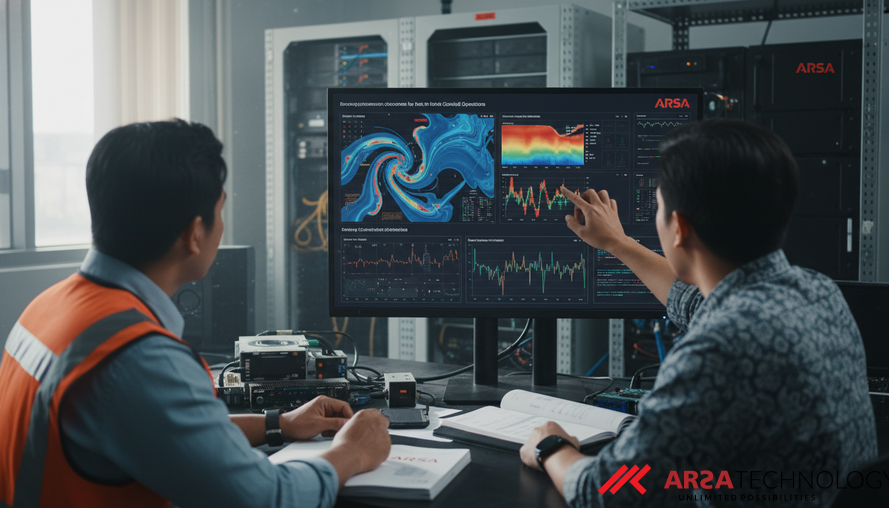
Bridging the Gap in Scientific Simulation with AI
In the world of physics, engineering, and various applied sciences, understanding how phenomena evolve over space and time is critical. This understanding often comes from solving complex mathematical equations known as Partial Differential Equations (PDEs). PDEs describe everything from heat flow in materials and fluid dynamics to structural integrity and even financial models. Traditionally, solving these equations has relied on advanced numerical methods developed over decades. However, the rise of Artificial Intelligence (AI) and machine learning (ML) has introduced new, innovative approaches that promise to accelerate and refine these simulations.
One such groundbreaking development is Variational Spectral Learning (VSL). This machine learning framework offers a powerful new way to tackle PDEs, integrating robust mathematical theory with modern AI optimization techniques. Unlike some data-hungry ML methods, VSL builds on established principles of variational PDE theory and spectral discretization, offering a principled, robust, and often more efficient path to highly accurate solutions for complex industrial challenges.
Variational Spectral Learning: A Smarter Approach to PDEs
At its core, Variational Spectral Learning (VSL) transforms the challenge of solving a PDE into an "energy minimization" problem. Imagine a complex physical system: rather than directly calculating every minute detail of its behavior, VSL seeks to find the state that requires the least "energy," a concept familiar to engineers and physicists. The system's behavior, which is the solution to the PDE, is represented not as a complex, continuous function directly, but as a combination of simpler, well-understood mathematical building blocks called "spectral basis functions." Each building block contributes a certain "amount" to the total solution, represented by a coefficient.
This allows VSL to operate in "coefficient space." Instead of a neural network trying to learn the entire complex solution curve (the "field space" approach), VSL trains an optimizer to find the best set of coefficients for these predefined basis functions. All the underlying complexity of the PDE is then absorbed into a mathematical expression called a "variational energy." This energy is designed to be "differentiable," meaning its changes can be precisely calculated, which is crucial for advanced gradient-based optimization algorithms used in modern machine learning. By minimizing this energy, VSL robustly and accurately determines the coefficients, thereby revealing the solution to the PDE.
The Power of Learning in Coefficient Space
The choice to learn in coefficient space offers significant advantages over other machine learning approaches, particularly Physics-Informed Neural Networks (PINNs). While PINNs directly approximate the solution function across the entire domain, they can sometimes struggle with stability, convergence, and the accurate enforcement of boundary and initial conditions. VSL, by contrast, leverages the inherent stability and high accuracy of spectral methods. The use of precisely defined basis functions means that fundamental conditions, like homogeneous Dirichlet boundary conditions (where a quantity is fixed at a boundary), are analytically built into the solution's structure, rather than imposed as penalty terms. This eliminates the need for large penalty weights or the risk of constraint violations common in other ML techniques.
Furthermore, learning the coefficients often leads to more stable training dynamics and can mitigate the "optimization pathologies" that deep learning models sometimes face when dealing with high-order derivatives or "stiff" (rapidly changing) PDE operators. For problems with smooth solutions, VSL can achieve accuracy comparable to classical numerical methods, but with the added flexibility and power of modern optimization tools, including automatic differentiation. This combination of mathematical rigor and AI agility makes VSL a highly robust framework for complex scientific and engineering simulations.
Real-World Impact: Where VSL Transforms Industries
The implications of a robust, AI-powered PDE solver like VSL are vast, touching numerous industrial sectors where understanding complex physical phenomena is paramount.
- Manufacturing and Material Science: VSL can simulate heat transfer in molds, predict stress distribution in new product designs, or model fluid flow in chemical processes. This leads to optimized designs, reduced material waste, and faster R&D cycles. Imagine simulating the exact cooling rate of a newly cast metal component to prevent defects, or predicting the wear and tear on machinery parts under extreme conditions.
- Engineering and Design: For analog circuit design, VSL could rapidly simulate the behavior of electrical signals through intricate pathways, optimizing performance and identifying potential issues before costly physical prototyping. In aerospace or automotive engineering, it can model aerodynamics, structural loads, and crash impacts with unprecedented speed and precision, accelerating product development and enhancing safety. ARSA, with its deep expertise in industrial automation, can help companies apply such advanced analytics to optimize their heavy equipment monitoring and product quality control, transitioning towards a smarter, Industry 4.0 paradigm.
- Smart Infrastructure and Environment: PDEs are crucial for modeling environmental processes, from predicting air pollution dispersion to simulating groundwater flow. VSL could offer more accurate and faster predictive models, aiding urban planners and environmental agencies in making informed decisions for sustainable development. Similarly, advanced traffic flow simulations could inform smart parking systems and urban mobility strategies.
Implementing Advanced AI for Practical Outcomes
While the underlying mathematics of VSL are sophisticated, its practical implementation leverages accessible modern tools. Frameworks like TensorFlow and Keras, combined with automatic differentiation, allow engineers and data scientists to build and optimize VSL models efficiently. This means businesses don't necessarily need to become experts in advanced numerical analysis; instead, they can partner with technology providers that specialize in translating these complex frameworks into tangible business solutions.
For enterprises aiming for digital transformation, adopting VSL means harnessing a tool that delivers high accuracy, stability, and interpretability for critical simulations. It signifies a move towards data-driven decision-making, where the insights gained from precise PDE solutions can directly impact a company’s ROI, reduce operational risks, ensure compliance, and boost productivity. ARSA has been experienced since 2018 in delivering integrated AI and IoT solutions across various industries, positioning us to assist businesses in navigating and deploying such advanced analytical frameworks. This could involve leveraging edge computing solutions like the ARSA AI Box Series to run optimized VSL models locally, ensuring real-time insights and maximum data privacy.
The Future of AI-Powered Scientific Computing
The introduction of Variational Spectral Learning marks a significant step forward in how we approach scientific and engineering problems. By effectively bridging classical mathematical rigor with the power of modern machine learning, VSL provides a more robust and accurate method for solving Partial Differential Equations. Its ability to mitigate common optimization challenges and deliver reliable results makes it an invaluable tool for industries striving for greater efficiency, safety, and innovation.
For businesses looking to harness the power of advanced AI for their complex simulation needs, understanding and integrating frameworks like VSL is key to unlocking new levels of operational excellence and competitive advantage.
Ready to explore how advanced AI solutions can transform your engineering simulations and operational efficiency? We invite you to explore ARSA’s comprehensive solutions and contact ARSA for a free consultation.