Advancing Underwater Robotics: Sim-to-Real AI for Real-Time SLAM and 3D Reconstruction
Explore SurfSLAM's AI innovation for real-time underwater mapping and navigation. Learn how sim-to-real training enables robots to accurately reconstruct 3D environments, vital for marine inspection and smart infrastructure.

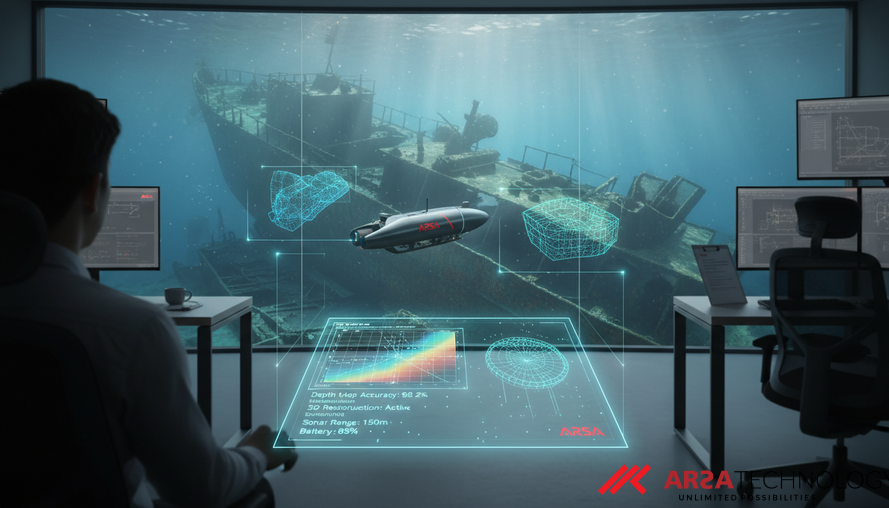
The Critical Need for Autonomous Underwater Navigation
Underwater environments present some of the most challenging conditions for robotic exploration and operations. From inspecting critical offshore infrastructure like pipelines and oil rigs to mapping historical shipwrecks or monitoring marine ecosystems, the ability for robots to navigate autonomously and understand their surroundings is paramount. This requires sophisticated perception capabilities, primarily Simultaneous Localization and Mapping (SLAM) – a technology that allows a robot to build a map of an unknown environment while simultaneously tracking its own location within that map. However, unlike terrestrial or aerial robotics, underwater SLAM faces unique hurdles that significantly degrade performance, making advanced solutions indispensable for industries requiring precision and reliability beneath the waves.
Traditional methods for underwater localization often struggle with the inherent visual distortions, limited light penetration, and lack of distinctive textures common in subsea settings. Light attenuation causes images to degrade quickly with distance, haze reduces contrast, and suspended particles create visual artifacts. These factors make it difficult for standard cameras to provide the consistent, high-quality data needed for accurate depth estimation and 3D reconstruction. As a result, many existing SLAM systems, particularly those relying heavily on visual cues, fall short in delivering the robust performance necessary for complex industrial or scientific applications.
Conquering Underwater Vision with Advanced Stereo Depth Estimation
Stereo cameras, which mimic human binocular vision by using two lenses to perceive depth, offer a cost-effective way to directly measure metric depth in an environment. While remarkable progress has been made in stereo depth estimation for land-based applications, translating this success to the underwater domain has proven difficult. The severe environmental degradation means that artificial intelligence (AI) models trained on terrestrial images simply cannot adapt effectively to underwater scenes. Moreover, the scarcity of large, high-quality real-world underwater datasets makes traditional supervised training for new AI models a significant challenge.
To overcome these limitations, innovative approaches are needed to enable AI-powered computer vision systems to accurately "see" underwater. The SurfSLAM framework addresses this by employing a sophisticated stereo disparity estimation algorithm. This algorithm is specifically designed to interpret degraded underwater imagery, recovering dense and reliable depth information. The precision achieved through this method provides essential geometric context, allowing for much improved navigation and mapping capabilities for autonomous underwater vehicles (AUVs) in even the most obscure subsea environments.
The Power of Sim-to-Real AI Training
A core innovation in advancing underwater robotics is the "sim-to-real" training pipeline. Given the difficulty and cost of collecting extensive real-world underwater data for training AI models, researchers are increasingly leveraging simulated environments. Sim-to-real training involves training an AI model in a carefully constructed virtual world that accurately mimics the physics and visual characteristics of the target real-world environment. The model then undergoes self-supervised fine-tuning using limited real-world data, allowing it to adapt its learned knowledge to the nuances of actual conditions.
This novel approach enables the development of robust AI solutions, even for data-scarce domains like underwater exploration. For industries like marine inspection or environmental monitoring, this translates into faster development cycles, more reliable systems, and significantly lower operational costs associated with data collection. ARSA Technology specializes in developing and deploying AI Video Analytics and AI Box Series solutions that can be adapted for challenging environments, utilizing edge computing power to process data locally and ensure maximum privacy and real-time insights, similar to the principles applied in sim-to-real pipelines.
Real-Time Localization and Comprehensive 3D Mapping
SurfSLAM is not just about improved vision; it's a comprehensive framework for real-time underwater SLAM. It achieves robust navigation and detailed 3D reconstruction by fusing the enhanced stereo depth predictions with data from multiple other sensors. These include:
- Inertial Measurement Units (IMU): Providing information about the robot's orientation and acceleration.
- Barometer: Measuring water pressure to determine depth.
- Doppler Velocity Log (DVL): Offering highly accurate velocity measurements relative to the seafloor.
By integrating these diverse data streams, SurfSLAM creates a more complete and resilient understanding of the robot's motion and its surroundings. This multi-sensor fusion approach mitigates the weaknesses of individual sensors in challenging underwater conditions, leading to significantly more accurate trajectory estimation and the creation of detailed 3D maps. For enterprises, such capabilities are crucial for tasks like precise anomaly detection on subsea assets or generating highly accurate digital twins of underwater structures, thereby enhancing safety and operational efficiency. The ability to track vehicle pose and reconstruct dense 3D maps supports critical decision-making in high-stakes underwater operations.
Business Impact and Future Applications for Global Enterprises
The advancements presented by SurfSLAM have profound implications for various industries, offering measurable benefits that drive efficiency and reduce risk. For companies involved in offshore energy, accurate real-time mapping enables more thorough and frequent inspections of underwater pipelines and platforms, predicting potential failures and reducing costly downtime. In the maritime and defense sectors, precise autonomous navigation and 3D reconstruction capabilities enhance underwater security, reconnaissance, and search and rescue missions. Environmental agencies can utilize such systems for detailed habitat mapping, monitoring marine life, and assessing ecological changes with unprecedented accuracy.
ARSA Technology, with its deep expertise across various industries, understands the transformative potential of such AI and IoT innovations. Our approach focuses on delivering solutions that provide measurable Return on Investment (ROI), from increasing operational efficiency and productivity to enhancing security and compliance. Whether it's industrial automation, smart surveillance, or real-time asset monitoring, integrating advanced AI capabilities like those demonstrated by SurfSLAM can revolutionize operational strategies. For instance, our Industrial IoT solutions can be adapted for similar challenging environments to monitor heavy equipment performance and quality automatically, preventing unexpected downtimes and defects.
The ability to create detailed 3D maps and navigate autonomously in previously inaccessible or hazardous underwater zones opens new avenues for exploration and resource management. By embracing these cutting-edge AI and IoT technologies, businesses can unlock significant competitive advantages, ensuring safer operations, optimized resource allocation, and a deeper understanding of critical underwater assets.
Are you ready to explore how advanced AI and IoT solutions can transform your operations in challenging environments? We are here to help you achieve your digital transformation goals. Discover more about ARSA Technology's solutions and contact ARSA for a free consultation.