Adversarial Water-Filling: Powering the Future of 6G and Satellite Spectrum Sharing
Explore Adversarial Water-Filling (AWF), an AI-driven approach for competitive spectrum allocation in LEO satellite networks. Learn how foundation models enhance efficiency, privacy, and real-time resource management for 6G.

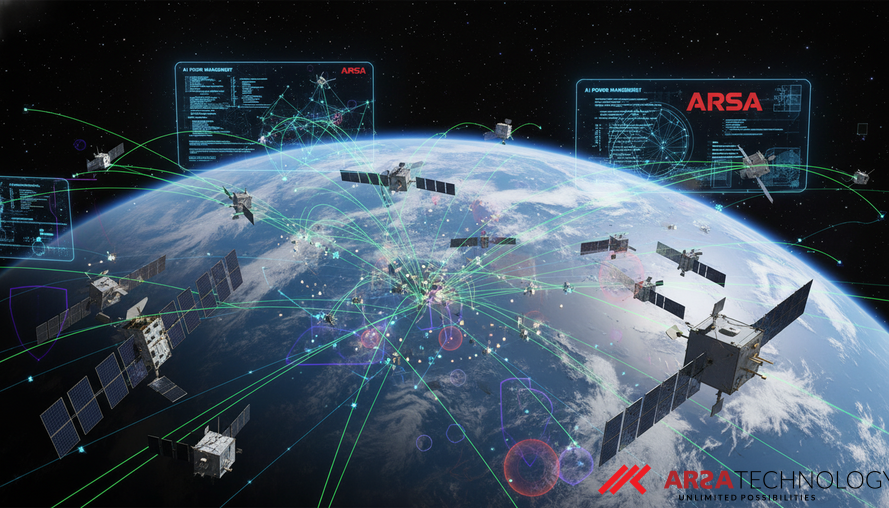
The Dawn of AI-Native 6G and Non-Terrestrial Networks
The wireless communication landscape is undergoing a profound transformation, spearheaded by the vision of a truly AI-native sixth-generation (6G) mobile network. This future network promises to embed intelligence at every layer, from design to operations, enabling scalable and autonomous resource adaptation. A critical component of this evolution is the integration of Non-Terrestrial Networks (NTNs), such as extensive low Earth orbit (LEO) satellite constellations, which will provide unprecedented global connectivity. However, this advancement introduces significant challenges, particularly in managing competitive interference and coordinating spectrum usage among multiple operators like Starlink and Omnispace. Unlike traditional cellular systems with fixed infrastructure, NTNs create a highly dynamic and spatially varying interference environment, necessitating innovative approaches to resource allocation.
Understanding Adversarial Water-Filling in a Competitive Landscape
At its core, resource allocation in wireless communication aims to distribute power efficiently across available channels, a principle often likened to "water-filling." In this analogy, power is poured into "channels" (like containers), filling them up to an optimal "water level" to maximize data throughput. Traditionally, for Gaussian channels, this leads to straightforward, well-defined solutions. However, in the real world, especially with discrete constellations (the specific ways digital data is encoded onto radio waves), the problem becomes far more complex, often described as "mercury/water-filling." This challenge is further amplified in competitive NTN scenarios where multiple operators vie for the same or adjacent spectrum, and one operator's transmissions appear as unpredictable, rapidly changing interference to another.
This complex scenario motivates the "Adversarial Water-Filling (AWF)" framework. AWF formulates the problem as a "minimax interaction" – operators aim to maximize their own transmit power efficiency while simultaneously minimizing the worst-case interference they might receive from competing constellations. This approach is vital for ensuring robust communication in environments with real-time, competitive spectrum sharing, especially with highly directional beams, overlapping footprints, and continuous satellite motion. The research from Xindi Tong, Chee Wei Tan, and H. Vincent Poor explores the theory and algorithms behind AWF, proposing robust solutions for these intricate real-world situations, as detailed in their paper, “Adversarial Water-Filling: Theory, Algorithms and Foundation Model” available at arXiv:2605.26163v1.
The Power of Wireless Foundation Models
Traditional optimization methods, while foundational, often fall short in the face of dynamic, high-dimensional wireless networks. They typically require recalculation from scratch for every new network configuration, making them too slow for the real-time demands of 6G. Existing learning-based approaches have accelerated certain aspects, but most remain task-specific and lack the adaptability needed for heterogeneous and rapidly evolving environments. This is where wireless foundation models emerge as a game-changer.
A wireless foundation model is designed to learn fundamental physical symmetries and coupling structures inherent in wireless networks, allowing it to generalize across various tasks and system configurations. Instead of replacing model-based optimization entirely, these models learn how to solve optimization problems more efficiently and adaptively. This approach is particularly suitable for AWF because core concepts like "channel permutation invariance" (meaning the order of channels doesn't change the underlying physics), "sparse constraint-induced interactions," and "global water-level coordination" (via dual variables) can be effectively encoded and learned by such a model.
Architecting an Intelligent Solution for AWF
The proposed wireless foundation model for AWF incorporates several innovative architectural components to learn the complex search dynamics effectively. First, it uses permutation-invariant channel representations, ensuring that the model understands the relationships between channels regardless of their arbitrary ordering. This is crucial for scalability and generalization. Second, a constraint-aware Graph Neural Network (GNN) is utilized. A GNN represents the wireless network as a graph, where nodes are communication channels or entities, and edges represent their interactions or constraints (e.g., interference limits, power budgets). The GNN processes information through "sparse message passing," allowing it to efficiently understand localized and global constraints.
Finally, the model integrates global latent variables. These variables essentially capture the low-dimensional "water level" concept implied by the AWF optimality conditions. By leveraging "learned projected extragradient iterations," the model is trained to approximate the stationary solutions of the constrained minimax problem, which is vital for both Gaussian and the more challenging non-convex mercury/water-filling scenarios. This intelligent design allows the model to achieve remarkable runtime improvements – more than an order of magnitude faster than traditional iterative baselines – and demonstrates robust generalization across unseen problem sizes, different constraints, and multiple discrete constellations.
Practical Applications and Business Advantages
The advancements in Adversarial Water-Filling and its implementation through wireless foundation models hold immense practical value for enterprises and governments alike.
- Optimized Resource Utilization: By intelligently allocating transmit power while anticipating worst-case interference, AWF ensures spectrum is used with maximum efficiency. This translates directly into reduced operational costs, as operators can achieve desired performance with less wasted power and infrastructure.
- Enhanced Network Robustness: The minimax formulation guarantees robust performance even in highly competitive and dynamic environments. This proactive approach to interference management increases network reliability and security, crucial for mission-critical applications and sensitive government communications.
- Scalability and Flexibility for Future Networks: The foundation model's ability to generalize across varying channel dimensions, constraint types, and modulation distributions makes it incredibly adaptable. This scalability is essential for managing the vast and diverse LEO constellations and the evolving demands of 6G, enabling rapid deployment and adaptation of services.
- Faster Deployment and Operation: With runtime improvements exceeding an order of magnitude, the AWF foundation model allows for real-time adjustments and rapid rollout of services, accelerating digital transformation initiatives. This agility can open new revenue streams by enabling novel services that require immediate and precise resource adaptation.
ARSA Technology: Engineering Intelligence into Operations
At ARSA Technology, we understand the critical need for practical AI deployments that deliver measurable impact. Our expertise in Artificial Intelligence and Internet of Things solutions positions us to help enterprises navigate complex challenges, from real-time video analytics to industrial sensor networks and sophisticated web platforms. Similar to how AWF optimizes wireless spectrum, our solutions focus on transforming raw data into actionable intelligence, enhancing security, and optimizing operations across various industries.
Our offerings, such as AI Video Analytics, the AI Box Series for edge processing, and the ARSA AI API for seamless integration, are designed for environments demanding precision, scalability, and measurable ROI. With our team experienced since 2018 in developing AI Vision solutions, we build systems that work in the real world, ensuring accuracy, privacy, and operational reliability for our clients in various industries.
By leveraging technologies that embody principles of robustness, efficiency, and real-time adaptation, ARSA helps organizations achieve their strategic goals. Whether it’s enhancing public safety, streamlining industrial operations, or optimizing smart city infrastructure, our commitment is to engineer intelligence directly into your operations.
To discover how advanced AI and IoT can transform your operational challenges into competitive advantages, we invite you to explore our solutions and contact ARSA for a consultation.
Source: Tong, X., Tan, C. W., & Poor, H. V. (2026). Adversarial Water-Filling: Theory, Algorithms and Foundation Model. arXiv preprint arXiv:2605.26163.