AI and Physics: A Hybrid Approach to Modeling Complex Fluid Dynamics
Discover how a new hybrid modeling approach combines deep learning with traditional fluid dynamics to simulate turbulent flows with unprecedented accuracy and efficiency, driving innovation in engineering.

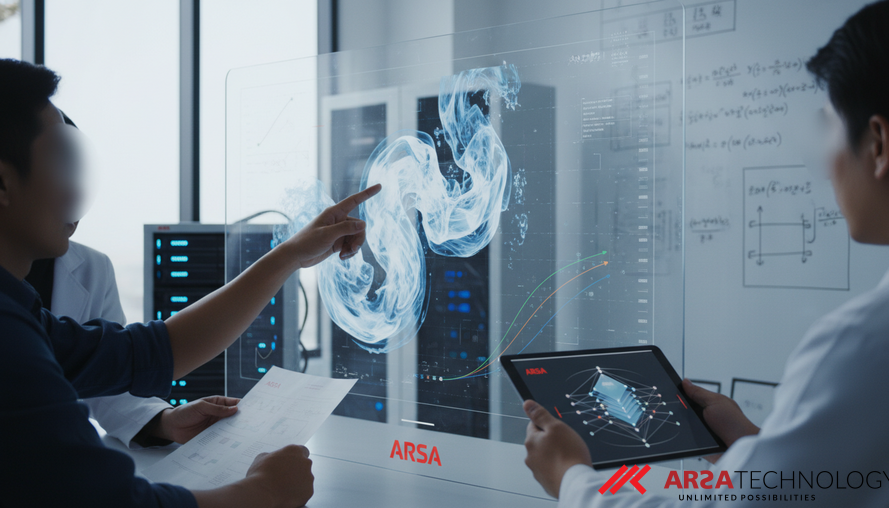
Fluid dynamics, the study of how liquids and gases move, is fundamental to countless aspects of modern engineering and science. From designing more aerodynamic vehicles and efficient aircraft wings to predicting weather patterns and optimizing industrial processes, understanding fluid behavior is critical. Traditionally, this understanding relies heavily on intricate mathematical equations that describe physical quantities like velocity, pressure, and temperature. However, solving these equations, especially for complex phenomena like turbulence, has always presented a significant computational challenge.
The Computational Bottleneck of Fluid Dynamics
Computational Fluid Dynamics (CFD) has become the gold standard for simulating fluid flow. CFD involves breaking down a physical space into millions of tiny cells (using methods like finite volume grids) and calculating fluid properties within each. While incredibly powerful and accurate, high-fidelity CFD models demand immense computational resources and memory, making them slow and expensive. This issue becomes particularly acute when dealing with turbulent flows—the chaotic, swirling motions you see in smoke or rapids. Simulating turbulence accurately requires capturing details across a wide range of scales, pushing computational limits. The need for faster, yet still accurate, simulation tools has driven the development of what are known as Reduced-Order Models (ROMs).
Reduced-Order Models: Streamlining Complex Simulations
Reduced-Order Models (ROMs) are designed to overcome the computational burden of high-fidelity simulations. Their core objective is to decrease the dimensionality of complex models, retaining only the most significant physical behaviors while drastically reducing the number of calculations required. Think of it like creating a high-resolution summary of a very long book: you keep all the key plot points and character developments without needing to read every single word. These models achieve this by projecting the governing mathematical equations onto a smaller, more manageable set of variables, often derived from observing the system's behavior over time.
One popular approach is the Proper Orthogonal Decomposition (POD)-Galerkin method. POD identifies the "dominant modes" or principal patterns within a dataset, such as snapshots of a fluid's velocity field. These modes represent the core coherent structures of the flow. Galerkin projection then takes the full governing equations and projects them onto this reduced set of modes, creating a simplified model that still respects the underlying physical laws. This drastically reduces the number of unknowns, leading to faster simulations. However, applying standard ROM techniques to complex, chaotic phenomena like turbulent viscosity—a property that characterizes the fluid's resistance to flow under turbulent conditions—often leads to inconsistent or unphysical results.
A Hybrid Solution: Marrying AI with Physics-Based Modeling
A recent study, "A Hybrid Discretize-then-Project Reduced Order Model for Turbulent Flows on Collocated Grids with Data-Driven Closure," introduces an innovative hybrid ROM framework that addresses the limitations of traditional methods for turbulent flows. This framework is specifically designed for incompressible fluid flows on collocated finite volume grids, a common numerical setup in large-scale CFD applications. The key innovation lies in its "discretize-then-project" strategy. Instead of simplifying equations before setting up the numerical grid, this method first discretizes (sets up the detailed numerical problem) and then projects it onto a reduced space. This ensures consistency between the velocity and pressure fields—two crucial components of fluid flow.
However, the problem of accurately modeling turbulent viscosity remains. Standard projection methods struggle to capture its chaotic, unpredictable nature. To overcome this, the hybrid strategy cleverly divides the problem: while velocity and pressure are resolved through rigorous, physics-based (intrusive) projection, the turbulent viscosity is handled by a non-intrusive, data-driven closure mechanism. This is where Artificial Intelligence steps in, leveraging its power to learn complex, non-linear relationships directly from data.
Deep Learning for Turbulence Modeling
The researchers evaluated three different neural network architectures to model the temporal evolution of turbulent viscosity coefficients:
- Multilayer Perceptron (MLP): A foundational type of neural network capable of learning complex mappings between inputs and outputs.
- Transformers: Initially developed for natural language processing, these networks excel at capturing long-range dependencies in sequential data.
- Long Short-Term Memory (LSTM): A specialized type of recurrent neural network (RNN) particularly adept at processing and predicting sequences, making it ideal for time-series data.
By integrating these AI models, the study aimed to create a data-driven "closure" that could accurately predict the turbulent viscosity, complementing the physics-based projection for velocity and pressure. When tested against a 3D Large Eddy Simulation—a detailed type of CFD simulation used for turbulent flows—of a lid-driven cavity (a classic benchmark problem in fluid dynamics), the LSTM-based closure demonstrated superior performance. It achieved impressive relative errors of just 0.7% for velocity and 4% for turbulent viscosity. This highlights LSTM's strength in capturing the dynamic, transient nature of turbulent phenomena. The success of this approach showcases how a blend of established mathematical rigor and advanced deep learning can be more powerful than either method alone, leading to more accurate and adaptable turbulence modeling.
Practical Applications and the Future of Engineering Design
This hybrid ROM framework represents a significant leap forward in simulating complex fluid dynamics. By dramatically reducing computational costs while maintaining high accuracy, it opens doors for faster iteration cycles in engineering design and research across various various industries. For instance, manufacturers can design and test new product prototypes—from cars to aerospace components—more quickly and cost-effectively, optimizing for performance, safety, and efficiency. Weather forecasting models could run faster and with greater detail, leading to more accurate predictions. In industrial settings, optimizing the flow of liquids or gases through pipelines or machinery can reduce energy consumption and improve output.
Companies like ARSA Technology, with expertise in AI Video Analytics and Industrial IoT solutions, are at the forefront of deploying sophisticated AI and IoT technologies to solve complex operational challenges. While the paper focuses on a specific research innovation, its principles—combining physics-informed models with data-driven AI for enhanced predictive power and efficiency—are directly applicable to real-world industrial optimization. Such hybrid models could form the basis for next-generation digital twins, allowing for real-time monitoring and predictive maintenance of systems where fluid dynamics play a critical role, leading to significant ROI through reduced downtime and improved operational visibility. The ability to model turbulent flows with high accuracy and reduced computational effort transforms passive monitoring into active business intelligence.
The integration of advanced AI models like LSTMs for complex scientific phenomena, as demonstrated by this research, underscores a growing trend where deep learning complements traditional scientific computing. This synergy allows us to tackle previously intractable problems, leading to innovations that are not only faster and more efficient but also more robust and adaptable. The continuous development in this field promises a future where sophisticated simulations are no longer confined to supercomputing centers but become accessible tools for driving innovation at scale.
**Source:** Nadim Rooholamin, Kabir Bakhshaei, and Giovanni Stabile, "A Hybrid Discretize-then-Project Reduced Order Model for Turbulent Flows on Collocated Grids with Data-Driven Closure," arXiv preprint arXiv:2601.18817, 2026. https://arxiv.org/abs/2601.18817
Ready to explore how advanced AI and IoT solutions can transform your industrial operations and drive measurable business impact? Discover ARSA Technology's innovative solutions and request a free consultation today.