AI for Agriculture: Boosting Maize Yields with Lightweight Disease Detection on Edge Devices
Discover how lightweight AI networks like LWMSCNN-SE are transforming maize disease detection on edge devices, enabling accurate, real-time insights for precision farming and improved food security.

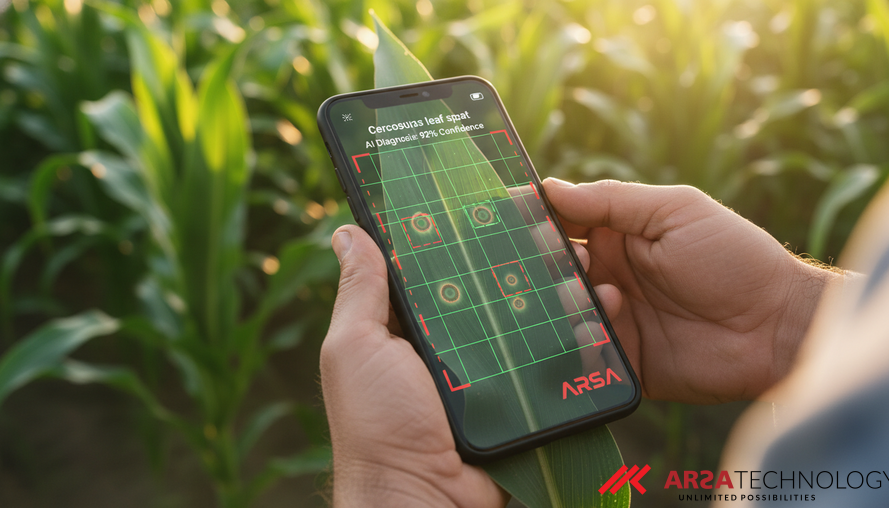
Revolutionizing Agriculture with AI: The Power of Lightweight Disease Detection
Maize, a cornerstone of global food security, faces relentless threats from diseases that can decimate harvests and jeopardize livelihoods. Traditional methods of disease detection, relying on human expertise and manual inspection, are often slow, subjective, and impractical for the vast, dispersed agricultural landscapes that characterize many farming operations. The challenge intensifies in resource-constrained environments, where advanced computing infrastructure is scarce. This necessitates innovative solutions that bring sophisticated diagnostic capabilities directly to the field, offering farmers timely and accurate insights.
The emergence of Artificial Intelligence (AI), particularly Convolutional Neural Networks (CNNs), has opened new frontiers in plant pathology. These powerful algorithms can analyze images of plant leaves to identify diseases with remarkable accuracy. However, many state-of-the-art CNN models are computationally heavy, requiring substantial processing power and memory, making them unsuitable for deployment on portable devices like smartphones or drones. This is where lightweight AI, designed for efficiency without compromising accuracy, becomes a game-changer for precision agriculture.
The Critical Need for Smart Disease Management in Maize Farming
Maize diseases such as Cercospora leaf spot, common rust, and northern leaf blight are silent threats that can lead to significant yield reductions if not addressed promptly. Global estimates suggest that these diseases contribute to an alarming 22-23% annual loss in maize yields. This impact is particularly severe in developing regions where access to expert agricultural support is often limited, leaving farmers vulnerable to preventable losses. The reliance on manual inspection, while historically essential, is fundamentally unscalable for modern farming demands.
Manual diagnosis is inherently time-consuming, requires extensive training, and can vary in accuracy depending on the individual agronomist. For large farms or widespread outbreaks, this approach becomes a bottleneck, delaying crucial treatment decisions and potentially leading to the overuse or misuse of pesticides. These limitations underscore the urgent need for automated, precise, and easily deployable disease detection systems that can empower farmers to make data-driven decisions directly at the point of need. Such systems can transform passive observation into actionable intelligence, safeguarding crop health and optimizing resource allocation.
Introducing LWMSCNN-SE: AI Designed for the Edge
To overcome the inherent limitations of traditional, heavy AI models, researchers have developed innovative lightweight CNN architectures. One such solution, LWMSCNN-SE, represents a significant step forward in making advanced plant disease classification accessible for on-field use. This cutting-edge model integrates several intelligent design principles, allowing it to deliver high accuracy while consuming minimal computational resources. Imagine turning your everyday smartphone or drone into a powerful diagnostic tool for your farm.
The LWMSCNN-SE achieves its efficiency and accuracy through a clever combination of techniques. First, it employs multi-scale feature extraction, which allows the AI to "see" and analyze visual information at different levels of detail—from tiny, localized disease spots to broader patterns across an entire leaf. This is crucial for identifying diseases that manifest in various forms and sizes. Second, it utilizes depthwise separable convolutions, a specialized method that significantly reduces the computational load of the neural network by breaking down complex operations into more manageable parts. Finally, the integration of Squeeze-and-Excitation (SE) attention mechanisms helps the model focus on the most relevant features in an image, much like a human eye would concentrate on specific symptoms, thereby enhancing the model's discriminative power with very little additional computational cost. For businesses interested in enhancing their agricultural operations with similar technologies, ARSA Technology offers advanced AI Video Analytics solutions that can be tailored to specific farming needs.
Bridging the Accuracy-Efficiency Gap for Real-World Impact
The real breakthrough with lightweight AI models like LWMSCNN-SE lies in their ability to bridge the long-standing accuracy-efficiency gap. Previous attempts to miniaturize AI models often resulted in a compromise on accuracy, making them less reliable for critical applications like disease diagnosis. LWMSCNN-SE, however, demonstrates that it's possible to have both. The model boasts an impressive 96.63% classification accuracy, making it highly reliable for identifying various maize diseases.
Crucially, this high performance comes with an extremely low computational footprint: it uses only 241,348 parameters (a measure of model size) and requires a mere 0.666 GFLOPs (a measure of processing power). To put this into perspective, these metrics mean the model can run efficiently on typical edge devices, such as consumer smartphones, agricultural drones, and IoT sensors, without needing a constant connection to powerful cloud servers. This capability for real-time, on-device processing is vital for precision farming systems, enabling instant diagnosis and faster intervention to protect crops. For businesses seeking robust, edge-optimized solutions, the ARSA AI Box Series provides a plug-and-play platform for deploying AI analytics in various real-world applications.
Beyond Maize: Broader Applications for AI in Agriculture
While the LWMSCNN-SE model showcases its prowess in maize disease classification, the principles behind its design have far-reaching implications for the broader agricultural sector. The integration of lightweight, multi-scale feature extraction with attention mechanisms can be adapted to detect diseases in other staple crops, monitor plant health, identify pests, and even assess nutrient deficiencies across a wide range of agricultural settings. This capability extends beyond just disease; it empowers farmers with comprehensive, data-driven insights into the overall well-being of their fields.
Such accessible AI technology can foster smarter, more sustainable farming practices. By enabling early detection and targeted interventions, farmers can reduce reliance on broad-spectrum pesticides, conserve resources, and optimize crop yields more effectively. This paves the way for a future where high-tech farming is not exclusive to large enterprises but is a practical reality for farmers of all scales, contributing significantly to global food security. ARSA Technology is committed to delivering advanced AI, IoT, and Smart Systems Technology that serves a multitude of various industries, including agriculture, to drive digital transformation.
Future-Proofing Food Security with Accessible AI
The development of lightweight, high-accuracy AI models like LWMSCNN-SE represents a pivotal moment for agricultural technology. By making sophisticated AI accessible and deployable on common edge devices, we are moving closer to a future where every farmer has the tools to protect their crops proactively. This democratizes access to advanced agronomic support, empowers communities, and strengthens the foundation of global food security. The ongoing innovation in edge AI is not just about technological advancement; it's about creating tangible, positive impacts on critical industries worldwide.
Ready to explore how AI-powered solutions can transform your agricultural operations, enhance efficiency, and secure your yields? Learn more about cutting-edge AI and IoT solutions, and for a tailored approach to your unique business challenges, we invite you to contact ARSA today for a free consultation.