AI for Cancer Diagnosis: Unlocking Deeper Insights with Phenotype-Aware Machine Learning
Explore PA-MIL, a novel AI framework that interprets cancer whole-slide images like pathologists, using phenotype knowledge and genetic data for more reliable and explainable diagnoses.

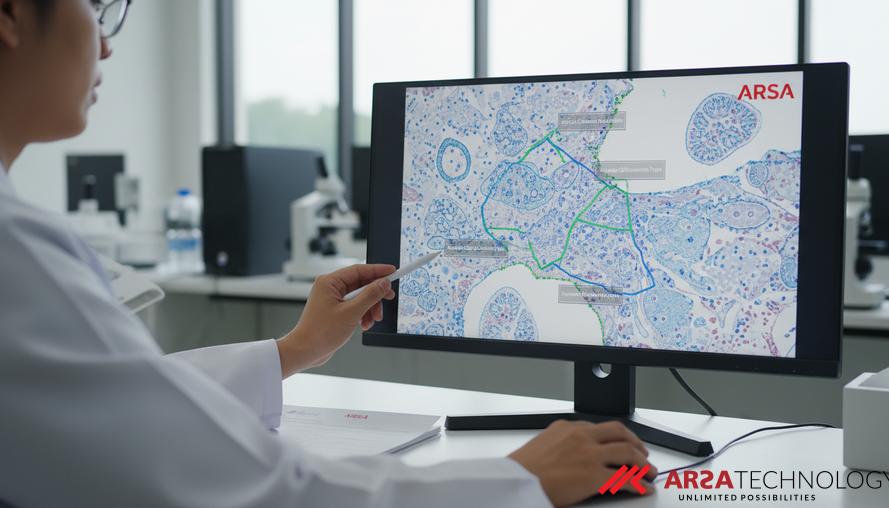
Unlocking Deeper Insights in Cancer Diagnosis with AI
Deep learning has revolutionized many fields, and its application in analyzing pathology whole-slide images (WSIs) for cancer diagnosis is no exception. These digital scans of tissue samples hold immense potential for advancing computational pathology and assisting in cancer diagnosis. However, a significant challenge persists: the "black-box" nature of many deep learning models. While these AI systems can achieve impressive accuracy in predicting cancer types, they often struggle to provide clear, understandable explanations for their conclusions. In critical clinical contexts, reliable and accountable AI is paramount, demanding detailed evidence to build trust among medical professionals and support diagnostic decisions.
Traditional AI models for pathology often offer what's called "post-hoc interpretability," meaning they highlight areas of an image after making a prediction. While this identifies "salient regions," it typically lacks the detailed, nuanced diagnostic evidence that pathologists rely on. Pathologists, as shown in the source paper PA-MIL: Phenotype-Aware Multiple Instance Learning Guided by Language Prompting and Genotype-to-Phenotype Relationships, meticulously observe cell morphology and tissue structures to identify specific clinical "phenotypes" (e.g., glandular structures, keratinization patterns) and then diagnose based on the correlation between these phenotypes and cancer subtypes. The question then arises: can AI truly emulate this human diagnostic process, identifying and reasoning with cancer phenotypes directly from WSIs?
The Pathologist's Eye, Empowered by AI: Introducing PA-MIL
Addressing this interpretability gap, a novel framework called Phenotype-Aware Multiple Instance Learning (PA-MIL) has been developed. PA-MIL represents a significant leap towards "ante-hoc interpretability," meaning it provides explanations before or during the prediction process, much like a human expert. Instead of merely pointing to areas, PA-MIL is designed to explicitly identify cancer-related phenotypes from WSIs and then leverage these identified phenotypes to classify cancer subtypes. This approach not only aims for competitive diagnostic performance but also offers improved interpretability, presenting clinically valuable, phenotype-based evidence for its predictions.
The core innovation of PA-MIL lies in its ability to mimic a pathologist's diagnostic pathway. It doesn't just look for general patterns; it actively seeks out and identifies specific, diagnostically relevant visual characteristics within the tissue samples. This makes the AI's reasoning more transparent and comprehensible, fostering greater confidence in its utility in real-world clinical settings where every diagnostic decision carries profound weight. Such advanced capabilities align with the demands for more sophisticated AI Video Analytics in healthcare.
Deciphering Disease: How PA-MIL Works
PA-MIL's sophisticated approach is built upon several key components:
- Phenotype Knowledge Base: The foundation of PA-MIL is a meticulously constructed knowledge base containing critical cancer-related phenotypes observable in WSIs. Crucially, each phenotype is described with its morphological characteristics and linked to its associated gene set (genotypes). This fusion of visual description and underlying genetic data provides a rich context for the AI.
- Language Prompting for Feature Extraction: To help PA-MIL learn phenotype-aware features, the morphological descriptions of phenotypes from the knowledge base are used as "language prompts." Imagine telling the AI, "Find areas that look like 'ovoid acini or tubules made up of neoplastic cells.'" This textual guidance helps the AI aggregate relevant visual features from the myriad of patches within a WSI, effectively guiding its "attention" to diagnostically important structures.
- Genotype-to-Phenotype Neural Network (GP-NN): A unique "teacher model" called GP-NN provides multi-level guidance to PA-MIL. This network leverages transcriptomic data (detailed molecular profiles of gene expression) and the known relationships between genotypes and phenotypes. GP-NN first groups transcriptomic data based on their association with various phenotypes. It then learns the interactions within these gene groups to generate "genotype-to-phenotype features," which are used to predict the clinical saliency of associated phenotypes and ultimately, the cancer diagnosis. By sharing a similar design, GP-NN provides crucial supervisory information to PA-MIL during training, enabling it to learn more precise, phenotype-related details.
- PA-MIL's Integrated Process: PA-MIL employs a text encoder to process phenotype descriptions and an image encoder to analyze WSI features. It then uses a cross-attention mechanism to bridge the gap between textual descriptions and image patches, extracting specific "phenotype features." These features are then used to predict the "clinical saliency" (importance) of each phenotype, culminating in a cancer diagnosis based on this comprehensive phenotypic evidence.
This intricate interplay of language, vision, and genetic data allows PA-MIL to move beyond simple pattern recognition. Instead, it builds a reasoned argument for its diagnosis, just as a human pathologist would, by identifying and assessing specific, semantically meaningful visual cues. This level of detail could enable faster and more precise disease detection, much like how ARSA's Self-Check Health Kiosk automates initial health screenings, offering quick and accurate vital sign measurements without medical personnel.
Beyond Predictions: The Power of Explainable AI in Healthcare
The development of PA-MIL signifies a pivotal shift towards more trustworthy and accountable AI in healthcare. Current multiple instance learning (MIL) methods, while effective for analyzing whole-slide images, often rely on identifying abstract "prototypes" or salient regions without explicit semantic meaning. PA-MIL distinguishes itself by grounding its analysis in concrete, histopathological knowledge, directly identifying and using cancer-related phenotypes as evidence. This makes the diagnostic process transparent, allowing clinicians to understand why a particular diagnosis was made.
The ability to provide explicit, phenotype-based evidence is crucial for clinical adoption. It transforms AI from a mysterious black box into a collaborative tool that speaks the language of pathologists. Such explainable AI can lead to:
- Enhanced Trust: Clinicians can verify the AI's reasoning, leading to greater acceptance and integration into daily practice.
- Improved Patient Outcomes: More precise and understandable diagnoses can guide more targeted treatment strategies.
- Educational Tool: AI can help train new pathologists by highlighting and explaining complex phenotypes.
- Research Acceleration: Providing insights into genotype-phenotype relationships can deepen scientific understanding of cancer biology.
This kind of advanced, interpretable AI represents the forefront of how artificial intelligence can transform complex domains. Leveraging rich data, advanced models, and a focus on human-understandable outputs is key to unlocking AI's full potential. Organizations looking to integrate such advanced AI capabilities into their existing systems can explore solutions like ARSA AI API, which offers modular, scalable, and easily integrable AI services.
Driving Future Innovations in Computational Pathology
The comprehensive experiments conducted with PA-MIL demonstrate its competitive performance against existing MIL methods, all while offering significantly improved interpretability. By thoroughly analyzing genotype-phenotype relationships and providing both cohort-level and case-level interpretability, PA-MIL reinforces its reliability and accountability. This research opens new avenues for AI-driven diagnostics that not only deliver accurate predictions but also provide the credible evidence needed for critical medical decisions.
The future of computational pathology lies in developing AI that works in synergy with human expertise, augmenting rather than replacing the diagnostician. Solutions like PA-MIL pave the way for a new generation of AI tools that are not only intelligent but also transparent, explainable, and ultimately, more valuable in the fight against cancer.
For enterprises and healthcare providers looking to explore how AI and IoT solutions can enhance their operations, from advanced analytics to automated systems, we invite you to explore ARSA Technology’s innovative offerings and contact ARSA for a free consultation.
**Source:** Zekang Yang, Hong Liu, Xiangdong Wang (2026). PA-MIL: Phenotype-Aware Multiple Instance Learning Guided by Language Prompting and Genotype-to-Phenotype Relationships. arXiv preprint arXiv:2602.02558. Available at: https://arxiv.org/abs/2602.02558