AI for Stroke Diagnosis: Revolutionizing Portable CT with Deep Learning
Explore how deep learning frameworks are enhancing low-dose CT for rapid stroke diagnosis in mobile settings, addressing noise and optimizing triage accuracy.

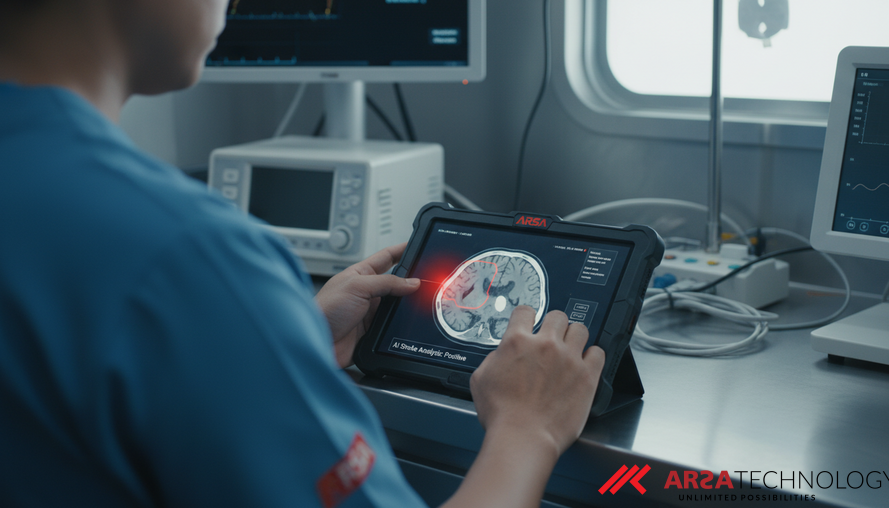
Stroke is a medical emergency that demands rapid diagnosis and intervention. Traditional Computed Tomography (CT) scans are the gold standard for detecting strokes, but their reliance on large, fixed equipment often means delays, especially in pre-hospital or remote settings. The emergence of portable CT scanners offers a transformative solution, bringing neuroimaging directly to the patient. However, these compact devices often operate at reduced radiation doses to ensure patient safety and enable miniaturization, which introduces a significant challenge: image noise. This noise can degrade image quality and compromise diagnostic reliability.
A recent academic paper, "Low Dose CT for Stroke Diagnosis: A Dual Pipeline Deep Learning Framework for Portable Neuroimaging" by Ghosal et al., explores how advanced deep learning techniques can overcome these limitations, making portable low-dose CT (LDCT) a viable tool for early stroke detection and AI-assisted triage (Source). This research paves the way for more efficient and accessible stroke care, especially in critical mobile and resource-constrained environments.
The Intricacies of Low-Dose CT and Image Noise
Portable CT scanners are crucial for decentralizing medical imaging, offering immediate insights at the point of care. However, the reduction in radiation dose, while beneficial for patient safety, leads to what's known as "photon starvation" and introduces specific statistical noise patterns, primarily Poisson noise. This type of noise manifests as a grainy, speckled appearance in images, making subtle details difficult to discern. For stroke diagnosis, where identifying precise differences in brain tissue is critical, such noise significantly impairs both human clinical interpretation and the performance of AI diagnostic tools.
To accurately simulate these conditions for research, high-dose CT (HDCT) images are intentionally degraded by applying controlled levels of Poisson noise. This process creates realistic low-dose CT images, allowing researchers to evaluate AI models under conditions that mirror real-world portable scanner outputs. The goal is to develop AI systems robust enough to provide reliable diagnostics despite compromised image quality.
Dual-Pipeline Deep Learning for Enhanced Diagnosis
The research introduces a sophisticated deep learning framework designed to classify stroke from these simulated low-dose CT brain scans. The core of this framework lies in its dual-pipeline approach, which offers two distinct strategies for processing noisy medical images:
- Direct Classification: This pipeline feeds the noisy LDCT images directly into a convolutional neural network (CNN) for immediate classification. The CNN, an AI architecture inspired by the human visual cortex, is trained to identify stroke patterns even amidst the noise.
- Denoise-then-Classify: This sequential pipeline first attempts to clean up the noisy LDCT images using a specialized denoising network, specifically a U-Net architecture. After denoising, the improved images are then passed to a separate CNN, such as a ResNet, for stroke classification. The U-Net is particularly effective at image restoration due to its U-shaped design that allows it to capture both local and global image features, while ResNet excels at learning deep, complex patterns for classification.
Both pipelines were rigorously evaluated across various simulated dose levels and subjected to artifact stress tests, such as those caused by patient motion or scanner ring artifacts. This comprehensive testing ensures the models’ resilience and reliability in challenging real-world scenarios, aiming to deliver actionable intelligence for rapid stroke triage.
Navigating the Trade-Off Between Image Quality and Diagnostic Utility
A key finding from this research is the nuanced relationship between how "good" an image looks (perceptual quality) and its actual diagnostic usefulness (diagnostic reliability). While the denoise-then-classify pipeline consistently improved the visual quality of the LDCT images—measured by metrics like Peak Signal-to-Noise Ratio (PSNR) and Structural Similarity Index Measure (SSIM)—this visual improvement did not always translate into better diagnostic performance.
Surprisingly, in several scenarios, direct classification on the noisy scans proved more sensitive for stroke detection. This suggests that crucial diagnostic information might be inadvertently lost during the denoising process, even when the resulting image appears clearer to the human eye. For instance, at a 10% dose level, the best denoise-then-classify pipeline achieved 0.94 AUC and 0.91 accuracy, outperforming direct classification by 6%. However, the paper explicitly notes that in other settings, direct classification was more sensitive. This critical trade-off highlights the need for a comprehensive evaluation that considers both approaches, moving beyond purely aesthetic improvements to focus on measurable diagnostic outcomes.
Practical Applications for Rapid Stroke Triage and Beyond
This research holds significant promise for transforming stroke care, particularly in pre-hospital and mobile care environments. By enabling reliable AI-assisted analysis of LDCT scans, it can empower ambulance-based stroke units, remote clinics, and field operations to perform rapid stroke assessments. This capability allows medical professionals to initiate triage and treatment protocols much earlier, drastically improving patient outcomes by reducing the time to intervention.
While this specific study focused on hemorrhagic stroke—a major subtype where early recognition is paramount—the underlying principles of robust AI for challenging imaging conditions are broadly applicable. For organizations seeking to implement advanced AI and IoT solutions, understanding these nuances is crucial. Companies like ARSA Technology, with expertise in AI Video Analytics, can leverage such deep learning frameworks to create customized solutions for various industries. For instance, the core technology in ARSA AI Video Analytics, which processes complex visual data, shares similarities with the robust image processing needed for medical imaging.
ARSA Technology’s Commitment to AI-Powered Healthcare
At ARSA Technology, we understand the critical importance of reliable, privacy-compliant AI and IoT solutions in sectors like healthcare. Our approach centers on engineering intelligence into operations, from real-time analytics to industrial sensor networks and enterprise-grade web platforms. The ability to deploy AI models effectively in resource-constrained or sensitive environments, without cloud dependency and with full data ownership, is a cornerstone of our offerings.
For medical facilities, emergency services, or organizations looking to enhance their diagnostic capabilities, our expertise in custom AI solutions can be invaluable. We provide solutions that range from Self-Check Health Kiosks for autonomous health screening to enterprise-grade AI systems deployed on-premise, ensuring data sovereignty and compliance. Our team has been experienced since 2018 in translating complex AI research into practical, deployable systems that yield measurable impact.
The work by Ghosal et al. underscores the potential of AI to revolutionize medical diagnostics by extracting critical information from challenging data sources. This aligns perfectly with ARSA Technology’s vision to build the future with AI and IoT, delivering solutions that reduce costs, increase security, and create new revenue streams by turning operational complexity into a competitive advantage.
To learn more about how ARSA Technology can help your organization implement cutting-edge AI and IoT solutions for enhanced operational intelligence and diagnostic capabilities, please contact ARSA for a free consultation.