AI-Powered Autonomous Missions: Navigating the Future Beyond Ground Control
Explore a novel computational framework and the Autonomy Necessity Score (ANS) for designing distributed autonomous systems operating in high-latency environments. Discover how AI and edge computing enable robust onboard decision support for deep space, underwater, and orbital missions.

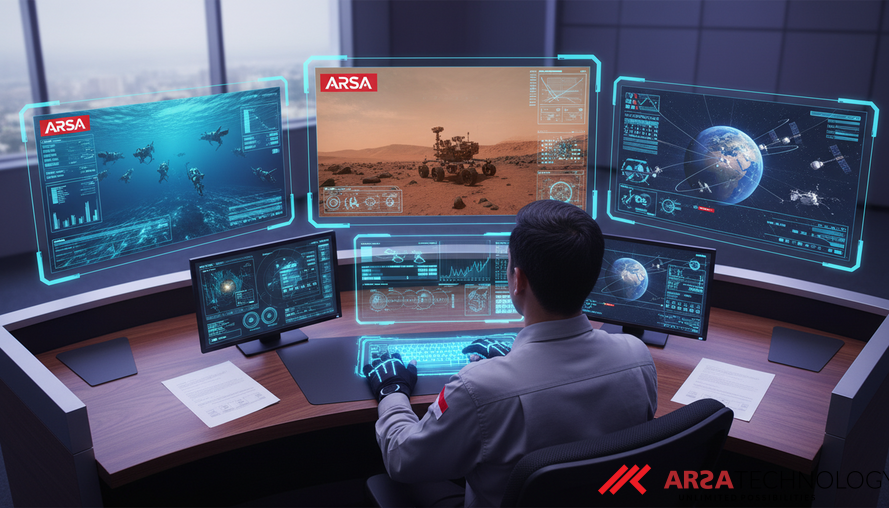
The ambition to explore distant planets, monitor vast oceans, or deploy sophisticated satellite networks has always been constrained by a fundamental challenge: the speed of light. As missions venture further from Earth, the round-trip communication latency—the time it takes for a signal to travel to a spacecraft and back—grows exponentially. This increasing delay dictates a critical shift in operational strategy: decisions that were once made by operators on Earth must now be delegated to the autonomous systems themselves. This necessitates a robust computational framework to quantify autonomy requirements and enable intelligent onboard decision-making.
The Growing Imperative for Autonomous Systems
Imagine a Mars rover encountering an unexpected obstacle. If it takes minutes or even hours for a command to reach it from Earth and for its response to return, a critical window for action could be missed, potentially jeopardizing the mission. This is the core tension for distributed autonomous systems operating beyond reliable ground contact. Whether in low Earth orbit, on the Martian surface, exploring the sub-surface oceans of Europa, or navigating the hydrocarbon seas of Titan, these systems must possess the capability to make critical decisions independently. This isn't merely a matter of improving communication bandwidth; it’s a physical constraint imposed by vast distances and the inherent speed limit of light.
Historically, the engineering community has tackled these challenges through single-mission analyses. Orbital mechanics optimize satellite constellation geometries, reliability engineers design fault-tolerant systems for specific spacecraft, and communication experts ensure link budgets for defined scenarios. While rigorous, these individual efforts often miss a crucial cross-domain perspective: how much autonomy does a given mission truly need, and how can we compare this requirement across vastly different operational contexts? This gap creates practical difficulties in allocating onboard computational resources, communication infrastructure, and power budgets effectively. Over-reliance on ground links for high-latency missions can lead to wasted mass and power, while under-designing onboard intelligence for time-critical events risks mission failure.
Introducing the Autonomy Necessity Score (ANS)
To address this critical gap, a recent study introduced a unified computational methodology, establishing the Autonomy Necessity Score (ANS). This innovative metric provides a continuous, log-domain value that quantifies how much autonomy a system or mission phase requires. Derived from the ratio of round-trip communication latency to the timescale of critical events, ANS maps any system from a fully ground-dependent mode to a completely autonomous operational regime. The framework was developed through nine independently validated computational studies applied to seven diverse mission architectures, including Earth low-orbit surveillance, Mars orbital navigation, autonomous underwater mine-clearing swarms, deep-space inter-satellite link networks, and outer-planet in-situ buoy platforms. The full academic paper, "A Computational Framework for Cross-Domain Mission Design and Onboard Cognitive Decision Support," can be found at arxiv.org/abs/2603.28926.
The underlying analyses, grounded in rigorous physics and engineering principles, cover a broad spectrum of challenges. These include orbital coverage mechanics, infrared detection, hypersonic tracking using advanced filters, radio frequency and acoustic link budgets across immense distances, Monte Carlo simulations for inter-satellite protocols, comprehensive power budget sizing, distributed magnetic-signature formation emulation, and reliability modeling for cryogenic swarm systems. By synthesizing findings from such varied computational domains, the ANS provides a robust, physics-grounded basis for comparing the autonomy demands of heterogeneous missions on a common, quantifiable scale. For instance, in real-world scenarios, ARSA Technology applies similar rigorous methodologies in developing custom AI solutions for complex industrial and public safety challenges, leveraging our expertise since 2018 to deliver systems engineered for accuracy, scalability, and operational reliability.
Unveiling Cross-Mission Design Constraints
The application of the Autonomy Necessity Score framework has yielded some physically non-obvious yet highly significant cross-mission constraints. For example, analyses revealed a critical 2431 kg battery mass boundary for underwater vehicle hull diameters, highlighting a fundamental trade-off between power and physical dimensions for autonomous underwater operations. Another crucial finding was a radar-band link margin failure during Mars solar conjunctions—a period when the sun obstructs communications between Earth and Mars—which could only be recovered by reducing data rates. Furthermore, the framework identified a timing synchronization requirement for certain missions that was tightened by a factor of 2.4 times compared to original specifications, underscoring the subtle complexities involved in coordinating distributed systems over vast distances.
These findings are not merely academic; they have direct implications for mission success and resource allocation. By quantifying these constraints, engineers can make informed decisions about system design, ensuring that critical components like power systems, communication protocols, and timing mechanisms are robust enough for the demands of high-ANS missions. Such detailed insights allow for optimized resource allocation, preventing both over-engineering, which wastes valuable mass and power, and under-engineering, which risks mission failure. Enterprises seeking to implement robust systems that account for such intricate constraints often benefit from integrated solutions, such as those provided by ARSA Technology, which offer comprehensive AI video analytics and edge AI systems.
Leveraging LLMs for Onboard Cognitive Decision Support
Building on this foundational understanding of autonomy requirements, the research explored the viability of using Large Language Models (LLMs) as an Autonomous Mission Decision Support (AMDS) layer for onboard cognitive functions. This represents a significant leap, moving from merely detecting events to enabling intelligent, real-time decision-making directly on the mission platform. The study evaluated three state-of-the-art foundation models: Llama-3.3-70B, DeepSeek-V3, and Qwen3-A22B. These models were queried live via the Nebius AI Studio API across ten structured anomaly scenarios, which were directly derived from the physics-grounded analyses performed earlier.
The results were highly promising: the best-performing model achieved an impressive 80% decision accuracy against physics-grounded ground truth. Crucially, all 180 inference calls completed within a 2-second latency budget. This performance is consistent with the demands of radiation-hardened edge deployment, demonstrating that advanced LLMs can function effectively as an onboard cognitive layer for missions with high Autonomy Necessity Scores. This capability is transformative, enabling systems to respond instantly to unforeseen events without waiting for delayed commands from Earth, thereby significantly enhancing mission resilience and success rates. For industrial applications, similar edge AI capabilities are provided by ARSA’s AI Box Series, offering pre-configured systems for fast, on-site deployment and on-premise processing, crucial for scenarios demanding low latency and data sovereignty.
The Future of Mission Design and Operation
The development of a unified computational methodology for cross-domain mission design and the successful evaluation of LLM-based onboard cognitive decision support layers mark a pivotal moment in the evolution of autonomous systems. By providing a quantifiable metric like the Autonomy Necessity Score, engineers can now systematically design missions with appropriate levels of autonomy, optimizing resource allocation and mitigating risks inherent in high-latency environments. The proven viability of integrating advanced AI models for real-time decision-making at the edge opens up unprecedented possibilities for future explorations and operations in the most challenging and distant environments.
This shift towards sophisticated onboard intelligence not only enhances the capabilities of individual missions but also paves the way for a new era of space exploration, deep-sea monitoring, and distributed sensing where human reach is expanded through intelligent, self-reliant robotic proxies. The insights gained from such frameworks enable enterprises and governments alike to embark on more ambitious projects with greater confidence, ensuring practical, proven, and profitable deployments.
To explore how advanced AI and IoT solutions can transform your operations and future missions, we invite you to discuss your specific needs with our experts.
Contact ARSA today for a free consultation and discover practical AI deployed for your enterprise.