AI-Powered Energy-Aware Robotics: Smarter Path Planning for Sustainable Precision Agriculture
Discover how advanced reinforcement learning, powered by CNNs and LSTMs, optimizes agricultural robots for energy-efficient, comprehensive coverage. Learn its impact on precision farming.

Introduction: The Dawn of Intelligent Farming
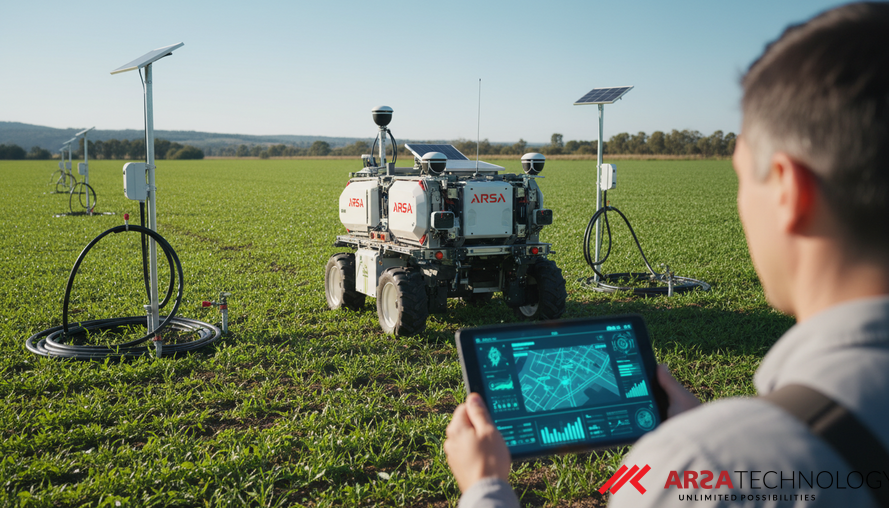
Precision agriculture is rapidly transforming the global food landscape, driven by the increasing integration of artificial intelligence and automation. Autonomous agricultural robots are at the forefront of this revolution, undertaking vital tasks such as crop monitoring, soil analysis, targeted weeding, and precise pesticide application. These robots promise enhanced productivity and significant reductions in operational costs. However, a fundamental challenge in deploying these advanced machines lies in Coverage Path Planning (CPP) – the process of generating optimal routes that ensure every inch of a given area is thoroughly covered while conserving essential resources. Inefficient CPP often results in wasted energy, redundant path overlaps, or, critically, missed areas, thereby undermining the very benefits automation seeks to deliver.
While extensive research has focused on maximizing coverage and task efficiency, the real-world deployment of battery-powered agricultural robots, particularly across vast farmlands, is often hampered by a critical factor: limited energy availability. The necessity of incorporating energy-aware strategies into CPP is therefore paramount for the sustainable and viable operation of autonomous agricultural systems. This shift ensures that robots not only perform their tasks effectively but also complete their missions without running out of power or failing to return to a designated charging station.
Addressing Energy Constraints in Robotic Agriculture
Traditional approaches to energy-constrained Coverage Path Planning have historically fallen into several categories, including classical optimization, heuristic algorithms, and early learning-based methods. Classical optimization techniques, such as linear programming, offer precision in well-defined, static environments. However, they often struggle with the dynamic and often unpredictable conditions of real agricultural fields, lacking the adaptability to changing obstacles or environmental factors. Many of these foundational methods also overlook the crucial aspect of energy conservation and the need for a robot to safely return to its base or a charging station.
Heuristic algorithms, while offering greater flexibility, typically require extensive fine-tuning of parameters, limiting their seamless application across diverse and dynamic environments. Previous efforts in this area have explored minimizing energy consumption by optimizing flight speed for UAVs or utilizing mobile charging stations for surveillance tasks. Yet, a common shortcoming observed in these methods is the tendency to treat energy management and coverage planning as separate concerns. This approach fails to recognize their inherent interdependence in continuous, long-duration agricultural operations, often leading to robots that either cover an area inefficiently or run out of power before completing their assigned tasks.
Pioneering a New Approach with Reinforcement Learning
To overcome these inherent limitations, a groundbreaking framework has been developed, harnessing the power of Reinforcement Learning (RL). This innovative approach, detailed in a recent academic paper by Wu, Ding, Ostigaard, and Huang (2025) from South Dakota State University (Source: arXiv:2601.16405), centers around the Soft Actor-Critic (SAC) algorithm. SAC is a sophisticated type of reinforcement learning that allows autonomous agents to learn optimal behaviors through extensive interaction with an environment. Unlike many conventional RL methods, SAC includes an "entropy regularization" component, which encourages the robot to explore various actions, leading to more robust and stable decision-making. Its "twin Q-network" architecture also helps prevent overestimation of action values, reducing the risk of the robot making unsafe choices that could lead to critical energy depletion.
The framework integrates advanced neural networks to enhance the robot's perception and decision-making capabilities within complex environments. Convolutional Neural Networks (CNNs), commonly used in computer vision for image analysis, are employed to extract spatial features from the environment. This enables the robot to "see" and understand the layout of the agricultural field, including fixed obstacles (like irrigation equipment or storage facilities) and the strategic locations of charging stations. Complementing this, Long Short-Term Memory (LSTM) networks are utilized to process temporal dynamics. LSTMs are a type of recurrent neural network particularly adept at remembering past actions and energy states, allowing the robot to make more informed, adaptive decisions over extended periods. Together, these sophisticated components allow for highly adaptive and robust path planning in complex agricultural settings.
Intelligent Path Planning for Comprehensive Coverage and Energy Safety
The core of this advanced system lies in its ability to formally formulate the complex energy-constrained CPP problem with a crucial "return-to-start" requirement. This means the robot not only needs to efficiently cover the designated area but also ensures it retains sufficient energy to return to a charging station once its task is complete or its energy levels fall below a safe threshold. The framework achieves this critical balance by designing a specialized multi-objective reward function. This function acts as the robot's internal guide, incentivizing it to:
- Maximize Coverage Efficiency: The robot receives positive rewards for covering new areas, ensuring thoroughness without unnecessary overlaps.
- Minimize Energy Consumption: Penalties are applied for excessive or inefficient energy usage, promoting judicious movement and operation.
- Enforce Safe Return: The system actively prioritizes actions that ensure the robot can reach a charging station when necessary, preventing mission failure due to power depletion.
This holistic approach ensures that energy considerations are deeply embedded within the robot's learning process, rather than being an afterthought. For instance, in a large-scale agricultural operation, a robot equipped with this technology could autonomously navigate expansive crop fields, identifying areas requiring specific care. As an example of real-time operational support, ARSA Technology provides AI Video Analytics solutions that can be integrated with such robotic systems to enhance immediate decision-making, allowing robots to identify specific crop health issues or pest infestations during their coverage paths.
Demonstrating Superior Performance and Real-World Viability
The experimental results of this SAC-based framework showcase its significant advantages over conventional methods. Tested rigorously in various grid-based agricultural environments, featuring diverse obstacles and charging station configurations, the proposed approach consistently achieved over 90% area coverage. Crucially, this high coverage rate was achieved while maintaining "energy safety," meaning the robots reliably completed their missions without critical power depletion or being stranded in the field.
The system dramatically outperformed traditional heuristic algorithms such as Rapidly-exploring Random Tree (RRT), Particle Swarm Optimization (PSO), and Ant Colony Optimization (ACO) baselines. Specifically, it achieved 13.4% to 19.5% higher coverage rates. More impressively, it reduced constraint violations—such as running out of energy or failing to return to a charging station—by an exceptional 59.9% to 88.3%. These findings underscore the framework's effectiveness and scalability, validating it as a robust solution for energy-constrained Coverage Path Planning in agricultural robotics. Such advancements are crucial for global enterprises looking to optimize their operations and deploy autonomous systems reliably. For effective deployment and monitoring of autonomous systems in challenging environments, businesses often seek reliable partners. ARSA Technology, for instance, offers AI Box Series devices that process video analytics at the edge, providing real-time insights without heavy cloud dependency.
Paving the Way for Sustainable and Efficient Farming
The implications of energy-aware coverage path planning extend far beyond merely improving robot uptime; they pave the way for a more sustainable and economically viable future for precision agriculture. By minimizing energy waste and ensuring complete area coverage, farmers can significantly reduce operational costs, optimize resource allocation (e.g., precise application of fertilizers or water), and ultimately achieve higher crop yields. The ability of robots to operate autonomously for longer periods, with built-in safeguards for energy management, enhances reliability and reduces the need for constant human supervision.
This research highlights a crucial step towards fully autonomous and intelligent agricultural systems that are not only efficient but also resilient to real-world operational challenges. As global demands for food production continue to rise, alongside increasing pressure for environmental sustainability, such AI and IoT-driven solutions become indispensable tools for modern farming. These advancements contribute to the broader vision of Industry 4.0, transforming agricultural operations through smart automation. Solutions like the ARSA Technology Industrial IoT & Heavy Equipment Monitoring suite exemplify how integrated AI and IoT can enhance operational efficiency and predictive maintenance in demanding sectors, echoing the energy management principles seen in this research.
Conclusion
The integration of reinforcement learning, specifically the Soft Actor-Critic framework enhanced with CNNs and LSTMs, represents a significant leap forward in addressing the critical challenge of energy-aware coverage path planning for agricultural robots. By prioritizing comprehensive coverage, energy conservation, and operational safety through a multi-objective reward function, this approach delivers superior performance compared to traditional methods. It not only boosts efficiency but also ensures the practical viability of autonomous agricultural operations.
For enterprises seeking to implement cutting-edge AI and IoT solutions to enhance their precision agriculture strategies and overall operational efficiency, explore ARSA Technology's specialized offerings.
Contact ARSA today for a free consultation and to learn how our expertise can drive your digital transformation.
---
**Source:** Wu, B., Ding, Z., Ostigaard, L., & Huang, J. (2025). Reinforcement Learning-Based Energy-Aware Coverage Path Planning for Precision Agriculture. International Conference on Research in Adaptive and Convergent Systems (RACS ’25), Ho Chi Minh, Vietnam. https://arxiv.org/abs/2601.16405