AI-Powered Robotic Navigation: GNN-DIP for Seamless Motion Through Challenging Narrow Passages
Explore GNN-DIP, an AI framework integrating Graph Neural Networks for superior robotic motion planning in complex, narrow environments. Learn its benefits for speed, accuracy, and enterprise-grade navigation.

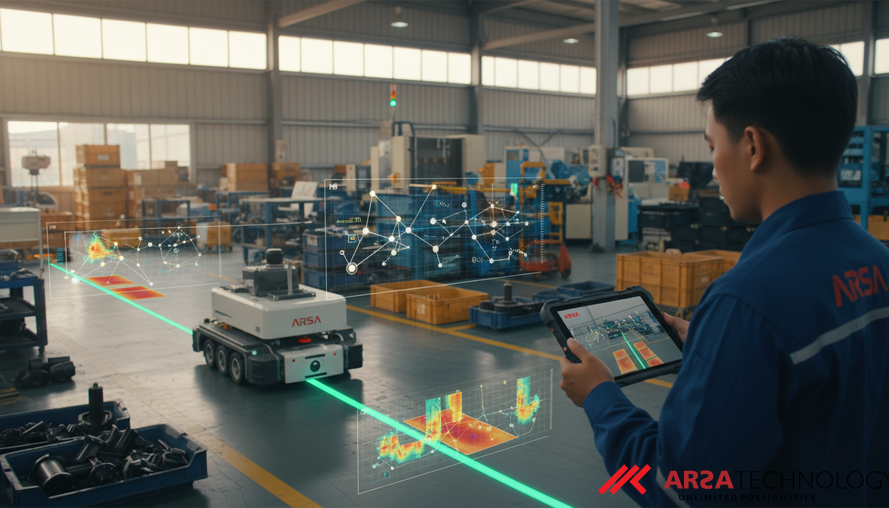
Motion planning is a foundational challenge in robotics, particularly when autonomous systems must navigate through environments rife with tight spaces, doorways, and intricate obstacle layouts. These "narrow passages" are often the only viable routes, yet they pose significant hurdles for traditional planning methods. A new framework, GNN-DIP, is emerging as a powerful solution, leveraging artificial intelligence to enable robots to navigate even the most complex environments with unprecedented speed and accuracy.
The Persistent Challenge of Narrow Passages in Robotics
Robots operating in industrial settings, logistics hubs, or smart cities constantly encounter constrained spaces. Imagine an autonomous forklift in a crowded warehouse, an inspection drone flying through a pipeline, or a delivery robot in an office building. For these systems, finding reliable and efficient paths through narrow gaps is not just an optimization; it's a necessity. Traditional sampling-based planners, which generate many random potential paths, often falter here. The probability of randomly generating a path within a narrow passage decreases exponentially with the passage's narrowness and the dimensionality of the environment (2D, 3D). Even if a path segment lands inside, the slight imprecision in collision checking can lead to frequent rejections, making reliable navigation through these critical areas incredibly difficult. These compounding issues can quickly lead to diminishing returns, even with increased computational power.
Decomposition-Based Planning: A Structural Advantage
Decomposition-based planners offer a fundamentally different and more robust approach to motion planning. Instead of randomly probing the environment, they systematically partition the robot's free space—the areas it can move through—into a collection of simpler, convex cells. Think of this as dissecting a complex room into many smaller, easy-to-manage sections where any straight line within a section is guaranteed to be clear of obstacles.
The genius of this method is that every narrow passage, regardless of its tightness, is precisely represented as a shared boundary (or "portal") between adjacent cells. This eliminates the problem of missing crucial routes due to sparse sampling. Moreover, because each cell is convex, any path chosen within that cell is inherently collision-free, removing the need for intensive, resolution-dependent collision checking that plagues sampling-based methods. This transforms the continuous problem of robot movement into a discrete problem: first, find a sequence of cells (a "corridor"), then optimize the path within that corridor. In 2D, efficient algorithms like the Funnel algorithm can compute the exact shortest path through a series of convex polygons in linear time, a significant advantage.
Overcoming the Corridor Selection Bottleneck with AI
While decomposition-based planning offers strong theoretical advantages, it introduces a new practical challenge: the "corridor selection problem." In complex environments with hundreds or even thousands of cells, the number of possible corridors from a start point to a goal can grow combinatorially, meaning exponentially. Selecting the optimal corridor from this vast array quickly becomes a computational bottleneck. Traditional methods often rely on simple heuristics, such as measuring the distance between cell centers, to estimate path costs. However, these estimates can be wildly inaccurate in environments with elongated cells, extremely narrow passages, or asymmetrical obstacle layouts, leading to suboptimal path choices or inefficient searches.
This is where GNN-DIP steps in, presenting an innovative solution by integrating a Graph Neural Network (GNN) into the planning process. ARSA Technology, experienced since 2018, specializes in integrating advanced AI to solve complex operational problems, highlighting the practical benefits of such intelligent systems. A GNN is a type of neural network designed to process data structured as graphs—perfect for the cell adjacency graph where cells are nodes and portals are edges. The GNN is trained to predict a "score" for each portal, indicating its likelihood of being part of a near-optimal path. These scores then intelligently influence the search, biasing it towards more promising regions without eliminating any potential paths entirely, thus preserving the planner's completeness while dramatically improving efficiency.
The GNN-DIP Framework: Two Phases of Intelligent Planning
GNN-DIP employs a two-phase Decomposition-Informed Planner (DIP) to leverage the GNN's predictive power:
- Phase 1: GNN-Guided Corridor Search and Initial Path Evaluation: The Graph Neural Network first analyzes the cell adjacency graph, assigning scores to each portal. These scores modify the "cost" of traversing between cells, directing the search algorithm (like a k-shortest path algorithm) towards corridors that the GNN deems most likely to contain an optimal path. For 2D environments, the Funnel algorithm is then used within these selected corridors to rapidly compute exact shortest paths. In 3D, where exact convex decomposition is more complex, a "Slab" convex decomposition coupled with "portal-face sampling" provides a near-optimal path evaluation. This phase quickly identifies a high-quality initial solution. Such precision and speed in pathfinding are crucial for advanced autonomous systems, aligning with solutions like ARSA's AI Video Analytics for intelligent monitoring and navigation.
- Phase 2: Informed Refinement: Once an initial path is found, the system refines this solution within a progressively shrinking "informed ellipsoid." This concept, borrowed from other advanced planning algorithms, effectively narrows down the search space around the current best solution, allowing for further optimization and a more precise final path. This iterative refinement ensures that the final path is not just feasible but also near-optimal in terms of length and efficiency.
Practical Applications and Measurable Impact
The GNN-DIP framework represents a significant leap in robotic motion planning, with clear benefits for various industries:
- Manufacturing & Logistics: Autonomous guided vehicles (AGVs) and robots on factory floors can navigate complex layouts, around machinery, and through narrow aisles with greater efficiency and fewer collisions. This translates to faster material transport, optimized production workflows, and reduced operational costs. For rapid deployment in industrial settings, robust edge AI systems, such as ARSA’s AI Box Series, are essential for implementing such advanced navigation capabilities directly on-site.
- Smart Cities & Traffic Management: Imagine intelligent traffic systems where autonomous vehicles, leveraging GNN-DIP, can dynamically adjust routes through congested city bottlenecks, reducing travel times and improving overall urban mobility.
- Construction & Inspection Robotics: Drones and ground robots performing inspections in construction sites or hazardous environments can precisely navigate through structural complexities, enhancing safety and data collection accuracy.
- Defense & Public Safety: For scenarios requiring rapid deployment in cluttered or unknown territories, robots equipped with GNN-DIP can quickly chart optimal and secure routes, improving situational awareness and operational effectiveness.
Benchmarks demonstrate GNN-DIP's robust performance: achieving 99–100% success rates in challenging 2D narrow-passage scenarios, 3D bottleneck environments with up to 246 obstacles, and dynamic 2D settings. Crucially, it delivers a remarkable 2–280 times speedup compared to traditional sampling-based baselines, all while ensuring collision safety by design. The investment in such sophisticated AI-driven planning translates directly into enhanced operational efficiency, reduced risk of accidents, and accelerated project timelines for enterprises leveraging automation.
Conclusion
GNN-DIP signifies a major advancement in the field of motion planning, particularly for robots navigating complex and constrained environments. By intelligently combining graph neural networks with a refined decomposition-based planning strategy, it addresses long-standing challenges of speed, reliability, and precision in narrow passages. This innovation paves the way for a new generation of autonomous systems capable of performing more complex tasks in more demanding real-world conditions, ultimately unlocking new levels of efficiency and capability across various critical sectors.
To learn more about how advanced AI and IoT solutions can transform your operations and to explore bespoke planning capabilities for your enterprise, we invite you to contact ARSA for a free consultation.
Source: Xie, P., Huang, Y., Wu, W., & Alanwar, A. (2026). GNN-DIP: Neural Corridor Selection for Decomposition-Based Motion Planning. https://arxiv.org/abs/2603.12361