AI Vision Transforms Scrap Metal Assessment for Smarter Steelmaking
Discover how AI-powered computer vision is revolutionizing scrap metal contamination estimation, enhancing safety, efficiency, and sustainability in steel production. Explore real-time analytics for quality control.

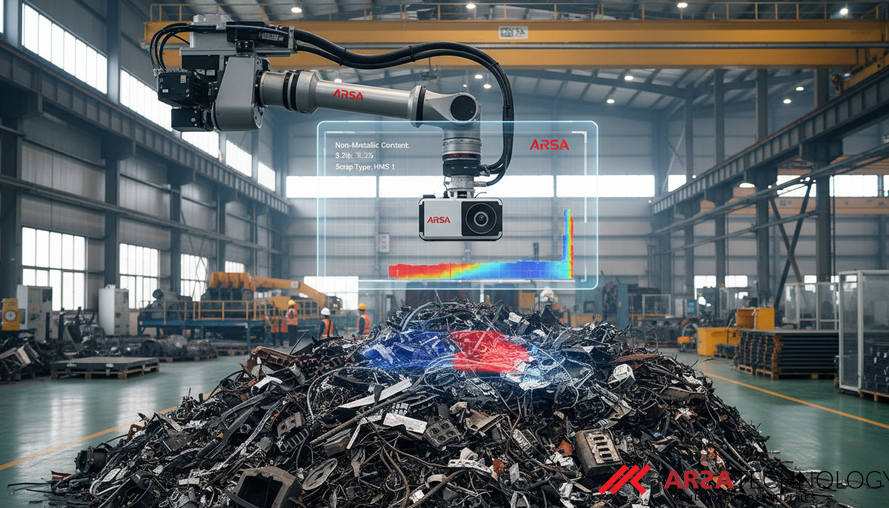
Steel production is a cornerstone of modern industry, and the increasing reliance on scrap metal offers significant environmental and economic advantages. Using recycled scrap reduces the need for virgin resources, lowers production costs, and decreases carbon emissions, contributing to a more sustainable future. However, the efficacy of this process hinges critically on the quality of the incoming scrap. Non-metallic inclusions, contaminants, and impurities can severely degrade the properties of the final steel product, leading to defects, increased processing expenses, and higher energy consumption. Traditionally, assessing this contamination has been a manual, subjective, and often hazardous task carried out by human inspectors.
The Critical Challenge: Subjectivity and Safety in Scrap Assessment
The presence of non-metallic inclusions in scrap metal poses substantial challenges for steelmaking, particularly in Electric Arc Furnace (EAF) operations. These impurities can compromise the quality of molten metal, reduce steel yields, and necessitate additional slag formation, which disrupts continuous melting and decreases overall productivity. Beyond efficiency, a direct correlation exists between increasing contamination and higher CO2 emissions, further underscoring the environmental impact.
Moreover, the manual assessment process is fraught with human-centric issues. Inspectors operate in dangerous environments, exposed to strong magnetic fields, airborne dust, and particulate matter from moving machinery, increasing the risk of accidents and respiratory problems. The subjective nature of human judgment also leads to inconsistent contamination reports and unreliable quality control. Different inspectors might evaluate the same railcar of scrap with widely varying results, hampering production planning and potentially causing economic inefficiencies such as unnecessary processing or the rejection of perfectly acceptable scrap. These traditional methods are labor-intensive, time-consuming, and prone to errors, making it difficult to keep pace with growing scrap volumes, as highlighted in a recent technical report on assistive computer vision for scrap metal assessment (Storonkin et al., 2026).
AI Transforms Scrap Metal Quality Control
To address these pressing issues, a pioneering deep learning pipeline has been proposed to automate and enhance the scrap metal contamination definition process. This innovative approach leverages advanced computer vision to estimate non-metallic content (as a percentage) and classify scrap types directly from images captured during railcar unloading. This method not only bypasses the subjectivity of human inspection but also removes personnel from hazardous zones, significantly improving workplace safety.
The core of this system formulates contamination assessment as a "regression task" – a machine learning problem where the AI predicts a continuous value, in this case, the precise percentage of non-metallic material at the railcar level. It utilizes sequential data, meaning it processes multiple images taken over time as the scrap is unloaded, mimicking how a human would observe the entire load. This process is facilitated by two sophisticated machine learning techniques: Multi-Instance Learning (MIL) and Multi-Task Learning (MTL).
Deep Dive into AI Methodologies
Multi-Instance Learning (MIL) for Contamination Estimation
Multi-Instance Learning (MIL) is particularly well-suited for situations where the target label (e.g., total contamination) applies to a collection of observations rather than individual ones. In scrap metal assessment, inspectors provide a single, holistic contamination rating for an entire railcar, even though they observe multiple magnet grabs or "layers" of scrap as it's unloaded. The ground truth (the final contamination percentage) exists only at the railcar level.
MIL addresses this by treating the multiple images of scrap layers from a single railcar as a "bag" of instances. The model learns to aggregate the evidence from all instances within that bag to produce a single, comprehensive contamination score for the entire railcar. This approach is vital because scrap content can be heterogeneous across layers, the number of layers varies, and a few highly contaminated sections could be diluted by simple averaging. Solutions like the ARSA AI Box Series are equipped with edge computing capabilities that can process these multiple instances locally and efficiently, offering privacy-compliant, real-time analytics.
Multi-Task Learning (MTL) for Comprehensive Analysis
Building on MIL, Multi-Task Learning (MTL) further enhances the system's capabilities by allowing a single AI model to perform multiple related tasks simultaneously. In this context, the model not only estimates the percentage of non-metallic contamination but also classifies the scrap type (e.g., different grades of steel scrap). Instead of training separate models for each task, MTL uses a shared architecture with distinct "heads" for each output, leading to improved efficiency and often better performance due to shared knowledge between related tasks.
The research also highlights a significant finding regarding AI model architecture: transformer-based models demonstrably outperform traditional Convolutional Neural Network (CNN) architectures in contamination prediction. Transformers, known for their ability to capture long-range dependencies and contextual information within sequential data, are better at distinguishing subtle differences in scrap types and assessing overall contamination patterns. This emphasizes the importance of selecting advanced AI architectures for complex industrial vision tasks.
Real-World Impact and Operational Integration
The proposed computer vision pipeline is designed for near real-time operation within existing acceptance workflows in steelmaking. Here’s how it transforms operations:
- Automated Data Collection: High-resolution cameras capture images during railcar unloading.
- Dynamic Layer Segmentation: The system intelligently detects the moving magnet and segments temporal "layers" of scrap as they are unloaded.
- Real-time Inference: A versioned inference service rapidly analyzes these layers, producing railcar-level contamination estimates along with confidence scores.
- Operator Oversight: Results are presented to human operators for review. In cases of uncertainty or detected errors, operators can provide structured overrides.
- Active Learning Loop: Crucially, these corrections and uncertain cases are fed back into an active-learning loop. This mechanism allows the AI system to continually learn from human feedback and improve its accuracy and robustness over time. This continuous optimization aligns perfectly with the agile deployment strategies offered by experienced providers. For instance, ARSA AI Video Analytics solutions are built with similar principles, transforming passive surveillance into active business intelligence.
This integration delivers tangible benefits: it eliminates the subjective variability of manual inspections, significantly enhances human safety by removing workers from dangerous areas, and enables seamless integration into critical acceptance and melt-planning workflows, ensuring that steel mills can make data-driven decisions.
Quantifiable Results and Future Potential
The effectiveness of this AI-powered pipeline is supported by strong performance metrics from the academic study. For contamination assessment, the Multi-Instance Learning (MIL) setup achieved a Mean Absolute Error (MAE) of 0.27% and an R2 coefficient of determination of 0.83. For the multi-task approach, which simultaneously estimated contamination and classified scrap type, results included an MAE of 0.36% for contamination and an F1 score of 0.79 for scrap class. While human inspectors still achieved slightly better results (average MAE 0.19%, R2 0.93%), the AI's performance is highly comparable and offers consistency, safety, and scalability that human inspection cannot match. Furthermore, the continuous improvement through the active-learning loop ensures that the AI's performance will steadily advance.
The findings demonstrate the immense potential of assistive computer vision to revolutionize industrial quality control. By leveraging AI, industries can not only achieve higher standards of quality and efficiency but also create safer and more sustainable operational environments.
Transform Your Industrial Operations with AI
Embracing AI-powered computer vision for tasks like scrap metal assessment is a strategic move for any enterprise aiming for greater efficiency, enhanced safety, and improved environmental sustainability. Companies like ARSA Technology specialize in developing and deploying tailored AI and IoT solutions across various industries, turning complex challenges into actionable insights.
To learn more about how AI vision can optimize your industrial processes and drive measurable results, we invite you to explore ARSA's solutions and contact ARSA for a free consultation.
Source: Storonkin, D., Dziub, I., Golyadkin, M., & Makarov, I. (2026). From Images to Decisions: Assistive Computer Vision for Non-Metallic Content Estimation in Scrap Metal. arXiv preprint arXiv:2602.07062. https://arxiv.org/abs/2602.07062