Continual Distillation: Adapting AI Models to Evolving Knowledge without Forgetting
Explore Continual Distillation (CD), a new AI paradigm that enables smaller models to learn from a continuous stream of large, evolving teacher models. Discover how CD addresses Unseen Knowledge Forgetting and offers efficient, privacy-aware AI adaptation for enterprises.

The Evolving Landscape of AI Models and the Need for Agility
In the dynamic world of artificial intelligence, deep learning models are constantly growing in size and complexity, often referred to as Foundation Models (FMs). These colossal models, which can exceed hundreds of billions of parameters, demand immense computational resources and storage, sometimes requiring more gigabytes than entire large-scale datasets. This rapid scaling and continuous evolution pose significant challenges for businesses aiming to deploy specialized AI solutions. The sheer cost and logistical complexity of constantly updating or retraining these massive models, coupled with the frequent unavailability of older versions or their original training data, necessitate innovative approaches to AI adaptation.
Enterprises today need AI systems that can seamlessly integrate new knowledge and capabilities without incurring prohibitive costs or compromising on efficiency. As new FMs emerge and existing ones are refined, the ability to distil their collective wisdom into smaller, more manageable models becomes paramount. This ensures that organizations can harness the latest AI advancements, maintain operational agility, and keep their specialized AI tools at the cutting edge, all while managing resources effectively and respecting data sovereignty.
Beyond Continual Learning: Introducing Continual Distillation
Traditionally, the challenge of adapting AI to new information over time has been tackled by Continual Learning (CL). CL trains a single AI model on a sequence of datasets, with the critical constraint that access to previous data is lost over time. This mimics how humans learn, gradually accumulating knowledge without needing to recall every past experience. However, the paradigm shifts when considering the proliferation of Foundation Models. Rather than a stream of new data, we now face a continuous stream of new, updated, or specialized teacher models.
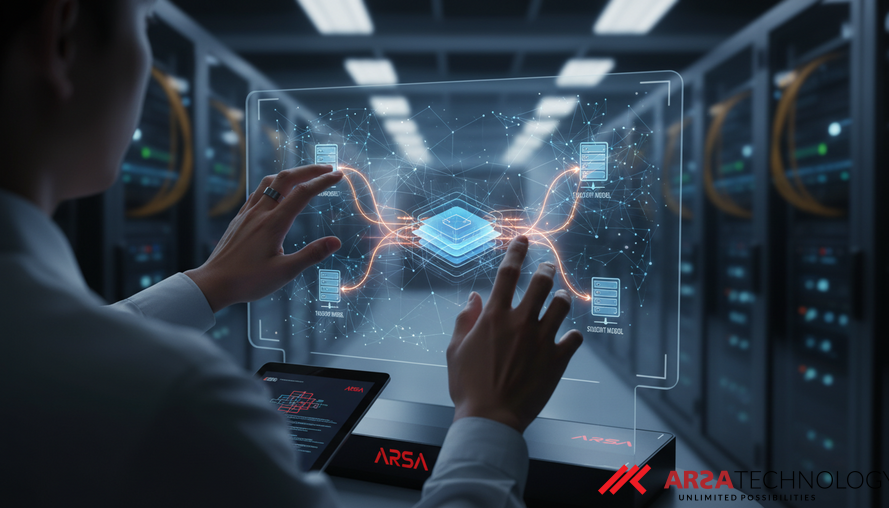
This evolving scenario introduces Continual Distillation (CD), a novel paradigm where a single, smaller "student" model learns sequentially from a series of "teacher" models. Each teacher brings its own expertise, often trained on different, domain-specific datasets. The crucial distinction in CD is that once a student learns from a teacher, that specific teacher model may no longer be accessible. This approach allows organizations to leverage the vast, ever-improving capabilities of large FMs to train efficient, specialized student models, without the burden of storing multiple massive teacher models or their original, often proprietary, training data. Imagine an AI system that continually upgrades its skills by observing expert mentors, rather than painstakingly reviewing all past training materials.
The Dual Challenge: Unseen Knowledge Transfer and Forgetting
Continual Distillation, while highly promising, presents two significant technical hurdles. The first is that the original training data used by the teacher Foundation Models is typically proprietary, too large, or simply unavailable. This means the student model must learn from the teacher's outputs and behaviors using a fixed set of distillation data, rather than directly accessing the teacher’s core knowledge. Surprisingly, researchers have found that utilizing what they term "External Data" (ED) – data unknown to the teachers themselves – is crucial for transferring knowledge about domains the student hasn't seen directly but the teacher has mastered. This phenomenon is called Unseen Knowledge Transfer (UKT).
However, the sequential nature of CD leads to a second, equally critical problem: Unseen Knowledge Forgetting (UKF). As the student model learns from a new teacher, it tends to "forget" knowledge transferred by previous teachers, especially concerning domains it hasn't directly encountered. This is akin to an expert learning a new skill and inadvertently losing some proficiency in an older, rarely practiced one. The core challenge of Continual Distillation then becomes optimizing the delicate balance between gaining new UKT from incoming teachers and preventing catastrophic UKF of previously acquired knowledge. For practical enterprise deployments, such as those provided by ARSA AI Box Series for edge processing, ensuring an AI model can continuously adapt to new requirements without losing essential operational intelligence is vital.
Self External Data Distillation (SE2D): A Solution for Persistent Learning
To mitigate the challenge of Unseen Knowledge Forgetting and ensure robust, cumulative learning, researchers propose a novel method called Self External Data Distillation (SE2D). Drawing inspiration from Continual Learning strategies, SE2D focuses on preserving the "logits" of the External Data. Logits are the raw, pre-probability scores an AI model generates, providing a detailed understanding of its confidence across various classifications. By stabilizing these logits on external data across sequential training phases, SE2D helps the student model retain a consistent understanding of previously learned, "unseen" domains.
This strategic preservation means that even as the student encounters new teacher models and acquires fresh insights, it maintains its proficiency in areas taught by earlier teachers. SE2D achieves a more effective trade-off between UKT and UKF, enabling positive knowledge transfer without sacrificing past performance. This breakthrough allows the development of AI systems that are not only adaptable but also resilient, capable of continuous improvement without the typical drawback of knowledge degradation.
Practical Implications for Enterprise AI Deployment
The principles of Continual Distillation and solutions like SE2D have profound implications for enterprises seeking to deploy advanced AI solutions. Imagine a retail analytics system that continually updates its understanding of customer behavior and traffic patterns based on the latest industry-specific Foundation Models, all while maintaining its precise capabilities in identifying specific product placements or recognizing queue lengths. Similarly, in industrial settings, an AI quality control system could learn to detect new types of manufacturing defects without forgetting how to identify older ones, leveraging an AI Video Analytics solution that evolves with new industry standards.
The ability to train smaller, specialized AI models from evolving, often cloud-based, FMs allows for cost-effective deployment, particularly in edge computing environments where resources are limited. Furthermore, the emphasis on data-free distillation and the use of external, unlabeled data addresses critical concerns around data privacy and regulatory compliance. Many sensitive applications, such as in healthcare or defense (where ARSA has been experienced since 2018 in providing solutions), cannot afford to transfer proprietary training data. CD allows organizations to maintain full control over their data, ensuring that biometric information or other sensitive operational data never leaves their secure infrastructure, as demonstrated by on-premise solutions like ARSA's Face Recognition & Liveness SDK. This flexibility in deployment and data management is key to unlocking the full potential of AI for mission-critical operations.
Conclusion: Navigating the Future of AI with Adaptive Models
The introduction of Continual Distillation and methods like SE2D represents a significant leap forward in how AI models can learn and evolve. By addressing the challenges of unavailable training data and knowledge forgetting, this paradigm empowers organizations to build smaller, more specialized, and continuously adaptable AI solutions. This efficiency is critical for managing the computational and storage demands of ever-growing Foundation Models, while simultaneously ensuring data privacy and operational reliability. As AI continues to integrate into every facet of enterprise operations, the ability for models to adapt intelligently and sustainably will be a cornerstone of future innovation.
To explore how ARSA Technology's AI and IoT solutions can help your organization leverage adaptive AI for enhanced security, optimized operations, and new revenue streams, we invite you to contact ARSA for a free consultation.
Source: Michel, N., Wang, M., He, J., & Yamasaki, T. (2026). Continual Distillation of Teachers from Different Domains. arXiv preprint arXiv:2605.04059. https://arxiv.org/abs/2605.04059