Driving Smarter Security: How AI-Powered Question Answering Revolutionizes In-Vehicle Network Protection
Explore CAN-QA, a groundbreaking benchmark transforming in-vehicle network security from basic anomaly detection to intelligent, AI-powered question-answering for deep forensic insights.

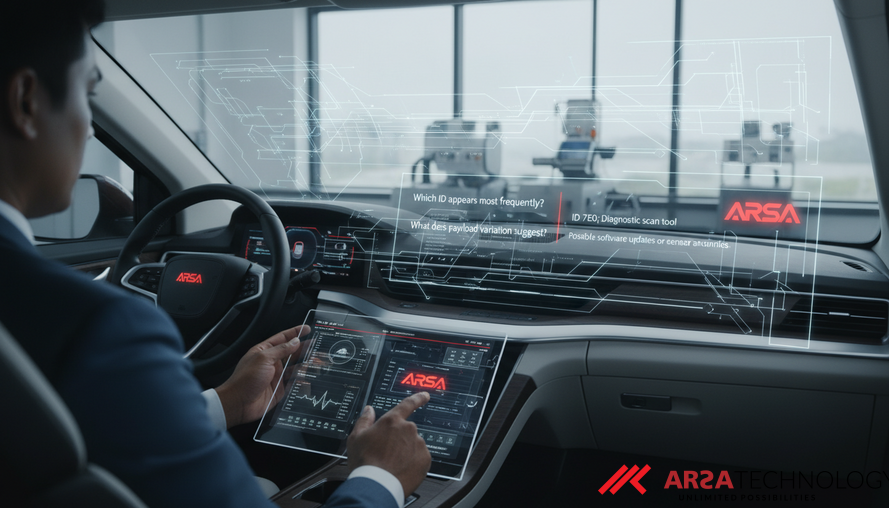
Modern vehicles are sophisticated marvels of engineering, increasingly resembling rolling data centers. At the heart of their intricate operations lies the Controller Area Network (CAN) bus, a communication protocol that acts as the vehicle's central nervous system. It enables critical components—from braking and steering to engine control and advanced driver assistance systems—to communicate seamlessly. However, this foundational technology, designed for simplicity and efficiency, predates modern cybersecurity concerns, leaving it inherently vulnerable to digital intrusions.
Historically, safeguarding CAN networks primarily involved intrusion detection systems (IDS) that flagged "anomalies" or classified traffic as "normal" or "attack." While these methods provided a first line of defense, they often fell short in providing detailed insights into how or why an intrusion occurred. This limited interpretability and forensic utility, making it difficult for analysts to understand complex attack strategies or pinpoint specific vulnerabilities. A recent academic paper introduces a groundbreaking approach called CAN-QA, which fundamentally redefines in-vehicle network analysis by transforming it into a question-answering (QA) task, aligning with real-world investigative needs (Source: CAN-QA: A Question-Answering Benchmark for Reasoning over In-Vehicle CAN Traffic).
The Evolving Landscape of In-Vehicle Cybersecurity
The Controller Area Network (CAN) bus has been a cornerstone of in-vehicle communication since its inception, valued for its robustness and cost-effectiveness. However, its original design lacked crucial security features such as message authentication or integrity protection. Operating as a broadcast medium, the CAN bus allows any connected electronic control unit (ECU)—even a compromised one—to transmit messages, making it a prime target for cyberattacks. This inherent vulnerability underscores the urgent need for more sophisticated intrusion detection and analysis techniques in automotive cybersecurity.
Traditional intrusion detection methods often rely on statistical anomaly detection or supervised classification. These systems learn what "normal" CAN traffic looks like and alert on deviations. While capable of identifying unusual patterns, they typically produce only binary outputs, such as "anomaly detected," without offering deeper context or explanation. This leaves automotive security analysts with a significant gap: they know something is wrong, but not what specific behavior indicates the anomaly, which component is affected, or how to mitigate it.
Beyond Binary: Rethinking In-Vehicle Intrusion Detection with CAN-QA
The limitations of traditional, binary anomaly detection methods highlight a critical misalignment with the practical demands of automotive forensics. In a real-world scenario, a security analyst doesn't just need to know if an attack is happening; they need to understand its characteristics. This involves localizing anomalous behavior, examining timing and payload irregularities, and correlating observed patterns with known attack signatures. This investigative process is inherently question-driven, requiring systematic reasoning rather than just a simple "yes/no" answer.
This is where CAN-QA offers a paradigm shift. Instead of merely classifying traffic, CAN-QA reformulates CAN traffic analysis as a question-answering (QA) task. It translates raw CAN logs into natural-language questions about specific traffic properties, paired with automatically derived ground-truth answers. This approach provides explicit reasoning targets that are both interpretable and directly aligned with the needs of a security analyst. By moving beyond opaque alerts, CAN-QA enables a multi-dimensional understanding of vehicle network behavior, fostering a more proactive and effective cybersecurity posture.
How CAN-QA Works: A New Framework for Intelligent Analysis
The CAN-QA framework operates by processing raw CAN logs, segmenting them into fixed-length temporal windows. Within these windows, it applies deterministic, rule-based templates to generate natural-language questions and their corresponding answers. This automated process ensures consistency, reproducibility, and eliminates the need for labor-intensive manual annotation. The generated questions cover a diverse range of analytical dimensions, targeting distinct semantic and temporal properties of CAN traffic. For example, questions might probe which CAN ID appears most frequently, what timing irregularities are present, or what payload variations suggest about behavioral changes.
The framework is designed to be dataset-agnostic, meaning it can be adapted to various vehicles, attack scenarios, or data sources by simply recomputing baseline statistics from new CAN traces. This flexibility makes CAN-QA a robust benchmark for evaluating the reasoning capabilities of large language models (LLMs) in the context of critical cyber-physical systems. The current instantiation of CAN-QA comprises over 33,000 question-answering pairs across ten categories, providing a comprehensive platform for standardized, reasoning-based evaluation. This systematic approach allows for a deeper understanding of network behavior, moving beyond surface-level statistics to reveal profound operational insights.
The Promise and Challenges of AI in Automotive Forensics
The advent of Large Language Models (LLMs) has opened new possibilities for structured reasoning and natural-language interpretation across various domains. In automotive cybersecurity, LLMs hold the promise of transforming complex telemetry data into actionable insights, enabling them to support analyst-driven workflows effectively. However, the evaluation of LLMs on the CAN-QA benchmark has revealed both their strengths and significant limitations. While these models effectively capture superficial statistical regularities in CAN traffic, they consistently struggle with more advanced tasks.
Specifically, LLMs demonstrate difficulties in temporal reasoning (understanding sequences of events over time), multi-condition inference (drawing conclusions from several simultaneous factors), and higher-level behavioral interpretation (connecting raw data to meaningful operational or attack patterns). These findings underscore that while LLMs are powerful, their application in safety-critical cyber-physical systems like automotive networks requires further research. Future efforts must focus on integrating structured time-series reasoning with language-based analysis to overcome these challenges and unlock the full potential of AI in automotive forensics. For enterprises looking to deploy advanced AI solutions that bridge the gap between data and actionable intelligence, platforms like ARSA's AI Box Series or AI Video Analytics already provide similar interpretive capabilities for other domains.
Practical Implications for Automotive Cybersecurity
The reformulation of CAN traffic analysis into a question-answering task, as demonstrated by CAN-QA, carries significant practical implications for automotive cybersecurity. For vehicle manufacturers and fleet operators, this shift means moving towards more proactive and precise security measures. Instead of merely reacting to binary alerts, they can leverage intelligent systems to obtain detailed explanations of security incidents, understand root causes, and implement targeted countermeasures more efficiently. This enhanced interpretability directly contributes to reduced downtime, faster incident response, and improved overall safety and compliance.
The ability to ask specific questions about vehicle network behavior—such as "Which specific component is under attack?" or "What timing anomalies indicate a flooding attack?"—transforms raw data into rich, actionable intelligence. This level of detail empowers security teams to conduct thorough forensic investigations, develop more robust intrusion prevention systems, and validate the security of new vehicle architectures. For companies like ARSA, which specializes in practical AI deployments and edge AI systems, the principles of deep, interpretive AI analysis are already applied across various industries, including smart cities, manufacturing, and critical infrastructure. Our focus on privacy-by-design and on-premise solutions ensures that sensitive data, whether it's from CCTV feeds or industrial IoT sensors, remains secure and under the client's control. Implementing AI solutions that offer detailed reasoning can significantly mitigate risks and create new revenue streams through enhanced operational insights and greater security assurance.
To explore how advanced AI and IoT solutions can transform your operational security and deliver measurable impact, we invite you to contact ARSA for a free consultation.
Source: CAN-QA: A Question-Answering Benchmark for Reasoning over In-Vehicle CAN Traffic