Efficient Robotic Planning: Harnessing Contextual Graph AI for Task-Driven 3D Perception
Explore how Graph Neural Networks optimize 3D scene graphs for robotic task planning, enabling efficient execution of complex tasks in real-world environments. Learn about task-driven perception for embodied AI.

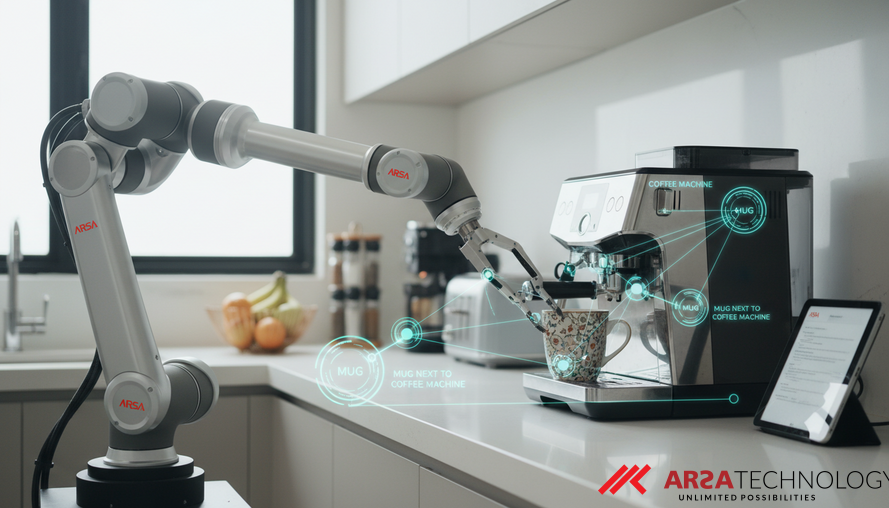
In the rapidly evolving landscape of artificial intelligence, a growing demand exists for robot systems capable of executing complex, multi-step tasks efficiently and reliably within dynamic environments, such as homes or industrial settings. While advanced robots can now perceive their surroundings with impressive detail, translating this rich sensory data into actionable plans for intricate tasks remains a significant challenge. Traditional approaches often struggle with the sheer volume of information, leading to computationally expensive planning processes that hinder real-world deployment. A recent academic paper by Christopher Agia, "Contextual Graph Representations for Task-Driven 3D Perception and Planning," addresses this core issue by proposing an innovative approach to streamline robotic task planning using intelligent graph representations.
The Complexity of Robotic Task Execution
Robots tasked with compositional actions, like "put the book on the table and then close the window," face two primary hurdles: understanding the goal and efficiently charting a path to achieve it. Pure policy solutions, which dictate actions based solely on the current state, offer efficiency but often fail to generalize to "long-horizon" tasks—those requiring a series of sequential sub-goals. To overcome this, robots need to break down complex tasks into smaller, more achievable subgoals through a process known as task planning. This planning hinges on a suitable "state representation"—an internal model of the environment that can be altered through high-level actions to reach a desired outcome.
Recent advancements in computer vision have made it possible to automatically extract sophisticated object-centric relational representations from visual and inertial data. These are often structured as 3D Scene Graphs (SGs), which provide a hierarchical and dense, multiplex graph description of real-world environments. Think of a 3D Scene Graph as a highly detailed blueprint of a room, mapping out every object and its relationships to others ("mug is on table," "table is next to chair"). While theoretically beneficial for planning, these comprehensive SGs can become overwhelming. They contain a vast number of objects and relations, most of which are irrelevant to a specific task, thus magnifying the "state space" that planners must navigate. This computational burden prohibits their deployment in resource-constrained settings, such as mobile robots or edge devices.
Streamlining Perception with Contextual Scene Graphs
The core problem identified is that while 3D Scene Graphs provide a rich understanding of an environment, they are often too dense for efficient task planning. To address this, the research explores how to make these representations more "contextual" – meaning, only the relevant parts of the scene graph are brought to the forefront for a given task. This involves leveraging Graph Neural Networks (GNNs), a powerful class of neural networks specifically designed to operate on data structured as graphs, to learn representations that inherently understand which objects and relationships matter for a particular goal.
GNNs are adept at processing interconnected data by passing "messages" between nodes (objects) along edges (relationships), allowing them to learn features based on the graph's structure. By harnessing the "invariances" in the relational structure of planning domains, GNNs can dynamically filter out extraneous information from a dense 3D Scene Graph. For instance, if a robot's task is to prepare coffee, the GNN would prioritize objects like the coffee machine, mug, and coffee beans, while deprioritizing irrelevant items like a remote control or a decorative vase. This focus on "sufficient object sets" significantly reduces the computational load on the planner, making the planning process much faster and more efficient. ARSA Technology, for example, develops robust AI Video Analytics systems that can interpret complex visual data, forming a foundational layer for such advanced perception capabilities.
Benchmarking and Innovation in Planning Architectures
The thesis includes two main lines of inquiry:
- Benchmark Construction: The first involves testing the suitability of existing embodied AI environments for research at the intersection of task planning and 3D scene graphs. It then constructs a dedicated benchmark, named SGPlan, for empirically comparing the performance of state-of-the-art classical planners. This benchmark is crucial for standardized evaluation and advancement in the field.
- Graph Neural Networks for Planning: The second and more innovative aspect explores the use of GNNs. The research investigates how GNNs can learn representations that accelerate planning by focusing on critical elements. Techniques like Graph Attention Networks (GATs) are employed to assess the importance of different objects and relations, essentially teaching the system to "pay attention" to what matters most. Additionally, "Regression Planners" are utilized to identify sufficient object sets, further refining the contextual representation. The integration of "Spatial Edge Attributes" also allows the system to incorporate geometric information, providing a richer understanding of how objects relate physically in 3D space. Such capabilities are vital for real-world deployments where context and efficiency are paramount, as seen in ARSA's AI Box Series, which offers pre-configured edge AI systems for rapid, on-site deployment in resource-constrained settings.
Practical Applications and Business Impact
The implications of this research extend far beyond household robotics. By enabling robots to plan more efficiently within complex, real-world environments, this approach can unlock significant value across various industries.
- Manufacturing and Logistics: Robots could more efficiently navigate dynamic factory floors, pick and place items in variable inventory systems, or manage complex assembly lines. Reduced planning time directly translates to increased operational throughput and lower labor costs.
- Healthcare: Autonomous assistants could perform complex tasks in clinics or hospitals, such as organizing medical supplies or delivering equipment, freeing up human staff for critical care. The precision and speed offered by contextual planning are crucial in such sensitive environments.
- Smart Cities and Infrastructure: AI-powered systems could better manage traffic flows, monitor public spaces for anomalies, or assist in maintenance tasks, requiring complex interactions with urban infrastructure.
- Security and Defense: Advanced robotic systems for surveillance or dangerous operations would benefit immensely from faster, more robust planning capabilities, particularly in environments with sensitive data or limited connectivity.
The ability to deploy AI solutions that are both intelligent and efficient at the edge, without heavy cloud dependency, is critical for many enterprise and government applications. This research aligns with the principle that AI must work reliably in the real world, providing measurable impact. Companies like ARSA Technology have been experienced since 2018 in delivering production-ready AI solutions engineered for accuracy, scalability, privacy, and operational reliability in diverse sectors.
Conclusion
The work presented in "Contextual Graph Representations for Task-Driven 3D Perception and Planning" offers a promising direction for the future of embodied AI. By intelligently pruning and prioritizing information within 3D Scene Graphs using Graph Neural Networks, robotic systems can achieve faster, more robust planning for complex tasks. This shift from an exhaustive understanding of an environment to a task-specific, contextual perception paves the way for truly intelligent and deployable robots that can deliver tangible benefits in real-world scenarios, optimizing operations, reducing costs, and enhancing safety across various industries.
Ready to explore how advanced AI and IoT solutions can transform your operations with practical, deployable intelligence? Learn more about ARSA's enterprise-grade AI platforms and request a free consultation.
Source: Agia, Christopher. "Contextual Graph Representations for Task-driven 3D Perception and Planning." B.A.Sc. Thesis, University of Toronto, April 2021. https://arxiv.org/abs/2603.26685