EgoMAGIC: Revolutionizing AI Training for Medical Augmented Reality Assistants
Explore EgoMAGIC, a groundbreaking egocentric video dataset for AI in field medicine. Discover how it trains perception algorithms for AR medical assistants, addressing critical challenges in high-stress environments.

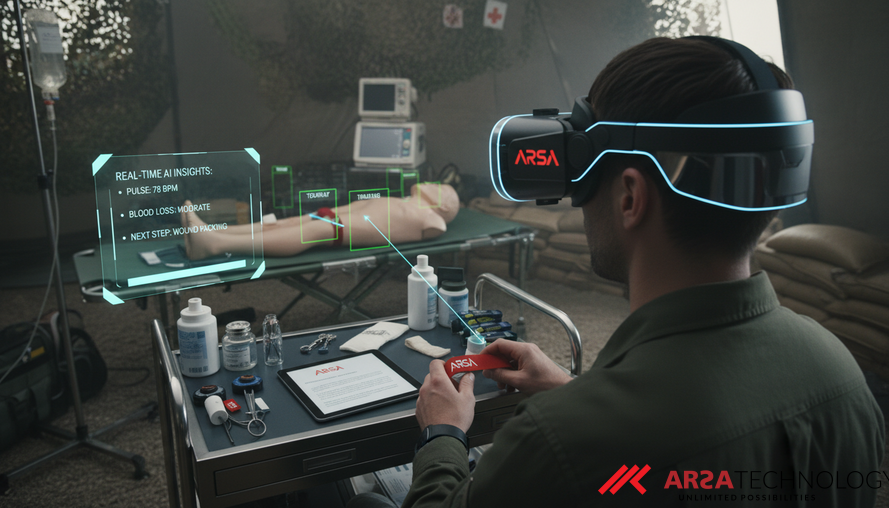
In the rapidly evolving landscape of artificial intelligence, specialized datasets are the bedrock for developing algorithms that can tackle real-world complexities. While general-purpose datasets have fueled significant advancements in machine learning, critical domains like healthcare, especially in high-stress, dynamic environments, demand more targeted and nuanced data. This demand is met by the introduction of EgoMAGIC (Medical Assistance, Guidance, Instruction, and Correction), a groundbreaking egocentric video dataset designed to propel the development of AI-powered augmented reality (AR) medical assistants.
This innovative dataset, a product of collaboration between RTX BBN Technologies, New York University, and Northeastern University, was primarily developed under the Defense Advanced Research Projects Agency’s (DARPA) Perceptually-enabled Task Guidance (PTG) program. The core vision of this program is to integrate virtual assistants into AR headsets, providing real-time guidance to users performing intricate medical tasks. The EgoMAGIC dataset, as detailed in the academic paper “EgoMAGIC- An Egocentric Video Field Medicine Dataset for Training Perception Algorithms” by Brian VanVoorst et al. (Source: https://arxiv.org/abs/2604.22036), is a significant step towards making this vision a reality.
The Power of Egocentric Data in Medical Training
Egocentric videos, captured from a first-person perspective, offer an unparalleled view into human actions and interactions with objects. For medical training and assistance, this perspective is crucial. Imagine a field medic or a new surgeon receiving real-time, step-by-step instructions and error corrections directly through their AR headset. This is the future EgoMAGIC aims to enable. The dataset comprises an impressive 3355 videos, covering 50 distinct medical tasks, with at least 50 labeled videos per task. These videos were predominantly recorded using a head-mounted stereo camera with integrated audio, providing a rich, immersive data stream for AI models to learn from.
The objective of the PTG program goes beyond mere information display; it seeks AR assistants capable of recognizing specific medical procedures, automatically tracking completed steps, and offering immediate guidance on subsequent steps or crucial corrections when errors occur. This level of intelligent assistance requires highly specialized AI models trained on data that accurately reflects the user's view and operational context.
Addressing the Unique Demands of Field Medicine
Combat medicine, chosen by DARPA for its unique challenges, presents an intensely fast-paced, chaotic, and unstructured environment. Such scenarios introduce several complexities that typical egocentric datasets struggle to capture:
- Brief and Overlapping Actions: Many medical steps are extremely short, sometimes lasting less than a second, and can frequently be performed concurrently, leading to overlapping activities.
- Procedural Variability: Medical tasks often involve optional steps, allowing for significant variability in the sequence and completion of actions.
- Dynamic Movement and Clutter: Rapid "egomotion" (the movement of the camera wearer) is common, adding complexity to visual data, compounded by realistic clutter of objects and environments.
These challenges necessitate robust AI solutions capable of handling motion blur, occlusions, and the need for rapid, fine-grained recognition of critical medical steps. The EgoMAGIC dataset provides the nuanced data required to train such resilient computer vision methods, pushing the boundaries of AI in emergency care where accuracy and timeliness have profound real-world implications.
A Rich Dataset for Advanced Perception Algorithms
EgoMAGIC is not just a collection of videos; it’s a meticulously annotated resource designed to facilitate a wide range of computer vision research. Beyond its primary focus on action detection—identifying the precise start and stop times of medical procedure steps—the dataset is equally valuable for:
- Action Recognition: Identifying the specific action being performed within a given video clip.
- Action Anticipation: Predicting future actions based on current observations, a critical capability for proactive AR guidance.
- Object Identification and Detection: Recognizing and locating the 124 distinct medical objects and supplies within the video frames.
To jumpstart development, the dataset includes over 1.95 million labeled objects, and 40 pre-trained YOLOv8 models, providing a robust foundation for developers. It further features more than 17,000 task step annotations across 286 step classes and over 39,000 hand-object interactions, offering granular detail essential for training sophisticated perception algorithms. Companies like ARSA Technology leverage such advanced data in developing their AI Video Analytics capabilities for various industries, turning raw visual information into actionable intelligence.
Real-World Impact and Future Applications
The significance of datasets like EgoMAGIC extends far beyond academic research; it directly impacts the ability to deploy practical, life-saving AI solutions. By providing a comprehensive benchmark for action detection—with initial models achieving an average mAP of 0.526—EgoMAGIC fosters a competitive environment for innovation. The meticulous labeling and focus on real-world medical scenarios make it an invaluable tool for creating AI systems that can genuinely assist medical professionals.
The development of such intelligent AR assistants could drastically reduce human error, improve training outcomes, standardize complex procedures, and ultimately save lives in critical situations. For organizations requiring robust, on-premise AI processing for sensitive operations, solutions such as the ARSA AI Box Series offer pre-configured edge AI systems that can integrate seamlessly with existing infrastructure, ensuring low latency and data privacy—factors crucial in medical and defense applications.
As AI continues to mature, specialized datasets are becoming increasingly vital for developing highly accurate and reliable models that can operate in complex, real-world conditions. EgoMAGIC represents a critical step forward in preparing AI for its pivotal role in augmenting human capabilities in medicine.
If your organization is exploring the integration of advanced AI and IoT solutions to transform operations, enhance safety, or create intelligent assistance systems, the expertise developed since 2018 at ARSA Technology can provide the necessary foundation. We specialize in tailoring AI solutions for mission-critical applications across various industries, from computer vision to edge AI deployments.
To discuss how AI and IoT can unlock new potential for your enterprise, contact ARSA for a free consultation.