Enhancing Safety with AI: Beyond Single-Agent Benchmarks to Human-AI Collaboration
Discover how evaluating AI agents in human-AI systems, focusing on uncorrelated error modes, fundamentally redefines safety in critical operations, from labs to industrial environments.

Rethinking AI Safety: The Imperative of Human-AI Team Reliability
The rapid advancement of artificial intelligence, particularly agentic AI systems capable of autonomous decision-making, necessitates a re-evaluation of how we assess their safety. Traditional AI benchmarks often focus on isolated task-level accuracy, treating an AI system as a standalone entity. However, this "single-channel" paradigm overlooks fundamental principles of safety-critical engineering, where true risk mitigation is built on redundancy, diverse error modes, and the joint reliability of an entire system. When AI agents are deployed in real-world, human-in-the-loop environments, their operational safety is profoundly influenced by their interaction with human operators. This article, drawing insights from recent research by Radpour (2026), argues for a shift in focus: from an AI's absolute accuracy to the emergent safety property of the human-AI dyad, prioritizing systems with uncorrelated error modes as the primary determinant of risk reduction.
The Flaws of Isolated AI Benchmarking
Contemporary benchmarks for evaluating agentic AI frequently assess safety through narrow, isolated accuracy thresholds. While these metrics provide a standardized way to compare different AI models, they often simplify the complex reality of real-world deployments. This approach implicitly assumes that the AI system functions as an authoritative, single-point decision-maker, where any failure by the AI directly equates to a system-level failure. This perspective is at odds with decades of research in safety engineering and human factors, which emphasize that perfect agents are unattainable. Instead, risk is managed through layered, redundant systems designed to tolerate individual component failures.
Consider a recent laboratory safety benchmark, LabSafety Bench, introduced to evaluate large language models (LLMs) and vision language models (VLMs) in scientific lab environments. The benchmark concluded that current AI models were "unsafe" for deployment due to failure to surpass a 70% hazard identification accuracy. While the benchmark itself is a valuable contribution, the conclusion drawn from it reflects a fundamental misunderstanding of comprehensive risk mitigation frameworks. By evaluating AI in isolation, it neglects the crucial role AI can play as a redundant audit layer against well-documented human failures like vigilance decrement and inattentional blindness.
Human Variability: The Overlooked Safety Factor
In high-stakes environments, human performance is inherently variable. Factors such as fatigue, stress, and circadian rhythm disruption can unpredictably degrade a human's ability to maintain vigilance. This "vigilance decrement" means a person who is highly effective at identifying hazards in the morning might be significantly less so by evening. Furthermore, phenomena like "inattentional blindness," where individuals fail to perceive objects or events because their attention is focused elsewhere, and "normalization of deviance," where deviations from safe practices become routine, contribute to human error.
These human variabilities are often the primary drivers of incidents and accidents. By introducing a consistent, albeit imperfect, AI agent, organizations can establish a critical safety margin against these stochastic human lapses. An AI system does not suffer from biological fatigue, nor does it experience tunnel vision or inattentional blindness in the same way a human might. Its error modes are fundamentally different, making it an ideal candidate for a redundant safety layer.
Safety as an Emergent Property of Joint Human-AI Reliability
Safety engineering traditionally views tools not in isolation, but by their ability to reinforce existing defensive layers. The "Swiss cheese model" of accident causation, for instance, posits that failures occur when multiple imperfect defensive layers (like slices of Swiss cheese, each with holes) align to allow a hazard to pass through. An AI system, when integrated into this model, acts as an additional slice, reducing the probability of such alignments. The key is not to find a single perfect monitor, but to create overlapping, diverse layers of defense.
In a human-only workflow, hazards go undetected when human cognitive lapses coincide with critical task demands. In contrast, a human-AI workflow achieves system-level failure only when both the human and the AI miss the same hazard. If human and AI error modes are weakly correlated, even AI agents with modest standalone accuracy can substantially reduce the overall probability of failure. This distinction between an individual agent's marginal performance and the joint reliability of the human-AI system is critical but often missing from current AI benchmarking.
Practical Applications and Real-World Impact
The shift towards measuring joint reliability is already demonstrating significant gains in other safety-critical fields. In clinical medicine, for example, the integration of AI decision support into human workflows has been shown to reduce diagnostic error rates by a substantial margin, confirming that a parallel human-plus-AI system achieves higher net reliability than a human in isolation. Similarly, in emergency medicine, AI-driven tools have reduced misdiagnoses in high-pressure settings by providing redundant checks that capture the often stochastic lapses in human attention. These examples highlight how AI can create a robust safety net, even when individual agents are imperfect.
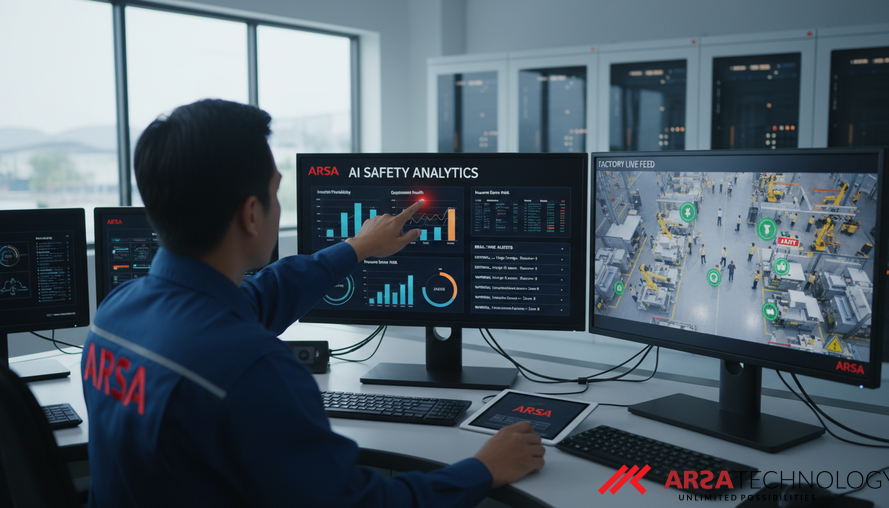
For enterprises, this means deploying AI solutions not as replacements for human operators, but as intelligent co-pilots and audit layers. In manufacturing, for instance, AI Video Analytics can monitor safety compliance, detect anomalies on production lines, or identify proper personal protective equipment (PPE) usage in real-time. This augments human supervisors, providing an unblinking, consistent check against human oversight. ARSA Technology, with its AI Box Series, offers edge computing solutions that can process video streams locally, ensuring low latency and privacy while acting as this crucial, independent layer of defense in industrial environments.
Building Resilient Systems with Uncorrelated Error Modes
The ultimate goal of AI safety evaluation should be to ensure that deployed systems enhance overall operational resilience. This requires a focus on designing AI that complements human capabilities, specifically by introducing error modes that are distinctly different from typical human errors. For example, while a human might miss a hazard due to momentary distraction, an AI might misclassify an object due to an unusual angle or lighting condition—errors that are less likely to occur simultaneously.
Achieving this level of synergistic safety demands a comprehensive approach to AI development and deployment. It involves:
- Understanding human factors: Recognizing and accounting for the inherent variability and cognitive biases in human performance.
- Designing for redundancy: Implementing AI systems as independent layers that can catch errors missed by humans.
- Prioritizing diverse error modes: Selecting or training AI models whose failure points are fundamentally different from those of human operators.
- Considering deployment realities: Opting for solutions like edge AI that offer privacy-by-design and minimal latency, crucial for real-time safety interventions.
By embracing this perspective, organizations can move beyond the limited scope of single-channel AI accuracy and build truly safer, more reliable operational systems for the future.
Ready to enhance your operational safety and efficiency with advanced AI and IoT solutions? Explore ARSA Technology's proven capabilities and see how our systems can provide critical redundancy and intelligence to your workflows. We have been experienced since 2018 in delivering transformative solutions across various demanding industries.
**Source:** Radpour, N. D. (2026). Beyond single-channel agentic benchmarking. arXiv preprint arXiv:2602.18456.