Enhancing Urban Mobility: AI and IoT Solutions for Visually Impaired Seniors in Public Transport
Explore how AI and IoT are transforming public transport accessibility for visually impaired elderly residents, addressing challenges in urban navigation and fostering independent mobility.

Introduction: Navigating Urban Landscapes for Independent Living
Independent mobility is a cornerstone of maintaining social participation and overall well-being, particularly for vulnerable populations. As global demographics shift towards an aging population, the number of elderly individuals experiencing sight loss continues to rise, significantly impacting their ability to confidently and independently navigate bustling urban environments. Public transport systems, while vital lifelines in connecting communities, often present a labyrinth of challenges, especially in historic cities with complex layouts. These barriers hinder independent travel for visually impaired seniors, leading to increased reliance on others and a potential decline in their quality of life.
The integration of advanced technologies like Artificial Intelligence (AI) and the Internet of Things (IoT) is increasingly being explored as a powerful tool to address these persistent accessibility gaps. By transforming traditional infrastructure into intelligent, responsive systems, these innovations hold the promise of revolutionizing how visually impaired elderly residents interact with public transport, fostering greater independence and inclusivity. This article delves into the challenges highlighted by a recent study, examining how real-time data and AI developments can enhance navigation aids and pave the way for smarter, more accessible urban mobility (Source: Pan, J., & Moews, B. (2025). Public transport challenges and technology-assisted accessibility for visually impaired elderly residents in urban environments. arXiv preprint arXiv:2601.15291).
The Critical Role of Independent Mobility and Public Transport
Accessibility within urban environments is not merely a convenience; it is a fundamental human right crucial for social equity and inclusion, especially for those with mobility limitations. The ability to navigate one's surroundings and access essential services without hindrance directly impacts individual autonomy and mental health. For the elderly, maintaining independence influences critical life decisions, from where they choose to live to how actively they engage with their community. Public transport serves as an indispensable link, offering a sustainable and cost-effective means of staying connected.
However, the very nature of urban landscapes—dense foot traffic, continuous vehicle movement, and sensory overstimulation—can present formidable obstacles. When combined with vision impairment, these factors create a scenario where even familiar journeys can become sources of fear and insecurity. The global senior population is rapidly expanding, projected to double by 2050, with over half residing in cities. This demographic trend underscores the urgent need for inclusive mobility solutions that leverage technological advancements to support independent living for all.
Unpacking Accessibility Barriers in Urban Transport
The academic study, which included spatial analysis of transport data and qualitative interviews with visually impaired elderly individuals, shed light on several critical barriers to independent navigation in urban public transport. Using Edinburgh, Scotland, as a case study, the research revealed a highly centralized transport system that often complicates travel to and from peripheral areas. Beyond structural issues, a significant challenge emerged from the lack of travel information presented in formats usable by the visually impaired.
Participants frequently relied on memory-based navigation, a strategy that, while effective to a degree, increases cognitive strain and becomes less reliable with age-related memory decline. This reliance is exacerbated by inconsistent services and outdated pedestrian infrastructure. These findings underscore that truly accessible public transport requires more than just physical infrastructure; it demands dynamic tools that cater to diverse sensory and cognitive needs, providing timely and digestible information to empower users.
AI and Technology as Enablers for Enhanced Accessibility
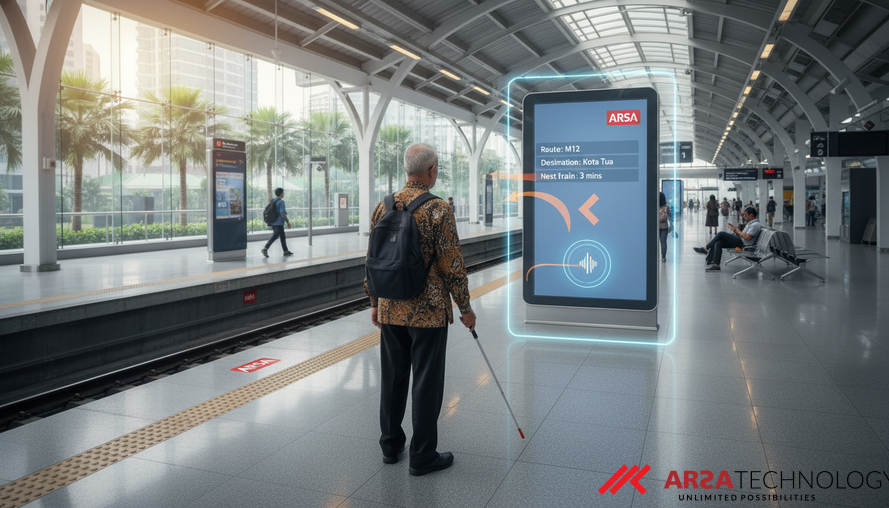
Despite the challenges, the research also highlighted a significant willingness among visually impaired elderly participants to adopt new navigation technologies, with many already using various assistive devices. This openness signals a fertile ground for AI-powered solutions. AI can transform raw data from public transport networks into actionable, personalized, and accessible information, delivered in real-time. For instance, AI-driven systems could provide proactive audio alerts about upcoming stops, transfer points, or sudden route changes, adapting to a user’s specific preferences and location.
Imagine a system that not only offers real-time bus locations but also predicts crowd density at stops, identifies optimal seating areas, or even guides users through complex interchanges using tactile feedback or augmented reality audio cues. By processing vast amounts of live data, AI can offer unprecedented levels of personalization and responsiveness. Technology providers like ARSA Technology leverage AI Video Analytics to develop solutions for real-time monitoring and behavioral analysis in various environments, which can be adapted to detect obstacles or guide movement within public spaces, making them safer and more navigable for all. Such intelligent systems can effectively reduce the cognitive load on users, making independent travel less daunting and more efficient.
Designing Inclusive Smart City Solutions: A Practical Approach
For urban planners and transport authorities, the insights from this research offer a clear directive: focus on dynamic, data-driven solutions that address the specific sensory and cognitive needs of vulnerable populations. Implementing AI and IoT in public transport isn't just about efficiency; it's about equitable access. This involves moving beyond static information displays to interactive, multi-modal communication channels. Spatial analysis, as used in the study, is crucial for identifying areas of disparity in transport coverage and service patterns, guiding targeted infrastructure and technology investments.
Companies like ARSA Technology, with expertise in AI and IoT solutions, can partner with cities to deploy sophisticated systems. For example, our Smart Parking System and AI BOX - Traffic Monitor already use advanced computer vision for vehicle tracking and traffic flow analysis, which could be extended to monitor pedestrian pathways, detect obstructions, and provide real-time alerts for visually impaired individuals. This integrated approach can transform an entire urban environment, making it more intuitive and less stressful for all residents. Implementing such solutions requires a strategic framework that includes in-depth analysis of user needs, custom AI model development, seamless integration with existing systems, and continuous optimization based on real-world feedback.
The Path Forward: Collaborative Innovation for Accessible Futures
The journey towards truly inclusive urban accessibility is ongoing, but the potential of AI and IoT to bridge existing gaps is undeniable. As urban populations continue to age, investing in intelligent, adaptive transport solutions becomes not just an option, but a necessity. The shift from passive surveillance to active business intelligence through AI-powered systems can generate measurable ROI by enhancing user satisfaction, optimizing operational efficiency, and reducing incidents.
Successful implementation will rely on collaboration between urban planners, technology developers, community organizations, and the target user groups themselves. By combining deep technical expertise with a profound understanding of human needs, we can design environments where independent navigation is a reality for everyone. ARSA Technology has been experienced since 2018 in developing and deploying such innovative AI and IoT solutions across various industries, committed to creating smarter, safer, and more accessible futures for global enterprises and communities alike.
Embark on a journey to enhance urban accessibility and integrate cutting-edge AI and IoT solutions into your public transport infrastructure. To learn more about how ARSA Technology can help your organization implement dynamic, user-centric solutions, request a free consultation today.