Generative AI Coding: Transforming Software Development for Enterprises
Explore how generative AI is revolutionizing software development, accelerating project completion, and empowering businesses to innovate faster. Learn its impact, benefits, and challenges.

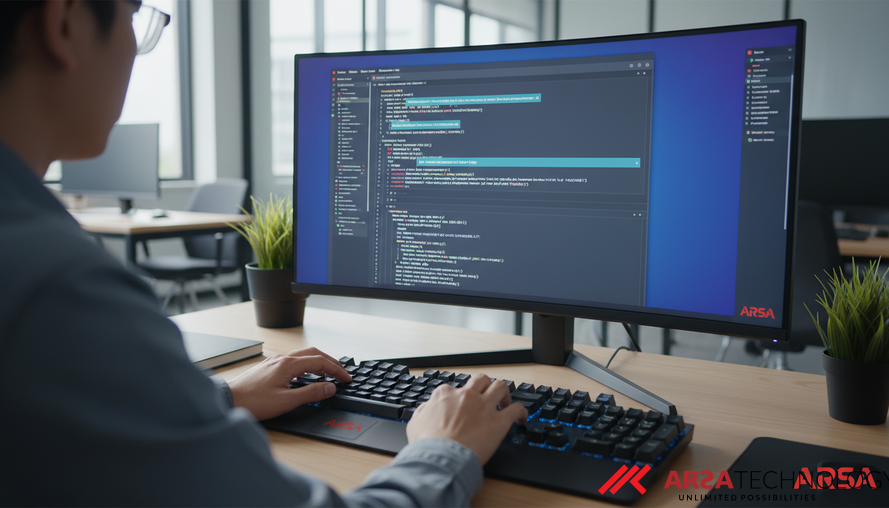
The Rise of Generative AI in Software Development
The landscape of software development is undergoing a profound transformation, driven by the emergence of generative AI. This groundbreaking technology, capable of writing software code, has rapidly established itself as one of AI's most practical and impactful applications for businesses. Both seasoned software engineers and coding novices are now leveraging AI coding assistants to streamline the entire development lifecycle, from generating initial code to testing, editing, and debugging. This significantly reduces the time and effort traditionally spent on repetitive and tedious programming tasks, thereby accelerating project completion and fostering innovation.
Major technology companies are at the forefront of this adoption. Giants like Microsoft and Google report that AI already generates a substantial portion of their internal code—as much as 30% for Microsoft and over a quarter for Google, according to their respective leadership. Mark Zuckerberg, CEO of Meta, envisions a future where AI agents will write the majority of Meta’s code. This widespread adoption by industry leaders underscores the strategic importance and tangible benefits of integrating generative AI into development workflows.
Empowering Developers and Non-Coders Alike
A new generation of powerful AI tools, including names like Microsoft Copilot, Cursor, Lovable, and Replit, is democratizing software creation. These platforms enable individuals with minimal or even no prior coding experience to develop impressive applications, games, websites, and other digital projects. By simply inputting a series of prompts detailing their desired outcome, users can bring complex ideas to life, effectively lowering the barrier to entry for digital innovation. This accessibility opens up new avenues for small businesses and departments to quickly prototype and deploy custom solutions without needing extensive in-house development teams.
Beyond basic generation, some developers are embracing a more collaborative approach, often termed "vibe coding," where they allow the AI software to take a leading role in code generation, accepting some or all of its suggestions. This method can significantly boost productivity, allowing engineers to focus on higher-level architectural design and problem-solving, rather than getting bogged down in syntax and routine coding. It's a testament to the evolving partnership between human creativity and artificial intelligence.
Enhancing Efficiency and Accelerating Innovation
For enterprises, the business implications of generative AI coding are substantial. The primary benefit lies in vastly improved operational efficiency and accelerated development cycles. By automating code generation, testing, and debugging, businesses can reduce the time-to-market for new products and features, gain a competitive edge, and respond more agilely to market demands. This translates into tangible ROI through reduced labor costs, faster deployment of revenue-generating applications, and improved resource allocation. For instance, developing specialized components for an ARSA AI API integration or custom features for an AI Box Series deployment can become considerably quicker and more cost-effective.
Consider the development of complex enterprise systems like AI Video Analytics. While the core algorithms require deep human expertise, generative AI can handle boilerplate code, data integration scripts, and even suggest optimized routines, allowing developers to focus on fine-tuning the AI models and ensuring robust performance. This shift empowers development teams to take on more ambitious projects and deliver advanced solutions with greater speed and precision, ultimately driving digital transformation across various industries.
Navigating the Challenges: Accuracy, Security, and Human Oversight
While the advantages of generative AI coding are clear, it's crucial to acknowledge its current limitations. AI models, particularly large language models, are prone to "hallucinations"—generating plausible-looking but ultimately nonsensical or incorrect code. There is no inherent guarantee that AI-generated suggestions will be entirely helpful, efficient, or, critically, secure. Researchers, such as those at MIT CSAIL, have highlighted how even syntactically correct AI-generated code might fail to perform its intended function, potentially introducing subtle bugs or security vulnerabilities that are difficult to detect.
Furthermore, current AI tools often struggle when dealing with large, intricate codebases. Integrating AI-generated modules into existing, complex enterprise systems requires careful validation and extensive human review. However, specialized companies like Cosine and Poolside are actively working to overcome these challenges, developing solutions specifically designed to enhance AI's capability in navigating and contributing to extensive software projects. For businesses adopting these tools, robust testing protocols and a strong emphasis on human code review remain indispensable for maintaining code quality, security, and functional integrity.
Strategic Impact on the Workforce and Future Outlook
The advent of generative AI coding also brings strategic implications for the software development workforce. While these tools significantly enhance the productivity of existing engineers, they are also beginning to impact the job market, particularly for entry-level positions. With AI handling more routine coding tasks, the demand for junior developers who primarily write boilerplate code might decrease. This emphasizes a shift in required skills, where future developers will need to be proficient not just in coding, but also in prompt engineering, AI output evaluation, debugging AI-generated code, and understanding complex system architectures.
As ARSA Technology has been experienced since 2018 in pioneering AI and IoT solutions, we understand the critical balance between leveraging advanced technology and ensuring human expertise drives impactful results. The future of software development will be a collaborative one, where AI acts as an intelligent assistant, augmenting human capabilities rather than replacing them entirely. Enterprises must invest in upskilling their engineering teams to work effectively with AI tools, fostering a symbiotic relationship that maximizes both efficiency and innovation.
Ultimately, generative AI coding is not just a technological trend; it's a fundamental shift in how software is created. It promises a future where businesses can build and deploy intelligent solutions with unprecedented speed and scale, unlocking new possibilities for digital transformation across every sector.
Ready to harness the power of AI to transform your operations and accelerate your digital journey? Explore ARSA Technology's range of AI and IoT solutions and contact ARSA today for a free consultation.