ImprovEvolve: Revolutionizing AI Optimization with Modular Discovery
Explore ImprovEvolve, an innovative technique enhancing AI-guided discovery for complex optimization problems. Learn how it boosts efficiency in analog circuit design and beyond.

AI and machine learning continue to push the boundaries of what’s possible, especially in areas requiring intricate problem-solving and optimization. From discovering new mathematical constructs to designing complex systems, large language models (LLMs) are becoming powerful allies. However, even these advanced AIs face challenges when confronted with "rugged landscapes" – optimization problems where the ideal solution isn't easily found through conventional means. A recent academic paper introduces "ImprovEvolve," a novel technique designed to enhance LLM-guided evolutionary computation, demonstrating significant breakthroughs in fields like analog circuit design and other complex optimization tasks. (Source: ImprovEvolve academic paper)
The Evolution of AI-Driven Discovery
The concept of leveraging evolutionary search for machine learning is not new, but recent advancements, particularly with frameworks like AlphaEvolve, have revolutionized how AI approaches complex optimization. AlphaEvolve combines the sophisticated reasoning capabilities of Large Language Models with the robust search mechanisms of evolutionary algorithms. Typically, this involves an LLM generating program code which, when executed, attempts to produce an optimal solution. This process iteratively refines programs by selecting promising candidates and mutating them with LLM guidance.
While powerful, this conventional approach places a heavy "cognitive burden" on the LLM. It demands that the AI not only understand the problem but also design an entire end-to-end optimization algorithm from scratch. This includes crafting initialization schemes, defining search strategies, and even setting termination criteria. For problems with highly intricate or "rugged" solution landscapes—where small changes can lead to drastically different outcomes—this monolithic task can be exceedingly difficult for an LLM, leading to suboptimal or heuristic-driven solutions.
ImprovEvolve: A Modular Paradigm for AI Optimization
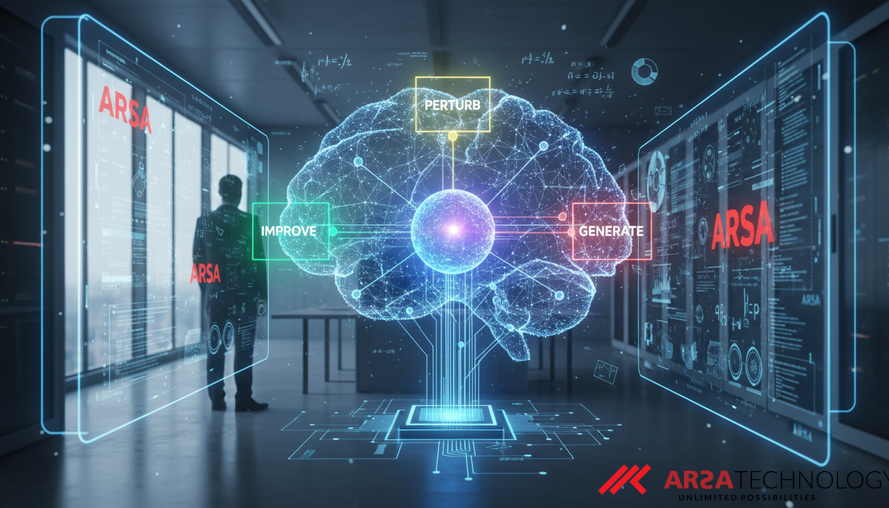
ImprovEvolve proposes a paradigm shift, reformulating the optimization problem definition to alleviate this cognitive load. Instead of asking the LLM to generate a single program that directly yields an optimal solution, ImprovEvolve trains the LLM to evolve a class that implements three distinct, modular functionalities:
- `improve(x)`: Takes an existing solution `x` and returns an improved version `x'` with better fitness (a higher score or closer to the optimum). This function focuses on local optimization.
- `perturb(x, sigma)`: Introduces controlled randomness or "perturbation" to a solution `x` with a specified intensity `sigma`. This method enables exploration of the solution space, allowing the AI to escape local optima.
- `generate_config(seed)`: Provides a valid initial solution based on a given random seed. This streamlines the starting point for the optimization process.
By decomposing the optimization task into these three specialized concerns – initialization, local improvement, and exploration – ImprovEvolve significantly reduces the complexity for the LLM. This modular structure then allows for a powerful global optimization framework, reminiscent of "basin-hopping" techniques, where initial configurations are sampled, locally improved, and then iteratively perturbed and re-improved with a scheduled intensity.
Beyond Traditional Optimization: The Advantages of Modularity
This modular decomposition offers several compelling advantages over previous LLM-guided evolutionary methods. Firstly, it inherently reduces the cognitive burden on the LLM, enabling it to focus on designing more effective and specialized sub-routines for each task rather than a single, sprawling optimization pipeline. This leads to more robust and higher-performing algorithms.
Secondly, the modular structure greatly enhances interpretability and debugging. For both human experts and even LLMs themselves, understanding and refining distinct `improve`, `perturb`, and `generate_config` methods is far simpler than dissecting a complex, end-to-end optimization program. This also provides a natural interface for incorporating human domain knowledge at each stage, allowing experts to guide or refine specific aspects of the optimization. For instance, in complex industrial settings that ARSA Technology works in, this approach could inform highly specific solutions, enhancing capabilities like AI Video Analytics or predictive maintenance.
Lastly, and most crucially, the evolved class becomes highly adaptable. It can be applied not just to newly generated initial solutions but also to any existing solution—even those meticulously crafted by domain experts and representing sophisticated mathematical constructions beyond the LLM’s immediate capacity. This means ImprovEvolve can take an already good solution and make it even better, pushing the boundaries of what was previously considered optimal.
Achieving New Benchmarks in Challenging Problems
The effectiveness of ImprovEvolve was rigorously tested on notoriously challenging problems previously tackled by AlphaEvolve. These problems involve "rugged landscapes" – environments where simple gradient descent algorithms or standard routines often fail due to the presence of numerous local optima.
For the problem of hexagon packing within a hexagon, ImprovEvolve delivered new state-of-the-art results for arrangements of 11, 12, 15, and 16 hexagons. Furthermore, a lightly human-edited variant of the evolved program improved upon these results for 14, 17, and 23 hexagons. This is a significant achievement, as packing problems are fundamental in various applications, from logistics optimization to material science.
Similarly, for the second autocorrelation inequality problem, a human-edited ImprovEvolve program achieved a new state-of-the-art lower bound of 0.96258, surpassing AlphaEvolve’s previous best of 0.96102. Such improvements, even seemingly small, can represent substantial breakthroughs in fields like signal processing or coding theory where these inequalities are crucial.
These results underscore ImprovEvolve’s ability to unlock new levels of optimization and discovery, particularly when combined with human insights. This collaborative potential of AI and human expertise positions ImprovEvolve as a powerful tool for tackling some of the most complex challenges in computational design and optimization. For businesses leveraging edge AI devices, like the ARSA AI Box Series, applying principles of modular optimization can lead to highly efficient and specialized solutions.
The Future of AI-Assisted Design and Engineering
The implications of ImprovEvolve extend far beyond academic benchmarks. In fields requiring the design of highly optimized systems, such as analog circuit design, this methodology could lead to significant advancements. Analog circuits are notoriously complex to design, often relying on expert intuition and iterative refinement. An AI capable of intelligently exploring design spaces, identifying local improvements, and generating diverse perturbations could drastically accelerate innovation and reduce development costs.
Consider the application in industrial IoT and automation, where ARSA Technology has been experienced since 2018. Optimizing sensor placements, configuring network topologies, or fine-tuning control algorithms in real-time all represent rugged optimization landscapes. Techniques like ImprovEvolve could enable AI systems to autonomously discover more efficient and resilient configurations, leading to enhanced operational efficiency, reduced downtime, and lower energy consumption across various industries.
By making AI more efficient at designing and refining optimization strategies, ImprovEvolve paves the way for a new era of AI-assisted engineering. This approach doesn't just promise incremental improvements; it offers a pathway to discover fundamentally new and superior solutions to problems that have long stymied human and conventional AI efforts.
ARSA Technology leverages cutting-edge AI and IoT solutions to help global enterprises navigate complex challenges. Explore our innovative solutions and discover how intelligent systems can drive efficiency, enhance security, and create new opportunities for your business. For a deeper discussion on implementing advanced AI for your specific needs, please contact ARSA today.