Mastering Dynamic Terrain: Legged Robots in Non-Inertial Environments
Explore the challenges and innovations in equipping legged robots to operate reliably on moving platforms like ships, trains, and aircraft, leveraging advanced AI and control systems.

Navigating the Unsteady World: Legged Robotics Beyond Stationary Grounds
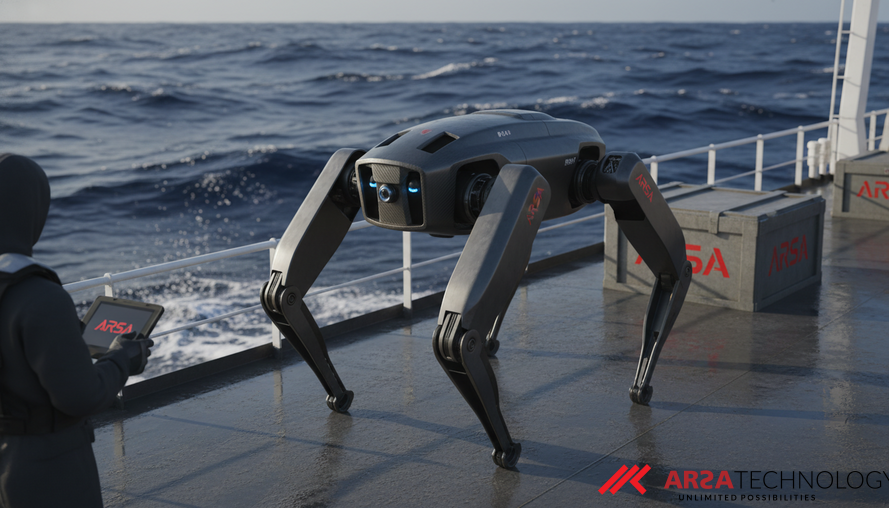
Legged robots have made impressive strides, showcasing remarkable agility and resilience on stable, rigid ground. Yet, their performance often falters dramatically when faced with dynamic environments where the supporting surface itself is in motion. Imagine a robot trying to walk on the deck of a rolling ship, a speeding train, or an aircraft experiencing turbulence – these are "non-inertial environments" where the ground moves, tilts, or accelerates relative to a fixed point on Earth. These conditions introduce continuous, unpredictable disturbances that fundamentally challenge the assumptions built into conventional robot locomotion systems.
This critical area of robotics, exploring how legged machines can maintain stability and perform tasks in such dynamic settings, is rapidly gaining importance. The capabilities of these robots, from their modeling to how they sense their environment and control their movements, are undergoing significant evolution to address these complex, real-world challenges. This article, inspired by recent research published in "A Survey of Legged Robotics in Non-Inertial Environments: Past, Present, and Future" (Source: arXiv:2604.20990), delves into the core issues and future directions for reliable legged locomotion in these challenging scenarios.
The Unsteady Ground: Why Non-Inertial Environments Challenge Legged Robots
The conventional design of legged robots assumes a stationary, unmoving ground. This simplifies how a robot calculates its balance, plans its steps, and interprets sensor data. However, in non-inertial environments, these assumptions break down. When a ship pitches and rolls, or a train accelerates, the robot experiences continuous forces and movements that are not due to its own actions. These "fictitious forces" and base-acceleration couplings are persistent and constantly perturb the robot's equilibrium, making robust locomotion profoundly more difficult.
Consider the difference between a robot being given an impulsive push on stable ground versus one continuously trying to balance on a surface that is constantly shifting. The latter requires far more sophisticated and adaptive systems. Early deployments, even with advanced commercial robots like Boston Dynamics' Spot, have shown significant body-position drift when performing simple tasks like stepping in place on a mildly wave-disturbed ship. This highlights a clear performance gap, emphasizing the need for new approaches in modeling, state estimation, and control to achieve true reliability.
From Passive Platforms to Active Intelligence: Real-World Applications
The need for robots that can operate in dynamic, non-inertial environments is not just an academic pursuit; it has significant practical implications across numerous industries. These environments are ubiquitous in modern transportation and industrial settings.
In ground transportation, billions of trips are taken annually on buses, subways, and trains. Legged robots capable of operating reliably within these moving vehicles could provide invaluable support for passenger safety monitoring, enhanced surveillance, and autonomous cleaning operations in confined spaces. Similarly, the maritime industry, responsible for over 80% of global trade and millions of cruise passengers, presents a strong demand for robotic inspection, maintenance, and emergency response on ships and offshore platforms that are constantly subject to sea states. For instance, advanced AI Video Analytics could be deployed on these platforms to monitor safety compliance or detect anomalies in real-time, regardless of the vessel's motion.
Even in aerospace, where billions of passengers fly annually, legged robots could offer in-flight services, assist with cargo stabilization, and provide crucial post-incident support during or after turbulence-related events. Equipping these robots with reliable edge AI systems, such as ARSA's AI Box Series, could enable them to process sensory data locally and react instantly to environmental changes, making them invaluable assets across these various industries.
The Algorithmic Core: Modeling, State Estimation, and Control
Achieving robust locomotion in non-inertial settings hinges on advancements in three fundamental algorithmic areas: modeling, state estimation, and control.
- Modeling: This involves how a robot mathematically represents itself and its interaction with the environment. For non-inertial systems, models must account for the platform's independent motion. This includes using "full-order models," which are highly detailed but computationally intensive, or "reduced-order models," which simplify complexity for real-time applications. Physics-based simulators also play a crucial role, allowing virtual testing and refinement of these models before deployment.
- State Estimation: This is the robot's ability to accurately perceive its own position and orientation (its "pose") and the motion of its supporting platform. "Absolute pose" refers to its position relative to a fixed Earth frame, while "relative pose" tracks its position relative to the moving platform. Crucially, "platform state estimation" involves sensing and predicting the movement of the ground itself, which is vital for proactive rather than reactive adjustments.
- Control: This encompasses the strategies a robot uses to move and maintain balance. "Classical feedback control" involves reactive adjustments based on sensor data. "Optimization-based control" employs complex algorithms to calculate the best possible movements given current conditions. More recently, "reinforcement learning" (RL) has emerged as a powerful tool, allowing robots to learn optimal locomotion strategies through trial and error in simulated and real environments, adapting to complex, unpredictable platform movements over time.
Pioneering Solutions for Dynamic Stability
Current research in legged robotics in non-inertial environments is focused on developing solutions that can overcome the inherent limitations of stationary-ground assumptions. This includes:
- Enhanced Sensor Fusion: Combining data from various sensors (e.g., IMUs, LiDAR, cameras, proprioceptive sensors) to create a more comprehensive and robust understanding of both the robot's state and the platform's motion. This is crucial for distinguishing between the robot's own movements and those imposed by the environment.
- Adaptive Control Strategies: Moving beyond static control algorithms to systems that can dynamically adjust their parameters in response to changing platform dynamics. This includes methods that learn from experience (e.g., reinforcement learning) or adapt based on real-time feedback.
- Robust Contact Planning: Planning foot placements and forces that can reliably maintain contact and stability even when the ground is accelerating, tilting, or moving. This might involve optimizing for larger contact areas or using adhesion where appropriate.
- Energy-Efficient Designs: Developing mechanical designs and control algorithms that are energy-efficient, allowing robots to operate for longer durations in dynamic environments where power sources might be limited or challenging to access.
While significant progress has been made, limitations persist. Many existing methods still rely on assumptions about the predictability or limited range of platform motion, or require extensive calibration. The challenge of achieving both agility and long-term robustness in highly dynamic and unpredictable non-inertial environments remains an open problem.
Shaping the Future: Emerging Trends in Legged Robotics
The field of legged robotics in non-inertial environments is poised for significant innovation. Future directions will likely focus on:
- Increased Autonomy: Developing robots that can operate for extended periods without human intervention, making complex decisions about navigation, task execution, and self-preservation in unpredictable environments.
- System-Level Design Integration: A holistic approach that considers hardware, software, and AI algorithms as an integrated system, optimizing for overall performance rather than isolated components. This includes creating lightweight yet robust mechanical structures and developing advanced embedded systems for edge computing.
- Bio-Inspired Strategies: Drawing inspiration from biological systems, such as animals adapted to highly dynamic terrains, to develop new locomotion and control mechanisms. This could lead to more inherently robust and energy-efficient designs.
- Enhanced Safety and Human-Robot Interaction: As robots become more prevalent in human-centric non-inertial environments (like public transport or aircraft cabins), ensuring their safety around people and developing intuitive interaction methods will be paramount.
- Rigorous Testing and Validation: Moving beyond controlled lab settings to extensive experimental validation in real-world, high-fidelity dynamic environments to prove reliability and performance. This will involve developing standardized testing protocols and metrics.
ARSA Technology, with its extensive experience since 2018 in developing and deploying AI & IoT solutions for mission-critical operations, understands the importance of these principles. Our commitment to practical, production-ready AI, whether for edge AI systems or AI API integration, aligns with the demand for reliable technology in challenging real-world scenarios. We continually bridge advanced AI research with operational realities, ensuring our systems perform accurately and reliably under industrial constraints.
To achieve truly versatile and dependable legged robots, a deep understanding of these non-inertial complexities is essential. By addressing these foundational challenges, the robotics community can pave the way for a future where intelligent machines reliably assist and operate across all dynamic environments, enhancing safety, efficiency, and operational capabilities worldwide.
Ready to explore how advanced AI and IoT can transform your operations in complex, dynamic environments? Learn more about ARSA’s solutions and contact ARSA for a free consultation.