Navigating the Unseen: How MilliWatt Ultrasound and AI Transform Drone Autonomy in Challenging Environments
Explore Saranga, a groundbreaking ultrasound and AI system enabling palm-sized drones to navigate dense fog, darkness, and snow with ultra-low power consumption. Discover its impact on industrial inspections, search & rescue, and smart city applications.

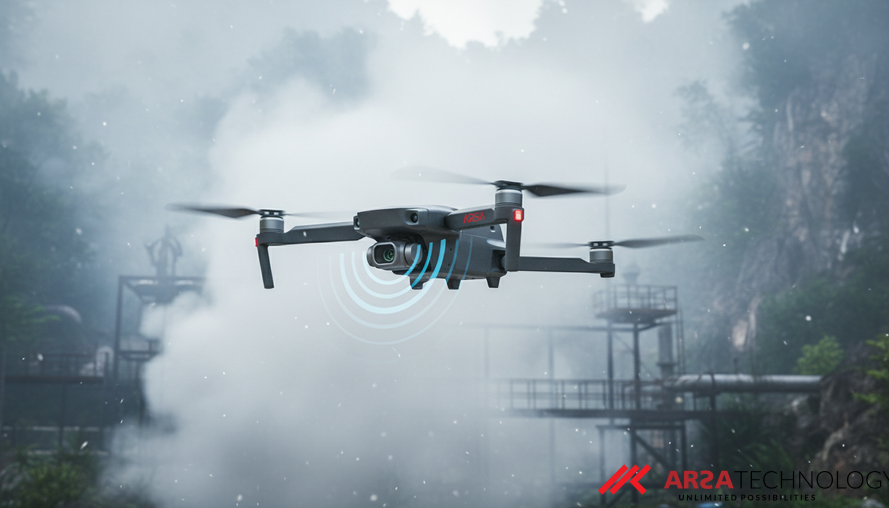
Tiny aerial robots, often referred to as drones, offer remarkable agility and cost-effectiveness for operating in complex and confined spaces. However, their compact size imposes strict limitations on the sensors they can carry, severely hindering critical navigation tasks in environments where GPS is unavailable or unreliable. Traditional obstacle avoidance methods relying on cameras and LIght Detection And Ranging (LIDAR) become ineffective when visibility drops due to conditions like fog, dust, darkness, or heavy snow. Other powerful sensors, such as RAdio Detection And Ranging (RADAR), are often too power-hungry for these small, battery-sensitive platforms.
Inspired by the exceptional navigational abilities of bats, researchers have developed Saranga, an innovative low-power ultrasound-based perception system. This system is designed to enable palm-sized aerial robots to localize obstacles and navigate effectively even in highly visually degraded environments. Saranga tackles the significant challenge of a critically low Peak Signal-to-Noise Ratio (PSNR) of -4.9 decibels, meaning the background noise is considerably stronger than the faint echoes. This breakthrough is achieved through two primary solutions: clever physical noise reduction and an advanced deep learning-based denoising method (Source: MilliWatt Ultrasound for Navigation in Visually Degraded Environments on Palm-Sized Aerial Robots).
The Critical Need for Robust Navigation
The ability for autonomous aerial robots to operate reliably in harsh environmental conditions is crucial for a myriad of mission-critical applications. Imagine search and rescue operations in smoke-filled buildings, industrial inspections inside dusty power plants, or rapid deployment in disaster zones during adverse weather. Current commercial drones, typically larger and more expensive, consume significant power (upwards of 20W for sensing) and are often unsafe in densely cluttered environments due to their size. These limitations highlight a pressing need for smaller, more efficient, and robust navigation systems.
The Saranga system, designed for a tiny quadrotor measuring only 0.16 meters and consuming a mere 1.2 mW of sensing power, addresses these challenges directly. By choosing ultrasound sensors, which operate effectively across a range of visually degraded scenarios, the system leverages a principle of "parsimony" – achieving complex tasks with minimal resources, much like bats. This parsimonious approach allows for extended operational times and safer interaction in sensitive environments.
Saranga's Bat-Inspired Approach to Echolocation
At its core, Saranga mimics the natural echolocation of bats, sending out short ultrasound chirps and then "listening" for the echoes that bounce back from surrounding objects. Unlike traditional visual or laser-based sensors that rely on light, ultrasound waves can penetrate fog, dust, and darkness, providing a reliable sense of the environment regardless of visibility. The system employs a dual sonar array, allowing the robot to not only detect obstacles but also determine their direction by analyzing the slight time difference in when an echo arrives at each sensor—a technique known as Interaural Time Disparity (ITD), similar to how bats localize their prey.
However, using ultrasound on a small drone presents a unique problem: the propellers themselves generate substantial noise that can easily overwhelm the faint echoes from distant objects. This propeller-induced noise, combined with the inherently weak returning signals in complex environments, results in the aforementioned extremely low PSNR, rendering raw ultrasound data nearly unusable for precise navigation. Saranga's innovations directly target this fundamental challenge, transforming passive noise-ridden data into active, actionable intelligence.
Combating Noise: A Two-Fold Innovation
Saranga's efficacy stems from its dual strategy to overcome noise. The first involves a practical physical noise reduction method. This innovation focuses on strategically blocking the propeller-induced ultrasound noise from interfering with the reception of weak echoes. By carefully designing the sensor placement and potentially incorporating acoustic shielding, the system physically reduces the immediate impact of the drone's own operation on its sensory input. This ensures that even the faintest returning sound waves have a better chance of being captured by the sonar array, setting the stage for advanced processing.
The second, and perhaps most transformative, solution is a deep learning-based denoising method. Traditional filtering techniques often struggle with high levels of uncorrelated noise, where the signal patterns are too subtle to distinguish. Saranga addresses this by training a neural network to analyze a "long horizon" of ultrasound echoes. This means the AI doesn't just look at individual sound pulses but processes sequences of echoes over time, identifying subtle patterns and correlations that signify actual objects amidst the noise. The neural network was trained using a combination of synthetic data, which simulates various noise and echo scenarios, and limited real-world noise data, enabling robust generalization to diverse operational environments. This powerful AI processing allows the robot to make sense of even the most challenging acoustic landscapes. ARSA, for instance, leverages advanced AI models for applications like AI Video Analytics, demonstrating expertise in developing sophisticated algorithms to extract meaningful insights from complex sensory data, a capability essential for such advanced denoising.
Real-World Impact and Future Applications
The results from the Saranga project are highly encouraging, demonstrating successful navigation by a palm-sized aerial robot in extremely challenging conditions. These include dense fog, complete darkness, and falling snow, within cluttered environments featuring thin and even transparent obstacles. This was achieved using only the drone's on-board sensing and computation, without reliance on external infrastructure. The system's ultra-low power consumption of 1.2 mW further highlights its potential for long-duration missions and deployment in remote areas where power sources are scarce.
The practical applications of such robust, low-power navigation technology are extensive. Industries could see improved safety and efficiency in areas like:
- Industrial Inspections: Drones could inspect confined spaces, pipelines, or machinery in dusty, smoky, or poorly lit factory floors without risking human personnel.
- Search and Rescue: Rapid deployment in disaster zones, navigating through rubble and smoke to locate survivors.
- Smart Cities & Infrastructure: Monitoring traffic or infrastructure health during adverse weather conditions or at night.
- Security and Surveillance: Enhanced capabilities for perimeter monitoring or facility inspections in low-light environments.
ARSA's commitment to delivering practical, production-ready AI and IoT solutions aligns perfectly with the implications of the Saranga system. Solutions like the ARSA AI Box Series, which offers pre-configured edge AI systems for rapid on-site deployment, could potentially integrate such low-power, robust navigation capabilities to extend their utility across various industries facing similar environmental challenges. The ability to deploy AI that "penetrates" visually challenging conditions, as Saranga's name implies, opens new frontiers for autonomous systems.
To discover how ARSA Technology can transform your operational challenges into intelligent, real-world solutions through cutting-edge AI and IoT, we invite you to explore our offerings and contact ARSA for a free consultation.