Personalized AI at the Edge: Revolutionizing Brain-Computer Interfaces with Neuromorphic Computing
Explore how personalized Spiking Neural Networks on ferroelectric hardware are enabling adaptive, low-power AI for EEG brain-computer interfaces, overcoming traditional challenges at the extreme edge for diverse industries.

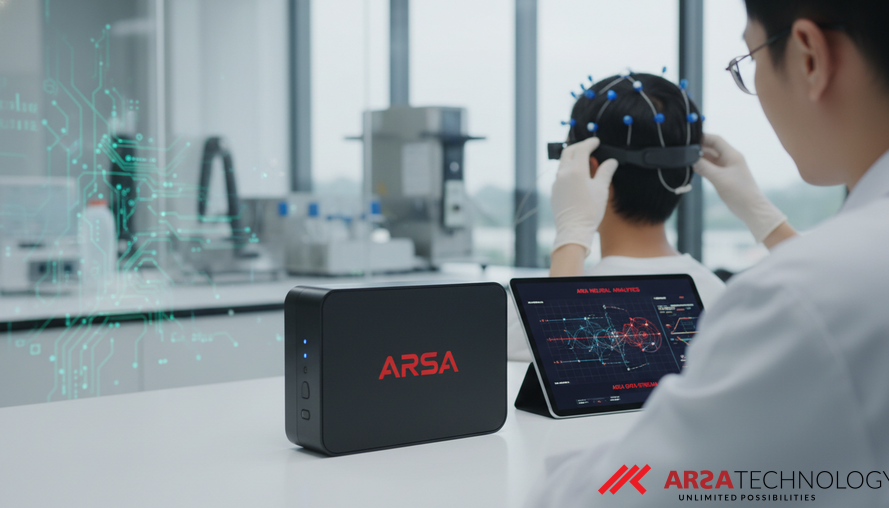
The advent of Brain-Computer Interfaces (BCIs) has opened transformative possibilities, particularly for assistive communication in individuals with severe motor impairments. These innovative systems, which translate brain activity into commands, hold immense promise. However, their practical deployment demands solutions that are not only highly accurate but also incredibly efficient, especially when operating at the "extreme edge"—on resource-constrained platforms like wearable or implantable devices. This is where advanced AI, like personalized Spiking Neural Networks (SNNs) on novel hardware, comes into play, offering a path to overcome the inherent challenges of non-stationary neural signals and stringent power budgets.
The Frontier of Personalized AI at the Extreme Edge
Processing biosignals such as Electroencephalography (EEG) for BCIs presents unique complexities. Neural signals are inherently "non-stationary," meaning they vary significantly across different recording sessions, and perhaps even more dramatically from one individual to another. This variability makes it challenging to develop "subject-agnostic" AI models that can generalize effectively across a broad user base. Traditional AI, often relying on continuous sampling, digitization, and dense processing, is poorly suited for the stringent latency and ultra-low power consumption required at the extreme edge. Such heavy computational loads lead to increased energy consumption in sensing, data transmission, and downstream computation, critically limiting battery life and potentially causing tissue heating in implantable contexts.
This scenario highlights a critical need for AI that can adapt and personalize its learning process directly on the device. Imagine a wearable health monitor that not only passively collects data but actively learns and adjusts its parameters based on the individual's unique physiological patterns over time. This adaptive capability, paired with extreme energy efficiency, is essential for unlocking the full potential of next-generation biosignal processing devices, enabling continuous, reliable, and user-specific insights without compromise.
Spiking Neural Networks: Mimicking the Brain's Efficiency
Inspired by the human brain's remarkable efficiency, Spiking Neural Networks (SNNs) represent a significant departure from conventional AI models. Unlike traditional artificial neural networks that process information in continuous numerical values, SNNs communicate through sparse, asynchronous "spikes" or events. This event-based processing paradigm offers a more efficient representation for time-series biosignals, such as EEG. Information in SNNs is encoded in the timing and temporal structure of these spikes, allowing for a natural capture of dynamic patterns crucial in biological signals.
The biological inspiration behind SNNs extends to their architecture, which intrinsically co-localizes memory and computation. This design principle helps reduce data movement, a notorious energy overhead in conventional CMOS processors. By mimicking the brain's event-driven and in-memory computing approach, SNNs provide intrinsic memory through neuronal and synaptic states, leading to superior energy efficiency and lower latency. This makes them an ideal candidate for real-time BCI applications where every millisecond and milliwatt counts. For businesses seeking to optimize real-time data processing and decision-making at the edge, solutions utilizing this advanced paradigm, such as ARSA's AI Video Analytics, offer a glimpse into the future of efficient AI deployment.
Ferroelectric Synapses: Hardware for Adaptive Learning
To fully realize the promise of SNNs, specialized hardware is crucial. Neuromorphic engineering aims to translate brain-inspired computing principles into event-driven hardware, while in-memory computing seeks to reduce data-transfer costs by blurring the boundary between storage and processing. Here, advanced memory technologies, particularly memristive devices, emerge as promising building blocks. These devices can emulate synaptic functionality by encoding network weights as programmable conductance states, effectively serving as "synapses" that connect successive layers of an SNN.
Among memristive devices, ferroelectric memristive synapses stand out. Composed of an ultra-thin ferroelectric film sandwiched between two asymmetric electrodes, these devices offer compelling advantages: nonvolatile retention (they remember their state without power), sub-femtojoule read energy (extremely low power to retrieve data), demonstrated multi-level programmability (can store multiple weight values), high endurance (withstanding over 10^12 cycles), and compatibility for co-integration with standard CMOS fabrication processes. These characteristics make them highly attractive for enabling adaptive processing of constantly changing physiological signals. However, practical deployment is challenging due to limited effective weight resolution, device-to-device variability, nonlinear and state-dependent programming dynamics, and finite device endurance. Addressing these non-idealities is paramount for achieving robust and accurate AI at the edge.
Strategies for Robust AI Deployment on Novel Hardware
To overcome the inherent challenges of deploying SNNs on real-world ferroelectric memristive devices, two complementary strategies have been rigorously evaluated. The first is device-aware training, where the neural network is trained using a sophisticated model that accounts for the specific physical characteristics and constraints of the ferroelectric devices. This approach ensures that the SNN learns to operate optimally within the hardware's inherent limitations from the outset, leading to more robust performance upon deployment.
The second strategy involves transfer learning and low-overhead on-device re-tuning. In this approach, the SNN is initially trained in software, and its learned weights are then transferred to the hardware. Following this, a lightweight, on-device re-tuning process is applied. To make this adaptation efficient and extend device lifetime, a novel "device-aware weight-update strategy" is introduced. This method accumulates gradient-based updates digitally and converts them into discrete programming events only when a predefined threshold is exceeded. This technique effectively emulates the nonlinear, state-dependent programming dynamics of ferroelectric devices while significantly reducing the frequency of programming, thereby enhancing device endurance and conserving energy. This kind of sophisticated hardware-software co-optimization is central to delivering practical, high-performance AI. Companies like ARSA Technology specialize in developing and implementing integrated solutions that are both technically advanced and practical for diverse industrial applications.
Unlocking Personalized Neuromorphic Processing
The innovative deployment strategies for SNNs on ferroelectric hardware have demonstrated impressive results, validating their potential for real-world applications. Crucially, both device-aware training and weight transfer with on-device re-tuning achieved classification performance on EEG-based motor imagery decoding comparable to leading software-based SNNs. This indicates that the efficiency gains and hardware-conscious design do not compromise the accuracy required for critical applications like BCIs.
Furthermore, the research highlighted the significant advantage of subject-specific transfer learning. By retraining only the final layers of the network, the classification accuracy for individual users saw notable improvements. This ability to rapidly adapt a pre-trained model to specific user data is paramount for personalization, especially in fields like healthcare where individual physiological differences are substantial. The proven robustness to limited weight resolution and programming variability, common challenges with memristive hardware, further underscores the practical viability of this technology.
This breakthrough paves the way for a new generation of personalized neuromorphic processing systems that can power advanced medical devices, enhance wearable technology, and even revolutionize smart healthcare monitoring. For instance, in health tech, ARSA offers the Self-Check Health Kiosk, an AI- and IoT-based solution enabling independent vital sign checks and supporting corporate wellness programs. Such innovations stand to reduce the burden on medical personnel, improve user experience, and provide crucial early detection capabilities.
The Business Advantage of Adaptive Edge AI
The findings from this advanced research offer clear and compelling advantages for businesses across various sectors. By enabling highly efficient, personalized, and adaptive AI at the extreme edge, companies can realize tangible benefits:
- Cost Reduction: Ultra-low power consumption translates to extended battery life for devices, reducing operational costs and maintenance.
- Enhanced Security: Real-time, on-device processing allows for quicker threat identification and response in security-critical applications, without relying on potentially vulnerable cloud infrastructure.
- New Revenue Streams: The capability to deploy highly specialized, personalized AI applications in compact, energy-efficient devices opens up markets for advanced wearables, smart implants, and custom biosignal processing solutions.
- Operational Efficiency: Faster, more accurate decision-making directly on the device, minimizing latency and the need for constant data transmission to the cloud.
- Privacy-by-Design: Processing sensitive data locally ensures maximum privacy and compliance, a critical concern in healthcare and other regulated industries. For enterprises prioritizing data security and local processing, solutions from the ARSA AI Box Series offer powerful edge computing capabilities that process everything locally, emphasizing privacy first by ensuring no data leaves the premises.
This research demonstrates that programmable ferroelectric hardware can support robust, low-overhead adaptation in spiking neural networks. It opens a practical and commercially viable path toward personalized neuromorphic processing of neural signals, marking a significant step towards a future where intelligent, adaptive AI is seamlessly integrated into our daily lives and critical infrastructure.
Ready to harness the power of personalized and adaptive AI for your enterprise? Explore ARSA Technology's innovative AI and IoT solutions, designed to deliver measurable impact and drive your digital transformation. We invite you to a free consultation to discuss how our expertise can address your unique business challenges.