Protecting Privacy in IoT Gesture Recognition: The ImmCOGNITO Approach to mmWave Radar Data
Discover how mmWave radar, while enabling camera-free IoT gesture control, can leak biometric data. Learn about ImmCOGNITO, an AI solution that obfuscates identity while preserving gesture recognition, enhancing privacy for smart devices.

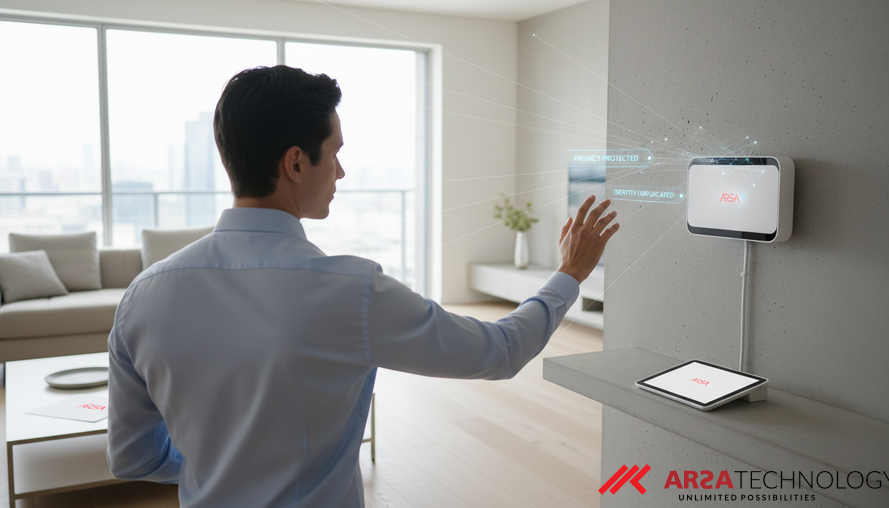
The Promise and Peril of mmWave Radar in IoT
The Internet of Things (IoT) is rapidly evolving, driving demand for intuitive, touchless interfaces. Radio Frequency (RF)-based gesture recognition has emerged as a compelling solution for these environments, offering advantages over traditional camera-based systems. Unlike optical methods, RF sensing infers motion from radio wave reflections, maintaining effectiveness in diverse lighting conditions and through common occlusions like clothing or furniture. This robustness and unobtrusive nature make RF-based solutions, particularly millimeter-Wave (mmWave) radar, ideal for sensitive IoT applications where visual approaches are impractical or raise significant privacy concerns.
mmWave radar systems, known for their high operating frequency and exceptional spatial resolution, can reliably detect both broad movements and intricate fine-grained gestures. This capability surpasses that of lower-frequency RF technologies like Wi-Fi or RFID, and its ability to penetrate non-metallic obstacles further enables non-line-of-sight gesture recognition. For instance, in healthcare IoT, mmWave radar supports touch-free patient monitoring and precise motor function tracking in sterile environments, addressing critical hygiene and privacy needs. Similarly, in connected vehicles, it facilitates intuitive gesture-based control and enhances passenger safety. However, this heightened sensitivity comes with an often-overlooked privacy risk. As detailed in the academic paper "ImmCOGNITO: Identity Obfuscation in Millimeter-Wave Radar-Based Gesture Recognition for IoT Environments", mmWave radar data can inadvertently encode unique biometric signatures, posing critical privacy challenges.
Unmasking the Invisible Threat: How Identity Leaks
While camera-free, mmWave radar’s high fidelity means it can capture subtle, individual-specific traits alongside intended gesture data. These biometric signatures can include unique vocal cord vibrations, individual breathing patterns, or distinct gait signatures, implicitly embedding personal information within the sensor readings. This unintended leakage creates a significant privacy vulnerability: even when a system is designed solely for gesture recognition, the underlying radar data can be repurposed to infer who performed each interaction.
To validate this threat, researchers investigated whether publicly available mmWave gesture datasets inherently leak identity information. By taking state-of-the-art gesture recognition models (such as those employed in commercial applications like the Tesla autopilot system or research models like Pantomime and PointNet++) and retraining them for identity classification instead of gesture classification, they achieved startling results. Experiments on two public datasets, PantoRad and MHomeGes, demonstrated that these models could achieve high identification accuracies, with one model, PointNet++, reaching over 80% accuracy on both datasets. This discovery highlights a crucial, previously overlooked problem: mmWave radar systems, despite their privacy-preserving promise, can expose identity, enabling persistent user tracking and the creation of longitudinal behavioral profiles by unauthorized parties. This risk threatens user trust and could hinder the widespread adoption of such technology in privacy-sensitive sectors. ARSA Technology addresses similar data privacy challenges in various contexts, for example, by offering features like privacy-compliant face blurring within its AI Video Analytics solutions.
ImmCOGNITO: An AI-Powered Shield for Your Digital Identity
To counter the growing risk of identity leakage in mmWave radar systems, the research introduces ImmCOGNITO, an innovative AI-powered solution designed to obfuscate identity while preserving the utility of gesture data. At its core, ImmCOGNITO is a graph-based autoencoder. In simpler terms, it's an intelligent system that learns to "re-engineer" or "re-design" the raw radar point cloud data. This transformation aims to retain all the necessary structural information for accurate gesture recognition, while actively suppressing any subtle cues that could reveal a user's identity.
The ImmCOGNITO system works in two main phases: encoding and decoding. The encoder component first constructs a directed graph for each sequence of radar data, mapping how different points relate to each other over time. This process utilizes advanced techniques like Temporal Graph KNN (K-Nearest Neighbors), which identifies and connects data points based on their spatial and temporal proximity. A message-passing neural network, combined with multi-head self-attention, then processes this graph, allowing the system to aggregate both local movement patterns and broader, global spatio-temporal context of the gesture. The decoder then takes this transformed, identity-suppressed representation and reconstructs a minimally perturbed point cloud. This reconstructed data is carefully designed to retain all the discriminative attributes essential for recognizing the gesture, while having successfully removed the identity-related information. The entire process is optimized through joint training objectives focusing on data reconstruction, gesture preservation, and active de-identification.
Behind the Scenes: How ImmCOGNITO Works
The effectiveness of ImmCOGNITO lies in its sophisticated architecture that meticulously processes mmWave point cloud data. Point cloud data, essentially a collection of 3D data points representing objects and their movement detected by the radar, is highly detailed.
The graph construction phase is crucial. Instead of treating each radar point in isolation, ImmCOGNITO builds a 'temporal graph'. Imagine connecting dots on a timeline for a single gesture: Temporal Graph KNN identifies and links these dots, particularly those that are close in space and time. This helps the system understand the flow and dynamics of the gesture rather than static biometric markers. These "edges" between data points capture the inter-frame temporal dynamics—how the gesture evolves.
Next, in the context aggregation phase, a message-passing neural network (MPNN) takes over. In an MPNN, each 'node' (a radar point in the graph) exchanges information, or "messages," with its connected neighbors. This allows the system to build a rich understanding of the gesture by combining local movement details with broader context. Multi-head self-attention further refines this, enabling the model to intelligently weigh different parts of the gesture for importance, ensuring that significant motion patterns are captured while irrelevant, identity-revealing details are downplayed. The ultimate goal is to create a robust, identity-agnostic representation of the gesture. ARSA’s AI Box Series leverages similar edge computing principles to process data locally, ensuring privacy without cloud dependency.
Finally, the feature transformation and reconstruction component uses global max-pooling to distill the most relevant information, which is then concatenated with the original features before the decoder reconstructs the final output. This reconstructed data is designed to be just "perturbed" enough to erase identity cues, yet sufficiently similar to the original to ensure high accuracy for subsequent gesture recognition tasks. This dual objective of privacy and utility is at the core of ImmCOGNITO’s design, offering a practical path forward for secure mmWave radar deployment.
Proven Results and Practical Impact
ImmCOGNITO's innovative approach has yielded promising results. Comprehensive evaluations conducted on the two public mmWave point cloud datasets, PantoRad and MHomeGes, unequivocally demonstrated its effectiveness. The solution substantially reduced identification accuracy, proving its capability to obfuscate user identity. Crucially, this de-identification was achieved without compromising the primary function of the system: maintaining high gesture recognition performance. This means that users can still interact effectively with IoT devices using gestures, but their biometric identity remains protected.
The significance of these findings extends beyond academic validation. For enterprises and organizations looking to deploy mmWave radar-based gesture recognition in real-world scenarios, ImmCOGNITO offers a critical layer of privacy by design. This capability can boost trust and accelerate the adoption of touchless interfaces in sensitive environments such as healthcare, smart homes, public spaces, and automotive interiors. By providing minimally perturbed data that preserves gesture-relevant attributes, the solution also ensures that the processed data remains useful for various other downstream tasks, such as activity monitoring or environmental analysis, without exposing personal identity. This balance between utility and privacy is essential for responsible AI deployment and compliance with evolving data protection regulations. ARSA Technology provides tailored AI & IoT solutions across various industries, prioritizing efficiency, safety, and operational visibility through advanced technologies like these.
Paving the Way for Trustworthy IoT Interactions
The development of solutions like ImmCOGNITO is a vital step in realizing the full potential of mmWave radar-based gesture recognition within IoT ecosystems. By proactively addressing the inherent privacy risks associated with biometric data leakage, we can foster greater trust and accelerate the deployment of these robust, camera-free interfaces. As industries increasingly adopt AI and IoT for automation and enhanced user experiences, embedding privacy-by-design from the ground up becomes non-negotiable. ImmCOGNITO represents a significant leap towards secure and privacy-respecting human-IoT interaction, ensuring that technological advancement goes hand-in-hand with individual data protection.
Ready to explore how advanced AI and IoT solutions can enhance your operations while ensuring data privacy? Learn more about ARSA Technology's innovative offerings and contact ARSA for a free consultation.