Real-time Object Detection with Deep Learning: Transforming Industries with AI Vision
Explore how deep learning algorithms like YOLO and SSD are powering real-time object detection, revolutionizing applications from security and traffic management to industrial automation and healthcare. Discover key architectures and practical applications.

The Power of Real-time Object Detection
Object detection, a cornerstone of modern computer vision, involves not only identifying what an object is but also precisely locating its position within an image or video stream. This capability has profound and compelling applications across a vast range of domains. From enhancing security and video surveillance systems to optimizing navigation and road traffic monitoring, real-time object detection provides dynamic analysis of visual information, enabling immediate and informed decision-making. Its impact extends into critical sectors like transportation, industrial automation, healthcare, augmented and virtual reality (AR/VR), and environmental monitoring, creating safer, more efficient, and more intelligent operations.
The rapid advancements in deep learning algorithms have significantly elevated the accuracy and efficiency of object detection solutions. These sophisticated algorithms leverage complex neural network architectures to process visual data with unparalleled speed and precision. This article delves into how deep learning algorithms are revolutionizing real-time object recognition, exploring the underlying models, their practical applications, and the exciting future challenges in this dynamic field, drawing insights from recent studies on the topic as detailed in "A Study on Real-time Object Detection using Deep Learning".
Deep Learning: Revolutionizing Computer Vision
The journey towards advanced computer vision began with the ambition to mimic the human brain's information processing capabilities. Early Artificial Neural Networks (ANNs) emerged in the 1940s, evolving with the introduction of backpropagation in the 1980s and 1990s. However, training deep neural networks (DNNs) with many hidden layers presented challenges like unstable gradients and complex error surfaces. The breakthrough came in the early 2010s when researchers began successfully applying deep architectures to solve complex visual recognition problems.
A pivotal moment arrived in 2012 with AlexNet, which demonstrated the power of deep Convolutional Neural Networks (CNNs) for image classification on large datasets. CNNs are a class of neural networks specifically designed for processing grid-like data such as images. They excel at identifying intricate patterns and features that are crucial for object detection. A typical CNN architecture comprises several key layers: the convolution layer extracts fundamental features like edges and textures using kernel filters; the pooling layer reduces the spatial dimensions of the feature maps, minimizing computational complexity; the fully connected layer synthesizes these extracted features for prediction; and finally, the non-linear layer applies activation functions (like ReLU) to determine the network’s output, enabling tasks like classifying objects.
Key Architectures Driving Real-time Detection
The landscape of deep learning-based object detection models is rich and varied, with several outstanding algorithms leading the charge. These can broadly be categorized into two main types: two-stage detectors and one-stage detectors. Two-stage detectors, such as the R-CNN family (including Faster R-CNN, Mask R-CNN, and Cascade R-CNN), first propose potential object regions and then classify and refine those regions. While highly accurate, they are typically more computationally intensive.
In contrast, one-stage detectors like YOLO (You Only Look Once), SSD (Single Shot Multibox Detector), and RetinaNet prioritize speed by performing region proposal and classification in a single pass. This makes them ideal for real-time applications where low latency is critical. YOLO, since its introduction in 2016, has seen numerous iterations (V2 through V7), consistently pushing the boundaries of speed and accuracy for real-time video analysis. Alongside these, lighter architectures like MobileNet, introduced in 2017, have been developed to enable efficient deployment of deep neural networks on mobile and embedded systems, leveraging techniques like depthwise separable convolutions to maintain high accuracy at faster speeds. ARSA Technology implements cutting-edge deep learning models, optimizing them for enterprise environments. For instance, our ARSA AI Box Series leverages such efficient architectures to deliver real-time insights directly at the edge, turning existing CCTV infrastructure into intelligent monitoring systems.
From Data to Decisions: How Object Detection Works
At the heart of any effective object detection system lies a meticulously prepared dataset. High-quality, diverse, and well-annotated data is fundamental for training models to achieve accurate predictions. This annotation often involves drawing "bounding boxes" around objects of interest within an image or video frame. These rectangular boxes not only delineate an object's spatial location but also provide critical information for tracking and monitoring. "Anchor boxes" further enhance this process by predefining a set of typical sizes and aspect ratios for bounding boxes, helping the model to more efficiently predict object locations.
The efficacy of a real-time object detection algorithm heavily depends on its "backbone network." This part of the neural network is responsible for extracting essential features from raw images. For real-time applications, the backbone network must be lightweight and computationally efficient to balance high accuracy with the necessary speed. Furthermore, specialized hardware supporting parallel processing, such as GPUs (Graphics Processing Units), can significantly accelerate the performance of these models, making real-time inference a practical reality. ARSA's expertise in this area allows us to design and deploy AI Video Analytics solutions that turn passive CCTV into proactive intelligence, from detecting safety violations to monitoring traffic flow, all powered by robust backbone networks.
Real-World Applications and Business Impact
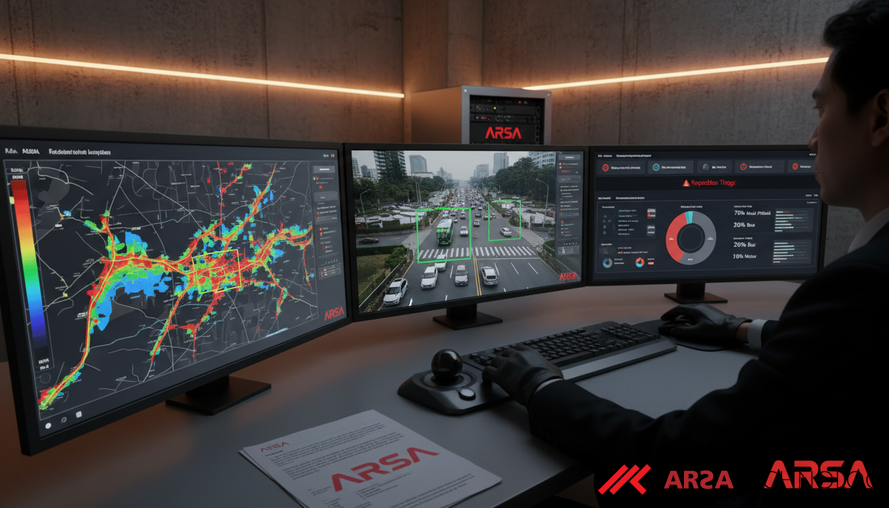
The practical applications of real-time object detection are vast and continue to expand, offering significant business value across diverse sectors. In security and surveillance, it enables automated monitoring for restricted area breaches, real-time alerts for unusual activities, and even advanced human-computer interfaces for access control. For smart cities and traffic management, object detection can count and classify vehicles, analyze congestion, predict traffic flow, and optimize infrastructure responses, leading to reduced delays and enhanced safety.
In industrial automation and manufacturing, these systems are critical for automated quality inspection, predictive maintenance, and ensuring worker safety through PPE (Personal Protective Equipment) detection and restricted zone monitoring. Retail and hospitality benefit from customer behavior analytics, foot traffic analysis, and smart inventory management. Healthcare applications range from patient flow management and self-check health kiosks to medical equipment tracking. Ultimately, by transforming raw visual data into actionable intelligence, object detection solutions lead to measurable returns on investment (ROI) through:
- Cost Efficiency: Automating tasks previously requiring manual oversight.
- Enhanced Security: Proactive threat detection and rapid response.
- Operational Optimization: Improved resource allocation and workflow efficiency.
- Increased Safety: Real-time compliance monitoring and accident prevention.
- New Revenue Streams: Data-driven insights for marketing and personalized services.
ARSA Technology provides solutions for various industries, demonstrating proven capabilities in deploying mission-critical systems that enhance security, optimize operations, and drive measurable ROI for enterprise and government clients.
Challenges and Future Directions in Object Detection
While deep learning has brought unparalleled capabilities to object detection, the field continues to evolve. Deploying these sophisticated AI systems in diverse, real-world environments presents several ongoing challenges. Ensuring consistent accuracy under varying lighting conditions, occlusions, and object scales remains an active area of research. Additionally, concerns around data privacy and regulatory compliance, particularly for sensitive applications like facial recognition or healthcare monitoring, demand robust, privacy-by-design solutions. The computational demands of advanced models also necessitate continued innovation in efficient algorithms and hardware, particularly for edge deployments where immediate processing is crucial and cloud dependency is undesirable.
Future research aims to develop even lighter, faster, and more robust models capable of learning with less data, adapting to new environments more seamlessly, and providing richer contextual understanding. This includes exploring novel neural network architectures, improving training methodologies, and integrating multi-modal data sources for more comprehensive detection. ARSA Technology is committed to bridging advanced AI research with operational reality, engineering systems that work at scale and under real industrial constraints, continually refining our solutions to meet these evolving demands.
Conclusion: Building an Intelligent Future with AI Vision
Real-time object detection powered by deep learning is no longer a futuristic concept but a vital technology transforming how industries operate. By accurately identifying and localizing objects in dynamic environments, these AI vision systems unlock unprecedented levels of efficiency, security, and insight. From streamlining operations in complex industrial settings to enhancing public safety and improving healthcare delivery, the practical implications are far-reaching.
For enterprises and governments seeking to leverage this transformative technology, selecting a partner with deep engineering expertise and a commitment to practical, production-ready solutions is paramount. ARSA Technology is dedicated to delivering robust AI and IoT solutions, empowering organizations to make smarter, faster decisions and secure a competitive advantage in an increasingly intelligent world.
Ready to explore how real-time object detection can transform your operations? Schedule a free consultation with the ARSA team today to discuss your specific needs.