Revolutionizing 3D Perception: How AI's Compressed Memory Makes Autonomous Systems Smarter
Discover Compressed Map Priors (CMP), an AI framework that equips autonomous systems with spatial memory, drastically improving 3D perception accuracy while reducing storage and computational costs.

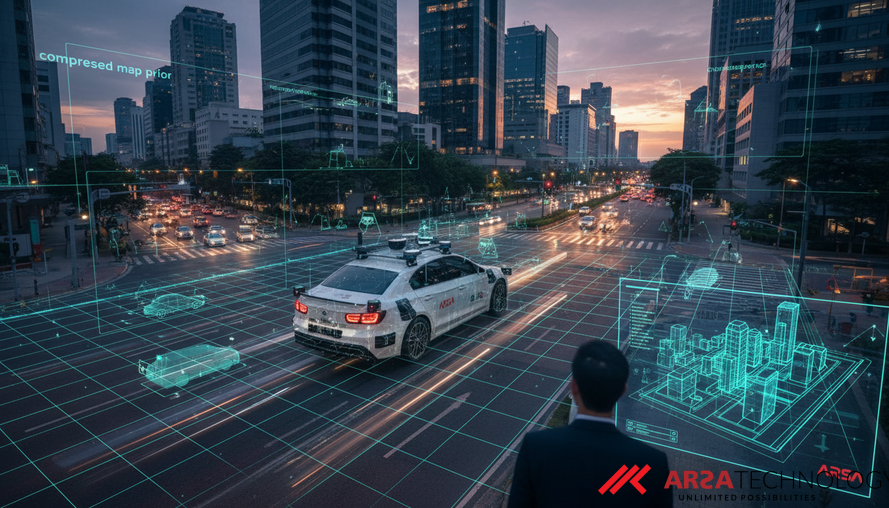
The Challenge of "First-Time" AI Vision in Autonomous Systems
Imagine a human driver navigating the same city streets every day. They instinctively know where buildings are, where traffic signs stand, and which lanes are static. They don’t treat every journey as if they've never seen the road before. Yet, this is precisely how many advanced autonomous computer vision systems operate. Despite frequently traversing the same mapped areas, these systems often process the static environment from scratch with each encounter, inferring structures and objects from live sensor inputs alone.
This approach, while robust for truly novel environments, becomes inefficient and resource-intensive in geo-fenced or regularly visited areas. It consumes vast amounts of computational power and memory, as the system constantly re-learns elements that haven't changed. This "amnesia" prevents AI from leveraging valuable historical context, leading to slower reactions, increased processing overhead, and missed opportunities for enhanced precision in 3D object detection and environmental understanding.
Introducing Compressed Map Priors (CMP): AI's Long-Term Spatial Memory
To overcome this inherent limitation, researchers have developed Compressed Map Priors (CMP), a groundbreaking framework designed to imbue AI vision models with a persistent, efficient memory of the static world. CMP allows autonomous systems to learn and store spatial priors—knowledge about the fixed elements of an environment—from previous traversals. This is akin to providing an AI with a comprehensive, internal "memory map" that it can continuously refer to and update.
By integrating CMP, vision models no longer need to re-identify every lamppost or building from scratch. Instead, they can augment live sensor data with pre-learned information about static structures, significantly enhancing their ability to perceive and interpret the surrounding environment. This framework makes AI systems smarter, enabling them to make more informed decisions based on a rich history of experience, rather than just immediate observations.
How CMP Works: A Compact Digital Memory for AI
At its core, CMP uses a highly efficient data structure known as a binarized hashmap to store spatial information. Unlike dense storage methods that might save every detail, CMP compresses this knowledge dramatically, requiring only a fraction of the memory—a remarkable 20x reduction compared to traditional approaches. This compact "memory map" can be seamlessly integrated into existing 3D perception systems with minimal computational overhead, typically around a 3% increase.
The system learns this spatial memory through end-to-end training. As the autonomous vehicle navigates and collects data, CMP extracts and refines relevant features about the static environment. These "prior features" are then fused with live multi-view image data from the vehicle's cameras, allowing the system to use both immediate and historical context for its predictions. This continuous learning and refinement process ensures the map prior remains accurate and up-to-date, making the AI vision system more robust and reliable.
Benefits for Businesses: Smarter Operations and Enhanced Safety
The implementation of Compressed Map Priors offers substantial benefits across various industries, extending beyond just autonomous vehicles. For enterprises deploying AI-powered vision systems in known environments, CMP translates directly into tangible operational improvements and cost efficiencies.
Firstly, the dramatic reduction in memory footprint means that less powerful, and therefore less expensive, hardware can still deliver high-performance 3D perception. This makes AI deployment more economically viable for a wider range of applications. Secondly, by equipping AI with a persistent memory, the accuracy of object detection and environmental understanding improves significantly. This can lead to enhanced safety protocols in industrial settings, more efficient logistics in warehouses, and better traffic management in smart cities. Solutions like ARSA's AI Box Series, which processes data locally at the edge, align with this principle of maximizing efficiency and privacy by leveraging powerful, compact AI processing.
ARSA Technology's Approach to Intelligent Vision Systems
ARSA Technology has been at the forefront of delivering AI and IoT solutions that prioritize efficiency, security, and real-world impact. Our expertise in computer vision and industrial IoT aligns with the principles demonstrated by Compressed Map Priors. By integrating advanced AI capabilities, we enable businesses to transform their existing infrastructure into intelligent, data-rich assets.
For instance, our AI Video Analytics solutions leverage intelligent algorithms to provide real-time insights for security, operational efficiency, and crowd management, turning passive CCTV feeds into proactive surveillance. Similarly, in logistics and urban environments, our Smart Parking System and traffic monitoring solutions utilize AI to optimize vehicle flow, manage access, and enhance safety, demonstrating how a "memory" of typical patterns and static layouts contributes to smarter operations. These systems are designed to deliver measurable ROI by reducing human error, accelerating response times, and providing actionable data for strategic decision-making, ensuring that every deployment is both effective and sustainable.
The Future of Adaptive AI Perception
The evolution of AI perception systems, driven by innovations like Compressed Map Priors, is moving towards more adaptive, intelligent, and resource-efficient solutions. By enabling AI to build and utilize a compact, persistent memory of its environment, we unlock new levels of accuracy and reliability that were previously unachievable with reactive, real-time-only processing. This capability is not just about making autonomous vehicles safer; it's about making all AI vision systems more capable, cost-effective, and ready for deployment in complex, dynamic real-world scenarios.
As industries continue their digital transformation journeys, the ability to rapidly deploy AI solutions that are both powerful and practical becomes paramount. The integration of spatial priors, facilitated by efficient memory representations, marks a significant step towards truly intelligent systems that learn, remember, and adapt.
To explore how ARSA Technology can help your business implement cutting-edge AI vision solutions for enhanced efficiency and security, we invite you to contact ARSA for a free consultation.