Revolutionizing 6G Networks: Agentic AI, Mixture of Experts, and Large Language Models
Explore how agentic AI, Mixture of Experts (MoE), and Large Language Models (LLMs) are converging to create intelligent, adaptable 6G networks for unparalleled optimization.

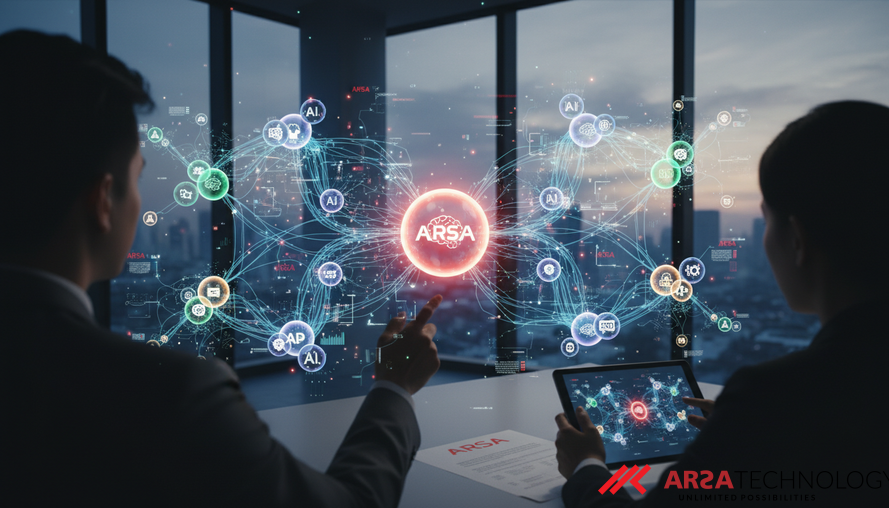
Future mobile networks, particularly the impending sixth-generation (6G), are set to redefine connectivity, offering speeds and intelligence far beyond current capabilities. This evolution is not just about faster data; it's about building networks that are inherently intelligent, capable of adapting, learning, and optimizing themselves in real-time. A recent academic paper, "Agentic AI-Based Joint Computing and Networking via Mixture of Experts and Large Language Models" by Reifert et al., delves into a groundbreaking framework that promises to unlock this vision, bridging human intent with sophisticated AI-driven network management (Source: arXiv:2605.02911).
This research explores how combining agentic Artificial Intelligence (AI) with Mixture of Experts (MoE) architectures and Large Language Models (LLMs) can create highly flexible and scalable network optimization. The core idea is to enable networks to autonomously select and coordinate specialized AI experts based on high-level operational goals, addressing the escalating complexity of modern digital infrastructures. For businesses and governments relying on critical network performance, this innovation signifies a leap towards more resilient, efficient, and intelligent operations.
The Evolving Landscape of 6G Networks and AI
The shift from 5G to 6G represents more than just an incremental upgrade; it's a paradigm shift towards truly "AI-native" networks. Earlier generations focused on static communication infrastructure, but 6G envisions dynamic, heterogeneous systems that seamlessly integrate communication, computing, and control across multiple layers. This includes advanced capabilities like remote data processing, task offloading, and sophisticated edge computing. For example, in extended reality (XR) applications, processing video frames at the base station before transmission significantly reduces latency and enhances user experience.
However, this unprecedented adaptability introduces a significant challenge: the proliferation of highly specialized AI optimization methods. Each method is typically tailored for a specific objective, system assumption, or uncertainty model—be it robust resource allocation, fairness-aware scheduling, or latency minimization. Reconciling these diverse and often interdependent approaches within a unified, flexible framework has been a major hurdle, leading to siloed optimizations that struggle to adapt to rapidly changing real-world conditions.
Introducing Agentic AI and Mixture of Experts
To tackle the increasing complexity, the concept of "agentic AI" is gaining traction. Unlike conventional AI that operates within predefined rules, agentic AI enables autonomous decision-making, self-organization, and dynamic adaptation. These AI agents can actively reason over system states, understand overarching objectives, and decide on the best course of action. This moves beyond passive learning to an active, goal-driven intelligence.
Within this agentic framework, "Mixture of Experts" (MoE) architectures provide a powerful mechanism for combining multiple specialized AI solutions. Imagine a team of highly skilled specialists: one excels at optimizing network throughput, another at ensuring fairness among users, and a third at minimizing data transmission delays. An MoE system acts as a coordinator, dynamically deciding which expert (or combination of experts) is best suited for a given situation. This allows the network to leverage the strengths of individual experts without being limited by their narrow specializations.
Large Language Models as the Semantic Gate
The innovation highlighted in the paper is the integration of Large Language Models (LLMs) into this MoE architecture, specifically as a "semantic gate." Traditionally, gating mechanisms in MoE are trained on low-level technical features, making it difficult for them to interpret high-level, human-readable objectives. This is where LLMs shine. Their advanced capabilities in semantic reasoning and intent interpretation allow them to bridge the gap between human language and machine execution.
The LLM in this framework acts as a high-level reasoning layer. An operator can articulate network optimization goals in natural language—for instance, "prioritize user fairness during peak hours" or "maximize throughput while maintaining robust connectivity." The LLM interprets this intent, then dynamically orchestrates and weights the most suitable specialized AI experts within the MoE architecture. This enables flexible optimization across heterogeneous objectives and operating conditions, transforming abstract goals into concrete resource allocation decisions. The framework essentially translates human strategy into granular AI actions, making complex network management more intuitive and responsive.
Practical Applications and Business Implications
The implications of such an agentic AI framework are profound for enterprises across various industries. Consider a joint communication and computing network, where resources like transmit power, computing power, and processing cycles are tightly coupled. In such environments, the proposed framework can be applied to:
- Smart Cities & Traffic Management: Optimizing traffic flow and congestion detection by dynamically balancing throughput and delay objectives. ARSA Technology's AI BOX - Traffic Monitor already provides real-time vehicle analytics, and integrating agentic AI could enable even more dynamic and responsive traffic management strategies based on evolving city demands.
- Industrial IoT & Manufacturing: Ensuring robust, low-latency communication for critical Industry 4.0 applications, even under fluctuating network loads. The ability to prioritize safety alerts over non-critical data, based on real-time conditions, offers significant risk reduction and operational efficiency.
- Retail & Commercial Analytics: Optimizing customer experience by ensuring smooth data flow for footfall analysis and queue management, while also maximizing advertising impact through real-time audience measurement.
- Public Safety & Defense: Orchestrating critical communication for emergency services or secure restricted area monitoring with unparalleled reliability and data control. The framework's emphasis on on-premise deployment options, where all AI processing runs locally, aligns with the stringent privacy and compliance needs of these sectors, similar to how ARSA's AI Video Analytics systems are deployed to process CCTV footage in real-time on-site.
This model-agnostic framework effectively bridges human-readable network intents with low-level resource allocation decisions, promising not only enhanced performance but also significant cost savings through automated, optimized resource utilization. The reduction in manual oversight and the ability to prevent outages or bottlenecks proactively directly translates to improved ROI.
Real-World Performance and Future Outlook
Numerical simulations cited in the paper confirm the efficacy of this agentic MoE framework. It consistently achieves near-optimal performance compared to exhaustive expert combinations, proving its intelligence in selecting the right tools for the job. Crucially, it significantly outperforms individual, specialized experts when faced with diverse, complex objectives, demonstrating its superior adaptability. This includes scenarios requiring delay minimization, throughput maximization, and ensuring fairness.
The proposed framework represents a significant step towards the next generation of intelligent, self-optimizing networks. As technology providers continue to build and deploy advanced AI and IoT solutions for global enterprises, architectures that enable dynamic orchestration of specialized AI agents will be critical.
To discover how advanced AI and IoT solutions can transform your operations and to explore customizable deployment models, contact ARSA today for a free consultation.
**Source:** Reifert, R-J., Ahmad, A. A., Dahrouj, H., & Sezgin, A. (2026). Agentic AI-Based Joint Computing and Networking via Mixture of Experts and Large Language Models. arXiv preprint arXiv:2605.02911. Available at: https://arxiv.org/abs/2605.02911