Revolutionizing Engineering Simulation: How AI is Transforming Geometry and Meshing
Explore how AI and machine learning are overcoming bottlenecks in engineering simulation, automating complex geometry preparation and mesh generation for faster, more accurate results.

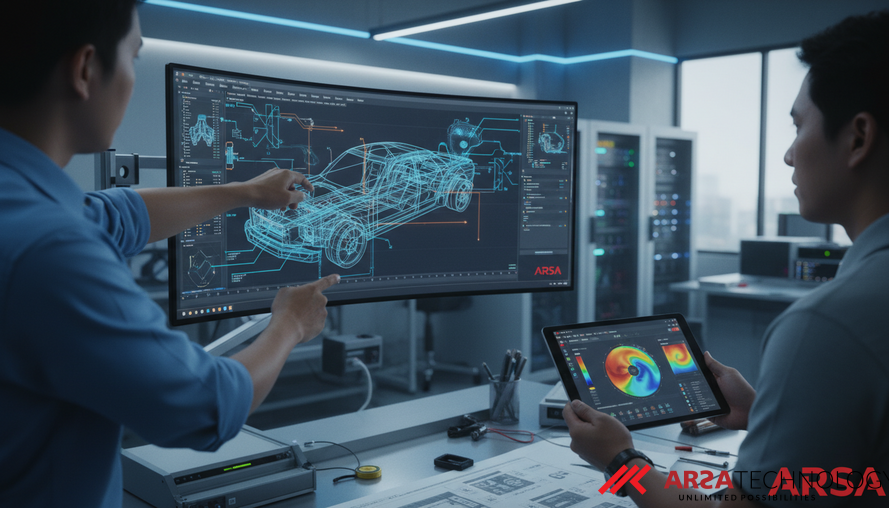
High-fidelity engineering simulation has become an indispensable tool across a myriad of industries, from automotive design to aerospace and medical device development. These simulations allow engineers to predict how products will perform under various conditions, identify potential flaws, and optimize designs long before physical prototypes are built. However, a significant, long-standing bottleneck exists in this crucial process: the journey from a raw 3D CAD (Computer-Aided Design) model to a simulation-ready mesh. This often manual and time-consuming step can delay projects, increase costs, and introduce errors, challenging even the most experienced teams.
The Stubborn Bottleneck in Engineering Workflows
For decades, the creation of a high-quality mesh—a digital structure that discretizes a 3D model into smaller, solvable elements for simulation—has been a labor-intensive endeavor. Engineers routinely dedicate countless hours to meticulously identifying individual parts within complex assemblies, simplifying intricate geometries, fine-tuning meshing parameters, and rigorously checking the quality of the resulting mesh. This process is not only repetitive but also highly susceptible to human error, particularly when dealing with large-scale models or similar designs that require slight variations in preparation.
Despite significant advancements in geometry processing algorithms and meshing software over the years, this critical phase of the simulation workflow remains surprisingly manual. The inherent variability in CAD sources, modeling conventions, manufacturing tolerances, and geometric noise often renders traditional, rule-based automation brittle and ineffective. This inefficiency creates a clear need for more robust, adaptive solutions that can learn and evolve with the complexities of modern engineering designs.
AI as an Amplifier: A New Era for Engineering Simulation
The advent of Artificial Intelligence (AI) and Machine Learning (ML) is beginning to address these long-standing challenges, offering a transformative shift from manual dependency to intelligent assistance. Instead of replacing conventional engineering methods, AI acts as a powerful amplifier, augmenting human expertise and extending the capabilities of existing tools. By learning from vast datasets of past design decisions and simulation outcomes, AI can automate tedious tasks, identify potential problems earlier, and guide engineers toward optimal solutions with unprecedented speed and accuracy.
ARSA Technology, with its deep expertise in AI and IoT solutions, recognizes this paradigm shift. We see AI not just as a buzzword but as a practical enabler for digital transformation across various industries. From enhancing security to streamlining operations, AI-powered solutions offer tangible ROI by boosting efficiency, reducing operational costs, and fostering innovation.
Key AI Applications in the CAD-to-Mesh Pipeline
The applications of AI and ML in model preparation and meshing are diverse and rapidly evolving. They range from basic classification tasks to advanced generative models and intelligent automation.
- **Intelligent Part Classification and Segmentation**
Complex engineering assemblies often contain hundreds or thousands of repeated components like bolts, screws, and springs. Manually identifying and preparing these for analysis—which might involve simplifying their geometry or assigning specific boundary conditions—is incredibly tedious and error-prone. AI-powered part classification automates this process by learning from data, allowing systems to recognize components despite variations in geometry or topology. Similarly, 3D part segmentation, another crucial application, allows AI to assign semantic labels to specific regions within a part, identifying features like holes or fillets at a finer level of detail.
Traditional methods struggle with the variability of real-world CAD data. However, AI, especially deep learning models tailored for geometric data, can learn robust decision boundaries. This allows for accurate identification and grouping of parts, which is essential for defining idealization recipes that streamline meshing and boundary condition setup. Solutions like ARSA's Basic Safety Guard demonstrate how AI can classify and monitor objects in real-time environments, applying similar principles to enhance operational safety and compliance in physical spaces.
- **Enhancing Mesh Quality and Generation**
Achieving a high-quality mesh is paramount for accurate simulation results. AI models can predict potential mesh failures or quality issues early in the process, allowing engineers to intervene proactively. Beyond prediction, AI is also being deployed to guide geometry simplification—a process known as "defeaturing"—which removes insignificant details that can complicate meshing without affecting simulation accuracy. This is crucial for optimizing computational resources and accelerating simulation cycles.
Furthermore, AI is making strides in the generation of meshes themselves. This includes improving the quality of unstructured meshes, facilitating the creation of block-structured meshes, and supporting volumetric parameterizations that define the internal structure of a model. These methods help automate what was once a highly specialized and manual art, making mesh generation faster, more consistent, and less prone to errors.
- **Automating Workflows with Reinforcement Learning and LLMs**
The ability to automate multi-step engineering decisions is a game-changer. Reinforcement Learning (RL) agents, which learn through trial and error, are being developed to guide complex meshing workflows, such as deciding optimal meshing strategies or performing specific geometry operations. This means AI can learn to navigate the intricate sequences of actions required to prepare a model for simulation, adapting its approach based on feedback.
The emergence of Large Language Models (LLMs) is also proving significant. These AI models, known for their ability to understand and generate human language, are beginning to assist with scripting automation, generating code for routine tasks, and enabling natural language interaction with CAD and meshing tools. Imagine instructing a system to "mesh all holes over 5mm in diameter with quadrilateral elements" and having the AI automatically generate the necessary commands. This capability promises to democratize complex meshing tasks and significantly reduce the learning curve for new engineers. ARSA's own ARSA AI API offers similar flexibility, allowing businesses to integrate powerful AI functions directly into their applications and automate complex processes with ease.
ARSA's Approach to AI-Powered Industrial Transformation
At ARSA Technology, we understand that the future of engineering and industry lies in smart, data-driven solutions. Our mission to build the future with AI and IoT aligns perfectly with the advancements seen in geometry preparation and mesh generation. Our AI Box Series, for example, transforms existing CCTV infrastructure into intelligent monitoring systems capable of real-time analytics for tasks like traffic monitoring, retail analytics, and safety compliance. While distinct from direct meshing, the underlying principles of leveraging edge AI for immediate, actionable insights are shared.
Our solutions are designed for practical deployment, ensuring high accuracy, real-time processing, and privacy-by-design. We focus on converting complex technological capabilities into tangible business outcomes—reducing operational costs, increasing security, and creating new revenue streams for our clients. By streamlining traditionally labor-intensive processes with AI, businesses can reallocate valuable human resources to higher-value, more creative tasks, driving innovation and competitiveness.
The Road Ahead: Challenges and Opportunities
While the promise of AI in engineering simulation is immense, several challenges remain. The development of robust AI solutions requires access to large, curated datasets of CAD models and their corresponding meshes, which are often proprietary and difficult to share. Standardized benchmarks are needed to objectively evaluate the performance of new AI methods. Furthermore, new representations for CAD geometry are being explored to better suit AI processing, and there's a continuous need for intelligent systems that can support analysts across the entire modeling and simulation workflow, rather than just isolated steps.
Ultimately, AI is poised to redefine the engineering simulation landscape. By transforming geometry preparation and mesh generation from manual bottlenecks into intelligently automated processes, AI empowers engineers to work faster, with greater accuracy, and focus on the strategic aspects of design and innovation. This evolution marks a significant step towards truly smart factories and the broader vision of Industry 4.0, where data-driven insights are at the core of every decision.
Ready to explore how AI can transform your engineering and industrial operations? Unlock the potential of AI-powered solutions to drive efficiency and innovation. We invite you to contact ARSA for a consultation.
Siap Mengimplementasikan Solusi AI untuk Bisnis Anda?
Tim ahli ARSA Technology siap membantu transformasi digital perusahaan Anda dengan solusi AI dan IoT terkini. Dapatkan konsultasi gratis dan demo solusi yang tepat untuk kebutuhan industri Anda.