Revolutionizing Hardware Verification: How Structure-Guided AI Accelerates Design Integrity
Explore STELLAR, a groundbreaking AI framework that uses structural similarity and LLMs to generate high-quality SystemVerilog Assertions (SVAs) for robust hardware verification.

The Critical Need for Robust Hardware Verification
In the fast-evolving world of Very Large Scale Integration (VLSI) design, the complexity of modern hardware architectures is spiraling. From advanced microprocessors to sophisticated IoT devices, ensuring that these intricate designs function flawlessly is paramount. This is where Formal Verification (FV) steps in, playing a vital role in the design flow. Unlike traditional simulation, which can only test a finite number of scenarios, FV applies rigorous mathematical methods to prove that a design meets its intended specifications under all possible conditions. This provides a significantly stronger guarantee of correctness and reliability.
A cornerstone of effective Formal Verification is Assertion-Based Verification (ABV), which relies heavily on SystemVerilog Assertions (SVAs). These are specialized code snippets written in SystemVerilog that formally define the expected behavior of a hardware design. Think of SVAs as a set of precise rules or contracts that the circuit must adhere to. The quality of these SVAs directly impacts the effectiveness of the entire verification process. However, the manual creation of high-quality SVAs is a painstaking, time-consuming, and error-prone endeavor. It demands deep expertise to translate often ambiguous natural language specifications into the highly precise formal properties required for verification, making it a significant bottleneck in modern hardware development.
The Bottleneck of Manual Assertion Writing and Early AI Limitations
The core challenge in automating assertion generation lies in bridging the "semantic gap" – the chasm between the high-level, often vague design intent described in natural language specifications (SPEC) and the granular, low-level implementation details found in Register-Transfer Level (RTL) code. Verification engineers must mentally synthesize information from both these sources to craft effective assertions, a process that is notoriously difficult to automate. While large language models (LLMs) have shown impressive capabilities in various code generation tasks, their application to SVA generation has, until recently, yielded mixed results.
Previous studies indicate that commercial LLMs, when used in isolation, frequently produce SystemVerilog Assertions with syntactic or semantic errors. While newer LLM-based approaches like SANGAM and AssertionForge have attempted to improve automation by reasoning over multimodal specifications and creating structured knowledge from design files, they share a fundamental limitation. These methods often generate assertions "from scratch" by analyzing only the target design's specifications and RTL. This approach overlooks a valuable asset available in industrial settings: vast repositories of expert-written RTL and SVA pairs from past projects. Failing to leverage these proven examples can lead to duplicated efforts, the reintroduction of previously resolved bugs, and a lack of consistent, industry-standard SVA styles across different designs or teams.
STELLAR: A Structure-Guided Approach to AI-Powered Verification
Addressing the limitations of prior methods, researchers at the University of Delaware developed STELLAR (Structure-guided LLM Assertion Retrieval and Generation for Formal Verification). This pioneering framework is built on the hypothesis that structural similarity is a more effective metric than purely semantic similarity for guiding LLM-based SVA generation. Assertions are intrinsically linked to the underlying structural patterns of a hardware design. By ignoring these patterns, previous retrieval methods missed a powerful signal for generating accurate and stylistically aligned SVAs.
STELLAR differentiates itself by intelligently reusing an existing knowledge base of proven (RTL, SVA) pairs. Instead of asking an LLM to "invent" assertions anew or relying on potentially flawed semantic retrieval, STELLAR identifies and leverages structurally similar patterns from this knowledge base. This allows the LLM to generate high-quality SVAs that are not only functionally correct but also adhere to established industrial best practices and stylistic consistency. This approach marks a significant step forward in the quest for truly automated and reliable hardware verification.
How STELLAR Works: Leveraging Code's DNA
The STELLAR framework incorporates several key innovations to achieve its structure-guided approach:
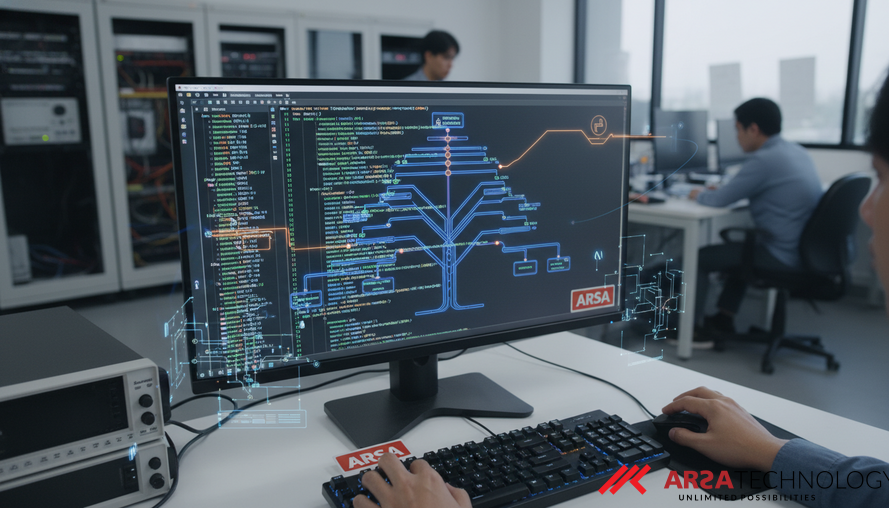
- Structural Fingerprinting: At the heart of STELLAR is a novel technique that transforms RTL blocks into Abstract Syntax Tree (AST) structural fingerprints. An AST is a tree-based representation that captures the hierarchical structure of source code, including its operations and control flow. These "structural fingerprints" act like unique DNA markers for each RTL block, encoding crucial information about its control flow, logical complexity, and contextual relationships within the design. This allows for a much finer-grained and accurate comparison between different RTL blocks than simple keyword or variable matching.
- Knowledge Base Retrieval: STELLAR utilizes these structural fingerprints to efficiently search a vast knowledge base filled with expert-crafted (RTL, SVA) pairs. When a new RTL block needs verification, STELLAR retrieves structurally similar pairs from this knowledge base. This means it finds existing examples where the underlying control flow and architectural patterns match, even if variable names or specific values are different. This targeted retrieval ensures that the LLM receives highly relevant and proven examples to learn from.
Structure-Guided Prompting: The retrieved, structurally relevant (RTL, SVA) pairs, along with a dynamically computed execution path count (which helps ensure comprehensive SVA coverage), are then integrated into the LLM's prompt. This "structure-guided prompting" strategy provides the LLM with a rich, context-aware input. By showing the LLM not just what the new design looks like, but also how* similar, proven designs were verified, STELLAR steers the LLM to generate SVAs that are not only syntactically correct and functionally sound but also stylistically consistent with industrial standards.
The researchers demonstrated that this structure-aware retrieval dramatically improves the generated SVAs' syntax correctness, semantic alignment, and functional accuracy. This underscores the power of integrating structural intelligence into AI-powered verification tools, as detailed in the source paper: STELLAR: Structure-guided LLM Assertion Retrieval and Generation for Formal Verification.
The Impact of Structure-Aware AI on Hardware Design
The advent of frameworks like STELLAR promises to significantly enhance the efficiency and reliability of hardware design and verification processes. By automating the generation of high-quality SVAs, enterprises can expect several tangible business impacts:
- Accelerated Time-to-Market: Automating a previously slow, manual process means hardware designs can move through the verification stage much faster, bringing products to market more quickly.
- Reduced Development Costs: Fewer errors in assertions lead to fewer bugs discovered late in the design cycle, which are exponentially more expensive to fix. The consistent application of verification rules also reduces rework.
- Enhanced Design Quality and Reliability: With mathematically proven assertions, the confidence in a design's correctness increases dramatically. This leads to more robust, reliable hardware that performs as intended in real-world applications.
- Scalability for Complex Designs: As hardware designs become more complex, manual SVA creation becomes unmanageable. AI-driven systems like STELLAR provide a scalable solution, enabling comprehensive verification even for the most intricate architectures.
- Consistency and Compliance: By learning from expert-crafted examples, the generated SVAs maintain a consistent style and adherence to industry standards, simplifying audits and ensuring compliance with stringent regulatory requirements.
This innovative application of AI, leveraging deep structural understanding, moves hardware verification from a reactive bug-finding process to a proactive design assurance methodology.
Beyond the Lab: Practical Implications for Enterprise Verification
The principles demonstrated by STELLAR highlight a critical shift in how advanced AI can be applied to highly technical domains like VLSI design. For global enterprises seeking to enhance their hardware development pipelines, the ability to rapidly generate accurate, high-quality SystemVerilog Assertions offers a distinct competitive advantage. Such sophisticated AI-driven verification tools can integrate seamlessly with existing design flows, transforming traditional CCTV-based monitoring in testing environments into intelligent analytics engines.
As an AI and IoT solutions provider, ARSA Technology recognizes the profound impact of such innovations. While ARSA does not claim to have developed STELLAR, our expertise in crafting custom AI Video Analytics and AI Box Series solutions positions us to help enterprises explore and implement similar advanced AI methodologies. Our teams, with expertise since 2018 in computer vision and deep learning, can assist in developing tailored AI models for specialized tasks, ensuring secure, privacy-compliant, and efficient operational intelligence.
Pioneering the Future of VLSI Design
The research behind STELLAR showcases the power of combining deep domain knowledge with cutting-edge AI techniques. By looking beyond superficial similarities and focusing on the underlying structure of code, AI can contribute to more robust, reliable, and efficient hardware verification. This approach not only streamlines a traditionally arduous process but also paves the way for further automation and intelligence in complex engineering disciplines. For enterprises globally, embracing such advancements is key to staying competitive and delivering the next generation of high-performing, error-free hardware.
Ready to explore how advanced AI and IoT solutions can transform your operational efficiency and enhance design integrity? We invite you to discover how ARSA Technology can partner with you to implement innovative AI-powered solutions. Start your journey towards smarter, more secure, and more efficient operations today.