Revolutionizing Industrial Inspection: AI-Powered Denoising and Deblurring for Terahertz Imaging
Discover ARSA Technology's approach to enhancing Terahertz (THz) imaging for industrial non-destructive testing, leveraging self-supervised AI to overcome blurring and noise for clearer, more accurate material analysis.

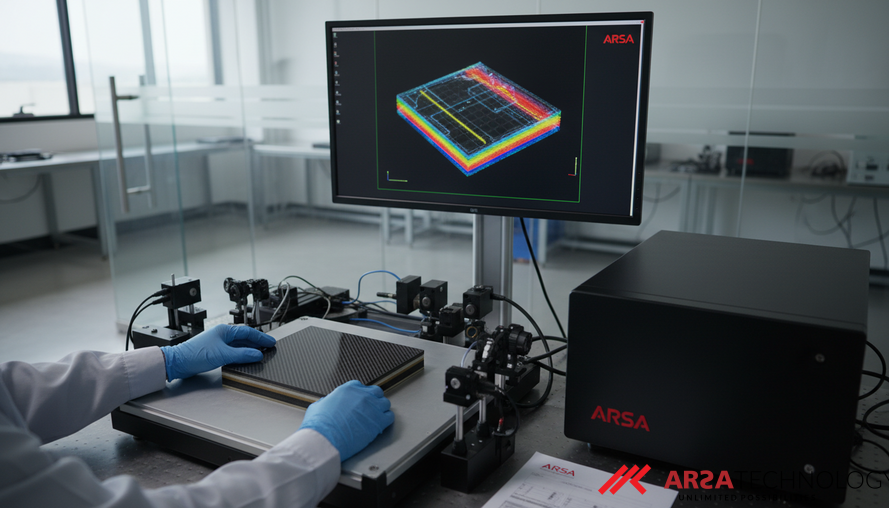
The Challenge of Clear Vision in Terahertz Imaging for Industry
Terahertz (THz) technology, with its non-ionizing, non-invasive, and highly penetrative properties, holds immense promise for industrial applications such as qualitative and quantitative identification of key substances and non-destructive testing (NDT) of materials. From inspecting multi-layer structures for hidden defects to analyzing the integrity of composites, THz imaging offers unique insights into material properties. However, this powerful technology comes with a significant challenge: image degradation. THz systems inherently introduce effects that result in both low-frequency blurring (loss of crisp detail) and high-frequency noise (graininess or speckles) in the resulting images.
This dual problem complicates data analysis, making it difficult for engineers and inspectors to draw precise conclusions. Traditional image processing methods often fall short, capable of addressing either noise or blurring, but rarely both simultaneously. Furthermore, these methods frequently require manual intervention to distinguish between noise and actual signal degradation, which is often an unknown boundary. This inefficiency underscores a critical need for advanced solutions that can automatically and intelligently restore THz image quality.
Unveiling the Innovation: Self-Supervised AI for THz Image Restoration
To overcome these inherent limitations, a groundbreaking approach has emerged: the Principal Component Analysis (PCA)-based THz Self-Supervised Denoising and Deblurring Deep Neural Network (THz-SSDD). This innovative network represents a significant leap forward by offering a unified solution that can simultaneously denoise and deblur THz amplitude images. This eliminates the need for multiple, sequential processing steps and complex manual adjustments, streamlining the analysis workflow for various industries.
The core innovation lies in its "self-supervised" learning strategy. Unlike traditional AI models that demand vast datasets of perfectly "clean" and "degraded" image pairs for training, THz-SSDD learns directly from noisy, unlabeled images. It achieves this by understanding the intrinsic characteristics of degradation patterns. This approach is particularly valuable in industrial settings where obtaining pristine, ground-truth images is often impractical or impossible. By focusing on learning from the data itself, the network becomes highly adaptable and robust.
How It Works: A Closer Look at THz-SSDD's Intelligent Approach
The THz-SSDD network leverages two powerful techniques: the Recorrupted-to-Recorrupted (R2R) self-supervised learning strategy and Principal Component Analysis (PCA). The R2R strategy allows the network to learn about noise and blurring by creating its own "recorrupted" versions of already degraded images. Imagine repeatedly introducing different types of digital "static" to an already fuzzy photograph; the AI learns to identify what the static looks like and, by extension, how to remove it. This clever method exploits the inherent invariance of the underlying signal even when continuously corrupted, enabling the network to discern real image features from degradation.
Following this self-supervised learning, PCA is applied to further refine the image. PCA is a statistical technique that simplifies complex data by identifying its most significant underlying patterns, known as principal components. In the context of THz images, these components represent different aspects of the visual information across various frequencies. The THz-SSDD network processes these principal components, restoring image quality across both low frequencies (addressing blurring) and high frequencies (mitigating noise) simultaneously. This decomposition and reconstruction process ensures that the fundamental physical characteristics of the original THz signals are preserved, which is crucial for accurate material analysis in fields like AI Video Analytics.
Real-World Impact: Enhancing Non-Destructive Testing and Material Analysis
The practical implications of the THz-SSDD network are substantial for industries relying on precision inspection. Testing on diverse samples, including glass fibre reinforced polymer (GFRP) laminates with holes, pyrolyzed woods, high-density polyethylene (HDPE) after tensile stress, and hybrid composite materials with impact damage, has demonstrated the network’s remarkable ability to deliver clear, deblurred images. This generalizability means that the system can be deployed across various industrial scenarios without extensive re-training for each new material or measurement mode.
For manufacturers, this translates to improved quality control, faster defect detection, and reduced downtime. In construction, it could mean more accurate assessments of structural integrity. For the energy and mining sectors, it provides clearer insights into critical components. By providing quantifiable improvements in image quality and preserving the physical characteristics of signals, THz-SSDD significantly enhances the reliability of NDT, leading to better decision-making, increased safety, and optimized operational efficiency. Such advanced AI capabilities can be integrated into solutions like ARSA's AI Box Series, transforming existing infrastructure into intelligent monitoring systems.
The ARSA Advantage: Bridging Advanced AI with Industrial Needs
ARSA Technology, with its deep expertise in Artificial Intelligence and the Internet of Things, recognizes the transformative potential of advanced image processing techniques like THz-SSDD. We are committed to translating complex academic innovations into practical, high-impact industrial solutions. By leveraging proprietary AI software and edge computing power, ARSA focuses on delivering systems that provide real-time analytics, maximum privacy through local processing, and easy integration into existing industrial infrastructure.
Our approach aligns with the need for robust, data-driven solutions that minimize human error and accelerate response times. Whether it's improving safety compliance on construction sites or optimizing production lines in manufacturing, ARSA brings scalable AI and IoT solutions to the forefront. We emphasize solutions that are not only technologically advanced but also deliver measurable Return on Investment (ROI) and tangible business outcomes for our clients.
The Future of High-Fidelity THz Imaging
The development of self-supervised denoising and deblurring networks for Terahertz imaging marks a significant milestone in industrial inspection and material science. By addressing the fundamental challenges of image degradation with a single, intelligent solution, this technology paves the way for more accurate, efficient, and reliable non-destructive testing. The ability to learn from unlabeled data and maintain signal integrity ensures that industries can harness the full potential of THz waves to build safer products, optimize processes, and drive innovation.
Embrace the future of industrial inspection with high-fidelity Terahertz imaging. To explore how advanced AI vision can transform your operations and to schedule a free consultation, contact ARSA today.