Revolutionizing Mobility: AI-Powered Crutch Gait Detection for Safer Exoskeletons
Discover how a minimalist, IMU-based system provides precise, real-time crutch gait detection for lower-limb exoskeletons, enhancing safety and efficiency without complex hardware.

The Critical Need for Precise Gait Detection in Assistive Robotics
Lower-limb exoskeletons and advanced prostheses are transformative technologies designed to restore or assist standing and walking for individuals with severe mobility impairments, such as those resulting from spinal cord injury or amputation. These devices fundamentally aim to enhance user safety, promote natural motion, and maximize comfort. However, their optimal performance hinges on a robust and highly accurate gait phase detection method. This detection unit acts as the brain, providing the device's main controller with real-time information about the user's current gait phase, such as heel strike or swing. Accurate and low-latency detection ensures the device can produce synchronized motion and actuation, which is paramount for improved responsiveness and safety.
Conventional methods for gait phase detection often rely on complex hardware, like force sensors integrated into foot soles or advanced joint encoders. While these provide direct kinematic and kinetic feedback, they primarily measure the device's current state rather than anticipating user intent. This "hindsight" approach can lead to sluggish coordination, lacking the proactive responsiveness crucial for natural walking. Furthermore, sole-based sensors can struggle with varied terrains or atypical gait patterns. More comprehensive, but challenging, approaches like Electro-Myography (EMG), which detects muscle activation, are often limited by electrode placement sensitivity, signal noise, and variability between individuals. The industry requires solutions that are both reliable and efficient.
A Simplified and Cost-Effective Approach
To overcome the limitations of complex and reactive sensing, a groundbreaking approach focuses on utilizing sensors placed on the assistive devices themselves, particularly crutches. Crutches serve as a primary interface where users naturally express their walking intent. Traditionally, instrumented crutches incorporate force sensors to quantify the axial load and shear forces exerted by the user onto the crutch tip, sometimes fused with Inertial Measurement Units (IMUs). IMUs, which are compact sensors measuring orientation, velocity, and gravitational forces, are relatively easy to deploy and cost-effective.
A recent development proposes a minimalist and computationally efficient framework for crutch gait detection that significantly simplifies this setup. The innovation lies in demonstrating that precise gait detection can be achieved using signals from a single, low-cost, off-the-shelf IMU discreetly integrated within the crutch hand grip. This eliminates the need for any force sensors or mechanical modifications to the crutch tip, making the system far more accessible and affordable. This advancement aligns with ARSA Technology's vision of providing impactful AI and IoT solutions, where integrating such smart sensing into existing infrastructure can transform operational capabilities.
Understanding the Technical Foundation: IMU Integration
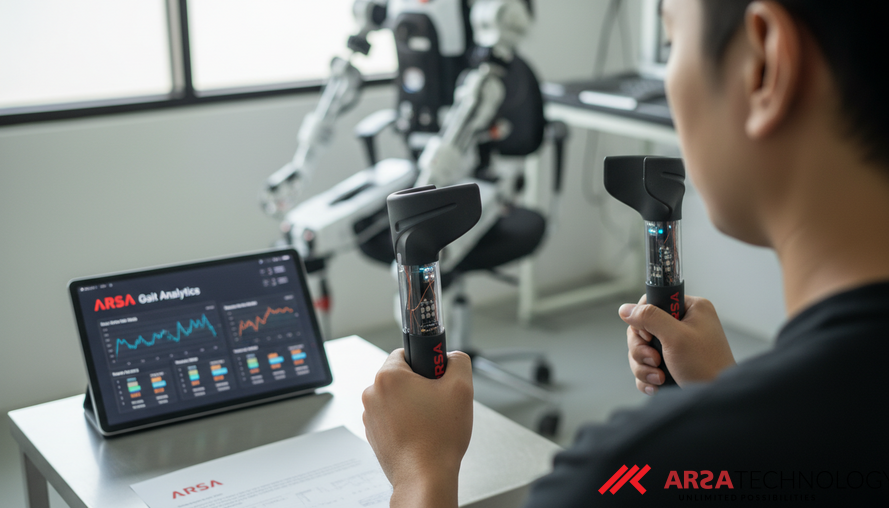
The core of this minimalist system is the IMU, strategically integrated within the hand grip of a standard forearm crutch. Its orientation is meticulously defined: the z-axis points vertically upward (aligned with gravity during standing), the x-axis points horizontally toward the walking direction, and the y-axis points perpendicular to the walking direction. This specific alignment ensures that output signals, such as forward pitch rotation, directly correspond to key crutch motions like the swing phase. The IMU streams data at 100 Hz, capturing tri-axial linear acceleration, tri-axial angular velocity, and tri-axial magnetic field strength.
To enhance reliability, the raw IMU data undergoes sophisticated processing. Raw accelerations are rotated into a global coordinate system using internal orientation quaternions, allowing for the unbiased separation of gravity and motion components. Angular velocity components are smoothed by a low-pass filter to provide a clean signal. Crucially, the IMU's internal sensor fusion engine integrates gyroscope and magnetometer data to provide pre-processed orientation outputs in Euler angles (ψ, θ, ϕ). Utilizing these processed angles, instead of raw magnetic field signals, significantly improves system reliability by mitigating the impact of local electromagnetic interference and magnetic anomalies, a key consideration for real-world deployments across various industries.
Enhancing Safety with a Five-Phase Gait Model
Traditional crutch gait analysis often focuses on a four-phase cycle: stance (crutch on ground), take-off (crutch lifting), swing (crutch in air), and strike (crutch landing). While these phases are critical for synchronized motion, they don't account for all user activities. A significant contribution of this research is the expansion to a five-phase classification system, introducing a crucial "Auxiliary" phase. This fifth phase covers any non-locomotor activities such as standing still, drinking, scratching, or interacting with the environment, which are common in daily life.
The inclusion of the Auxiliary phase is vital for safety. During these non-gait activities, incidental sensor readings could otherwise trigger undesired exoskeleton motion. By classifying these moments as Auxiliary, the control system can enter a locked or safe state, preventing accidental movements and significantly improving user confidence and safety. This proactive safety measure is a testament to designing AI solutions that understand and adapt to human behavior beyond just the primary task, aligning with the "Safer" aspect of ARSA's motto.
Real-Time Intelligence: Deep Learning for Precision Analysis
The heart of this intelligent gait detection system lies in its use of deep learning architectures. Three different deep learning models were benchmarked to identify the most effective for real-time application on both standard PCs and embedded systems. To further improve performance, particularly under data-constrained conditions, these models were augmented with a Finite State Machine (FSM). An FSM helps enforce biomechanical consistency, essentially adding a layer of "common sense" by ensuring that the detected gait phases follow a logical and sequential pattern that aligns with how humans actually walk.
Among the architectures tested, the Temporal Convolutional Network (TCN) emerged as the superior choice. TCNs are particularly adept at processing sequential data, making them ideal for time-series analysis like gait patterns. It yielded the highest success rates and lowest latency, critical factors for real-time control in assistive devices. A remarkable finding was the model's ability to generalize to a paralyzed user, despite being trained exclusively on data from healthy participants. This demonstrates the robustness and broad applicability of the system, achieving a 94% success rate in detecting crutch steps and proving its value as a high-performance, cost-effective solution for real-time exoskeleton control. ARSA Technology, with its AI Box Series, specializes in deploying such real-time edge computing solutions for immediate insights.
Transforming Mobility: Business Implications
This innovative IMU-based gait detection system offers significant business advantages across multiple sectors. For healthcare providers and rehabilitation centers, it promises more effective and safer rehabilitation protocols. The high accuracy and low latency enable exoskeletons to respond more naturally, leading to better patient outcomes and potentially faster recovery times. The cost-effectiveness of a single, low-cost IMU also reduces the barrier to entry for clinics and hospitals looking to adopt advanced assistive technologies. Such advancements complement ARSA's existing healthcare technology solutions, such as the Self-Check Health Kiosk, by focusing on patient wellness and data-driven care.
For manufacturers of lower-limb exoskeletons and prostheses, this research presents an opportunity for competitive differentiation. By integrating a simpler, more robust, and more affordable gait detection system, they can develop next-generation devices that are safer, more user-friendly, and more widely accessible. The privacy-by-design aspect, relying on motion data rather than biometric markers, also enhances user trust. Furthermore, the principles of AI-driven motion analysis are highly adaptable, finding parallels in ARSA's AI Video Analytics, which can monitor complex behaviors and patterns in various industrial and public settings. This research underscores the potential for AI and IoT to truly build a future of enhanced mobility and greater independence.
Ready to explore how AI and IoT can transform your industry's operational efficiency, safety, or product development? Our team, experienced since 2018, is eager to discuss customized solutions.
Begin your journey towards a smarter, safer future. Contact ARSA today for a free consultation.