Revolutionizing Pediatric Pneumonia Diagnosis: How AI-Powered X-Ray Analysis Builds Trust and Saves Lives
Discover how AI-powered deep learning models, like EfficientNet-B0, are enhancing pediatric pneumonia detection from chest X-rays. Learn about explainable AI (XAI) and its crucial role in building clinician trust for faster, more accurate diagnoses.

The Urgent Need for Smarter Pediatric Pneumonia Diagnostics
Pneumonia remains a critical global health challenge, especially for young children. It accounts for a significant portion of child mortality worldwide, particularly in low- and middle-income countries where access to advanced healthcare infrastructure and specialized radiological expertise is often limited. Accurate and timely diagnosis is paramount, but conventional methods often face hurdles such as reliance on manual interpretation, which can be subjective and vary greatly depending on the radiologist’s experience. This can lead to diagnostic delays, inconsistencies, and ultimately, poorer patient outcomes.
The World Health Organization (WHO) and UNICEF have consistently highlighted the urgent need for scalable diagnostic support systems. These systems are crucial for improving early detection and effective management of pneumonia, especially in regions with strained healthcare resources. By enhancing diagnostic capabilities, healthcare providers can intervene sooner, potentially saving hundreds of thousands of lives annually.
Leveraging Deep Learning for Medical Image Analysis
The advent of Artificial Intelligence (AI), particularly deep learning, has brought about a revolution in medical image analysis. These sophisticated systems can automatically extract complex features from images and classify them with remarkable accuracy, minimizing the need for extensive manual data preparation. Convolutional Neural Networks (CNNs) are at the forefront of this transformation, demonstrating state-of-the-art performance in various radiological applications, from detecting tuberculosis and lung nodules to identifying COVID-19.
A key technique enabling this progress is "transfer learning," where AI models initially trained on vast general image datasets (like ImageNet) are then fine-tuned for specific medical tasks. This approach allows these models to achieve high diagnostic accuracy even with a limited amount of specialized medical image data. Among the advanced CNN architectures, DenseNet and EfficientNet are highly regarded for their balance of accuracy and computational efficiency. They are designed to optimize how features are processed and scaled, leading to impressive results in medical imaging scenarios, including pneumonia detection.
Ensuring Trust: The Power of Explainable AI (XAI)
Despite their impressive performance, many deep learning models operate as "black boxes." This means they can provide an accurate diagnosis, but the process by which they arrive at that conclusion remains opaque. In critical fields like healthcare, this lack of transparency poses a significant barrier to adoption. Clinicians and regulatory bodies demand to understand why an AI makes a certain decision to ensure its reliability, safety, and accountability. Trust is paramount when human lives are at stake.
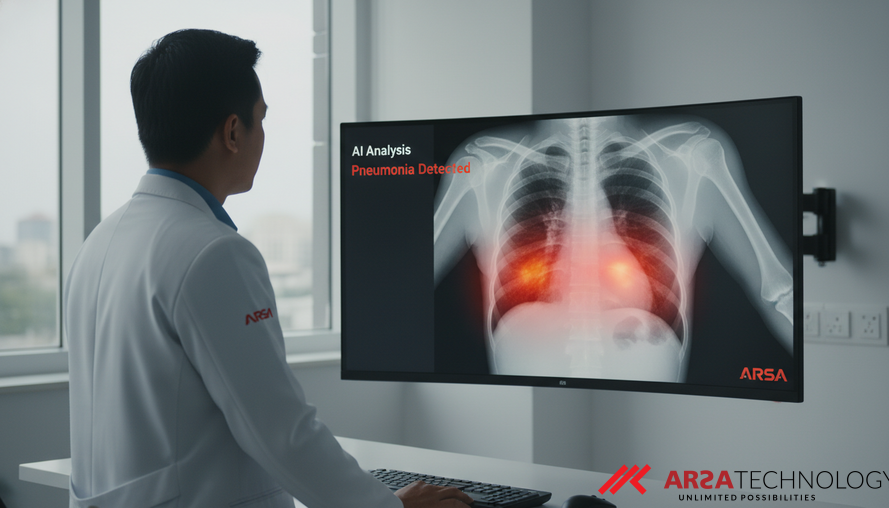
This is where Explainable Artificial Intelligence (XAI) comes in. XAI provides methods to make AI systems more transparent and understandable. Techniques such as Gradient-weighted Class Activation Mapping (Grad-CAM) and Local Interpretable Model-agnostic Explanations (LIME) are particularly valuable. These tools visualize the specific regions of an image that an AI model focuses on when making its decision. For instance, they can highlight lung consolidations or infiltrates on an X-ray image, allowing medical professionals to verify if the AI’s attention aligns with clinically relevant patterns. This visual explanation fosters collaboration between human experts and AI systems, significantly enhancing clinical trust and decision support. ARSA Technology, for example, develops robust AI Video Analytics solutions that prioritize interpretability in sensitive applications.
A Comparative Study: DenseNet121 vs. EfficientNet-B0
A recent study aimed to compare two leading deep learning architectures, DenseNet121 and EfficientNet-B0, for automated pediatric pneumonia detection from chest X-rays. Utilizing a publicly available dataset of 5,863 pediatric X-ray images, both models underwent identical training conditions, leveraging transfer learning with ImageNet pre-trained weights. The images were meticulously preprocessed—normalized, resized, and augmented—to ensure the models could generalize well to new, unseen data.
The results underscored the superior performance of EfficientNet-B0. It achieved an impressive accuracy of 84.6%, an F1-score of 0.8899, and a Matthews Correlation Coefficient (MCC) of 0.6849. While DenseNet121 also performed commendably with 79.7% accuracy, an F1-score of 0.8597, and an MCC of 0.5852, EfficientNet-B0 demonstrated a more balanced and computationally efficient classification. Crucially, both models achieved very high recall values, exceeding 0.99, indicating an excellent ability to correctly identify cases of pneumonia. The integrated explainability techniques, Grad-CAM and LIME, visually confirmed that both models consistently focused on the clinically relevant lung regions, adding a critical layer of interpretability and reinforcing the reliability of their predictions. For businesses looking to adopt cutting-edge AI, partnering with a provider like ARSA Technology, experienced since 2018, ensures access to these advanced, trustworthy technologies.
Real-World Impact and Future Implications for Healthcare
The findings of this study have profound implications for global healthcare, particularly in regions where specialized medical expertise is scarce. The deployment of AI-powered diagnostic tools like those using EfficientNet-B0 can significantly reduce diagnostic delays, improve accuracy, and provide consistent support for clinical decision-making. This translates to faster treatment initiation, better patient outcomes, and a reduction in the severe health burden of pediatric pneumonia.
Beyond direct diagnosis, such systems can alleviate the workload on medical professionals, allowing them to focus on more complex cases and critical patient care. The emphasis on explainability is vital; it not only builds trust among clinicians but also supports regulatory compliance and ethical AI deployment in sensitive medical environments. By understanding how AI arrives at its conclusions, doctors can confidently integrate these tools into their workflows, enhancing their capabilities rather than replacing them. This type of AI innovation can also be integrated into broader healthcare solutions, such as ARSA’s Self-Check Health Kiosk, enabling preliminary screenings and early detection to reduce strain on medical facilities.
In essence, these advanced AI solutions offer a powerful avenue for digital transformation in the healthcare sector. They promise to make high-quality diagnostic support more accessible, efficient, and reliable, directly contributing to the vision of a healthier future, particularly for the most vulnerable populations.
Ready to explore how advanced AI and IoT solutions can transform your organization's operations and enhance critical services? Our team is equipped to discuss your unique challenges and demonstrate how tailored technologies can deliver measurable impact.
Contact ARSA today for a free consultation.