Revolutionizing Port Logistics: AI Predictions for Efficient Container Management
Discover how AI-powered predictive analytics for service requirements and container dwell times are transforming port logistics, reducing unproductive moves, and boosting operational efficiency.

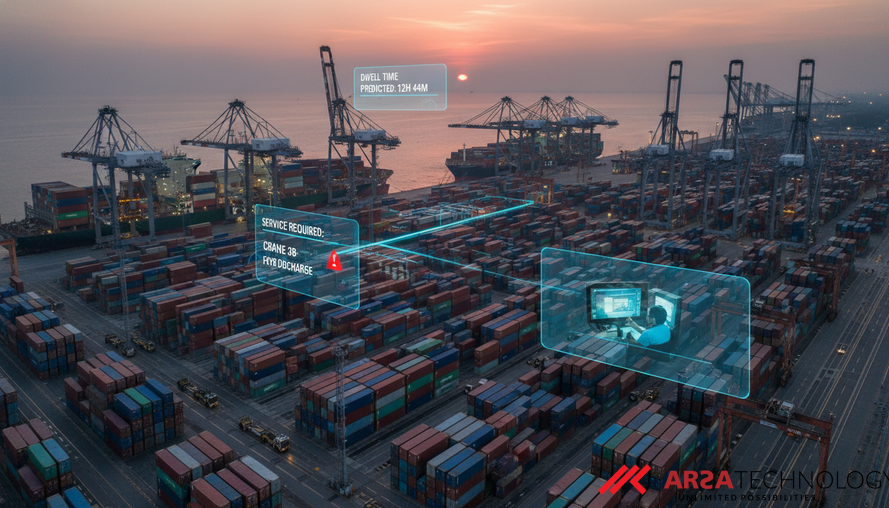
Global supply chains rely heavily on the efficiency of container terminals, which serve as crucial junctures between sea and land transportation. As international trade volumes continue to surge, the operational fluidity of these terminals directly impacts vessel turnaround times, hinterland connectivity, and overall trade performance. Optimizing these complex operations is paramount for maintaining competitiveness and ensuring reliable service delivery.
Within this intricate ecosystem, yard management stands out as one of the most challenging and impactful operational areas. Decisions regarding the placement and stacking of containers significantly influence equipment utilization, operational costs, and, critically, the number of unproductive moves. These unproductive moves, often referred to as reshuffles or rehandling moves, occur when a container needs to be accessed but is buried beneath others. Such activities consume substantial resources, including fuel, labor time, and equipment wear, making their reduction a key goal for terminal operators.
The Challenge of Unpredictability in Container Operations
Traditional methods for yard planning often rely on static heuristics or deterministic optimization models, which assume a fixed sequence of container departures. However, the reality of container terminal operations is far more dynamic and unpredictable. Container behavior is inherently stochastic, meaning it is subject to random variation. Factors such as pre-clearance administrative procedures, probabilistic consignee pickup schedules, and diverse influences like cargo type, shipping line, origin port, and seasonal factors all contribute to this unpredictability. This complex interplay makes it difficult to manually encode predictive patterns that could improve efficiency.
The stochastic nature of container movements and service requirements makes it an ideal problem for machine learning (ML). By leveraging vast amounts of historical operational data, ML models can learn subtle predictive patterns that are beyond the scope of traditional rule-based systems. This data-driven approach allows for a fundamental shift: instead of optimizing a stacking plan based on uncertain assumptions, the problem is reframed as one of precise prediction.
AI-Powered Predictions for Smarter Yard Planning
A recent data science study conducted at a container terminal highlights the transformative potential of predictive analytics in this domain. The research, titled "Toward Reducing Unproductive Container Moves: Predicting Service Requirements and Dwell Times," aimed to mitigate unproductive container moves by accurately forecasting two critical pieces of information before a container even arrives at the terminal: whether it will require pre-clearance handling services and its estimated dwell time (how long it will stay in the terminal). The full study can be found at arXiv:2604.06251.
Pre-clearance services typically involve administrative procedures by customs brokers, necessitating the repositioning of specific containers for handling. By anticipating these requirements and accurate dwell times, yard planners gain the ability to make more strategic stacking decisions. For instance, containers requiring pre-clearance can be placed closer to their designated service areas, short-stay containers can be positioned in easily accessible locations, and long-stay containers can be allocated to lower-priority zones. This proactive approach directly translates into a significant reduction in unnecessary reshuffles, enhancing operational flow and resource utilization.
Advancements in Predictive Analytics for Terminal Operations
Research in container terminal operations has steadily moved from basic rule-based systems to sophisticated data-driven strategies utilizing machine learning for enhanced yard efficiency. A significant area of focus has been the prediction of container dwell times, which is crucial for optimizing yard space. Early models, such as those using Artificial Neural Networks (ANNs), identified key factors like discharge timing, port of origin, container dimensions, and cargo type as major determinants.
More advanced studies have employed ensemble machine learning methods, like Random Forest, XGBoost, and LightGBM, consistently demonstrating that ML models surpass traditional operational benchmarks. These models analyze millions of container records to pinpoint factors such as free storage periods, transshipment status, and geographical proximity to industrial hubs as strong predictors of dwell-time variations. The push for transparent and actionable insights has also led to the integration of Explainable AI (XAI) techniques, which help operators understand the critical factors influencing dwell times, fostering greater adoption and trust in these advanced systems.
Integrating Prediction with Optimization for Real-World Impact
While substantial progress has been made in predicting dwell times and optimizing stacking plans separately, a crucial gap remains in seamlessly integrating these predictive outputs directly into real-time operational decisions. Many studies focus on either prediction or optimization in isolation, leaving a void for solutions that bridge the two. The research mentioned above addresses this by developing a decision support system that first predicts dwell times using machine learning and then uses these predictions to inform heuristics aimed at minimizing reshuffles.
This integrated approach represents a significant step forward, moving beyond theoretical models to practical applications that enhance efficiency. For organizations like ARSA Technology, specializing in AI and IoT solutions, the ability to combine advanced analytics with operational insights is central to delivering tangible business value. For instance, ARSA's AI Video Analytics can transform passive CCTV streams into real-time intelligence, detecting operational anomalies and providing data critical for such predictive models.
The ARSA Approach to Operational Intelligence
At ARSA Technology, we understand that effective AI solutions must be designed for the demanding realities of enterprise environments. Our core expertise in Artificial Intelligence, especially Computer Vision and Predictive Analytics, combined with Industrial IoT, enables us to develop systems that directly address complex operational challenges. Our solutions are built to provide actionable intelligence that reduces costs, increases security, and creates new revenue streams, all while prioritizing privacy-by-design and practical deployment realities.
For example, our ARSA AI Box Series offers pre-configured edge AI systems that combine robust hardware with powerful video analytics software for rapid, on-site deployment. These systems can process video streams locally at the edge, ensuring low latency and data privacy—critical considerations in port logistics and other sensitive industrial environments. Such edge computing capabilities are essential for enabling real-time decision-making, which is at the heart of reducing unproductive moves and optimizing resource allocation. ARSA has been experienced since 2018 in developing and deploying such solutions across various industries.
Business Implications and Future Outlook
The practical value of predictive analytics in container terminal logistics is undeniable. By consistently outperforming existing rule-based systems and random baselines in terms of precision and recall, these machine learning models demonstrate their capability to significantly improve operational efficiency. The ability to predict service requirements and dwell times provides a valuable input for strategic planning, leading to optimized resource allocation and a reduction in costly, unproductive container movements. This translates directly into measurable ROI through decreased operational expenses and improved service reliability.
As global trade continues to expand, the demand for sophisticated, data-driven solutions in port management will only grow. Integrating predictive AI with existing operational workflows offers a clear path towards more resilient, efficient, and cost-effective supply chains.
Ready to transform your logistics operations with intelligent AI and IoT solutions? Explore ARSA Technology's innovative products and services, and contact ARSA for a free consultation to engineer your competitive advantage.