Revolutionizing Video AI: Opto-Atomic Processors for High-Speed 3D CNNs
Explore how opto-atomic spatio-temporal holographic correlators are poised to overcome computational bottlenecks in 3D CNNs, enabling ultra-fast video recognition for enterprises.

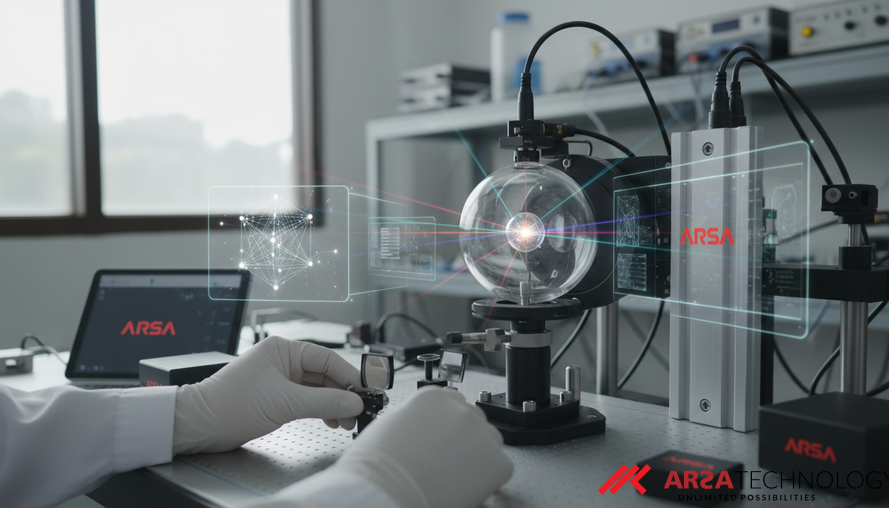
The modern digital landscape is increasingly dominated by video content, moving beyond static images to dynamic, information-rich sequences. From smart city surveillance to autonomous vehicle navigation and human action recognition, the demand for sophisticated video understanding by artificial intelligence is skyrocketing. However, processing this wealth of visual data comes with a significant computational burden, especially for advanced tasks that require analyzing both spatial (within-frame) and temporal (across-frame) information simultaneously. A groundbreaking approach leveraging opto-atomic spatio-temporal holographic correlators is emerging to tackle these challenges, promising to revolutionize how enterprises deploy high-speed video AI.
The Growing Demand for 3D Video Analytics
Traditionally, AI for image recognition has focused on two-dimensional (2D) data, achieving remarkable feats with convolutional neural networks (CNNs). Yet, when it comes to video, a static image only tells part of the story. Consider distinguishing between a person walking and a person running; a single frame might show similar postures, but the sequence of frames reveals distinct motion patterns. This is where 3D CNNs come into play. By extending convolution kernels into the temporal dimension, 3D CNNs learn not just spatial features but also how these features evolve over time, making them indispensable for complex video understanding tasks like Human Action Recognition (HAR), intelligent surveillance, and manufacturing quality control.
Pioneering architectures like the C3D network demonstrated the power of 3D kernels to learn spatio-temporal features from video datasets. This capability, while transformative, is incredibly resource-intensive. Unlike their 2D counterparts, 3D CNNs face a "cubic scaling" problem, meaning that as video resolution and frame rates increase, the computational time and energy consumption grow exponentially. This burden becomes unsustainable for conventional silicon-based hardware, limiting the size of kernels and the ability to capture long-range temporal dependencies crucial for truly understanding complex activities. While factorized architectures, such as R(2+1)D networks, have attempted to reduce this computational load by decoupling spatial and temporal convolutions, they inherently sacrifice the intrinsic coupling between space and time that is critical for certain advanced applications.
Opto-Atomic Holography: A New Paradigm for AI Acceleration
To overcome these fundamental limitations, researchers are exploring innovative hybrid optoelectronic architectures. The core idea is to offload the most computationally demanding parts of AI processing – specifically the 3D convolutional layers – to the optical domain, where light can perform calculations at speeds unimaginable for electronic circuits. A particularly promising development in this field is the use of opto-atomic Spatio-temporal Holographic Correlators (STHCs) as detailed in a recent paper by Shen et al. (Shen et al., 2024).
At the heart of this innovation lies a unique property of cold Rubidium-85 atoms. These atoms can store temporal information as "atomic coherence" – a quantum-mechanical phenomenon where atoms retain a memory of the light they've interacted with. By carefully structuring the atomic medium, temporal information from a video sequence can be imprinted as a "grating in the frequency domain." When a new video sequence (the "query") is passed through this atomic memory, if it matches the stored information, a specific optical signal is generated, effectively performing a correlation. This process is analogous to how stimulated photon echoes work, where light pulses are re-emitted based on stored holographic information.
How Hybrid Optoelectronics Redefines AI Processing
The STHC system integrates this atomic temporal memory with a traditional 2D optical spatial correlator. This allows for the simultaneous processing of both spatial and temporal features within video data. Imagine each group of atoms acting as a pixel in a 2D array, covering a small sub-band of spatial frequencies. This clever arrangement enables the system to perform a 3D correlation – across both the width, height, and time dimensions of a video – in a single optical step.
In a hybrid system, the computationally intensive 3D convolution, which is typically the most power-hungry part of a 3D CNN, is delegated to this optical STHC layer. The remaining layers of the neural network, which involve non-linear activation functions and other logical operations, can still be handled by conventional digital electronics. This division of labor offers significant advantages:
- Massive Speed Increase: Optical processing can operate at speeds far exceeding digital processors.
- Energy Efficiency: Passive optical components consume significantly less power than electronic transistors performing the same complex calculations.
- Addressing Cubic Scaling: The optical correlation inherently handles the 3D data without the cubic increase in computational resources experienced by digital methods.
Companies like ARSA Technology, which specializes in real-time AI Video Analytics and edge AI systems, understand the critical need for such high-speed, efficient processing in demanding environments. Developing custom AI solutions that leverage cutting-edge hardware, whether traditional or novel hybrid architectures, is essential for truly transformative applications.
Real-World Performance and Future Potential
The research demonstrates promising results, achieving a classification accuracy of 59.72% on a four-class human action dataset. While this number might seem modest compared to some state-of-the-art digital systems on larger datasets, the significance lies in the scale of the kernels processed (30x40 pixels spatially and 8 frames temporally) and the unprecedented speed projections. The STHC-based optical layer is projected to operate at speeds up to an astonishing 125,000 frames per second. To put this into perspective, current state-of-the-art digital 3D CNNs operate around 350-400 frames per second. This represents more than a two orders of magnitude speed improvement, opening doors for truly real-time, high-volume video analysis that was previously impossible.
This massive acceleration, coupled with the ability to maintain full spatial resolution and allocate multiple convolution kernels for parallel channel processing, has profound implications for industries requiring instant decision-making. Imagine intelligent surveillance systems that can identify complex behaviors in real-time across hundreds of cameras, or autonomous systems that can react to dynamic environments with unparalleled speed. The hybrid optoelectronic approach, as demonstrated by the STHC, offers a pathway to making such high-performance video AI a practical reality for global enterprises.
ARSA Technology, experienced since 2018 in delivering production-ready AI and IoT systems, is continuously exploring and developing solutions that push the boundaries of performance and efficiency. Our focus on practical, proven, and profitable AI deployment means we are consistently evaluating how advancements like opto-atomic processing can translate into tangible benefits for our clients across various industries.
This research highlights a crucial shift: rather than trying to make digital computers do everything faster, we are learning to delegate specialized, computationally intensive tasks to domains where physics itself offers a fundamental advantage. The future of AI processing will likely involve a sophisticated blend of digital and analog, electronic and optical, pushing the boundaries of what's possible in real-time intelligence.
To explore how ARSA Technology can help your enterprise harness the power of advanced AI and IoT solutions, including high-speed video analytics and custom system development, we invite you to contact ARSA for a free consultation.