Rivian's Strategic Shift: Powering Future Growth with R2 Production and Advanced AI Integration
Rivian's Q1 2026 results highlight a strategic pivot towards R2 production and a significant boost in software revenue. Discover how AI and IoT drive its autonomous future and industry partnerships.

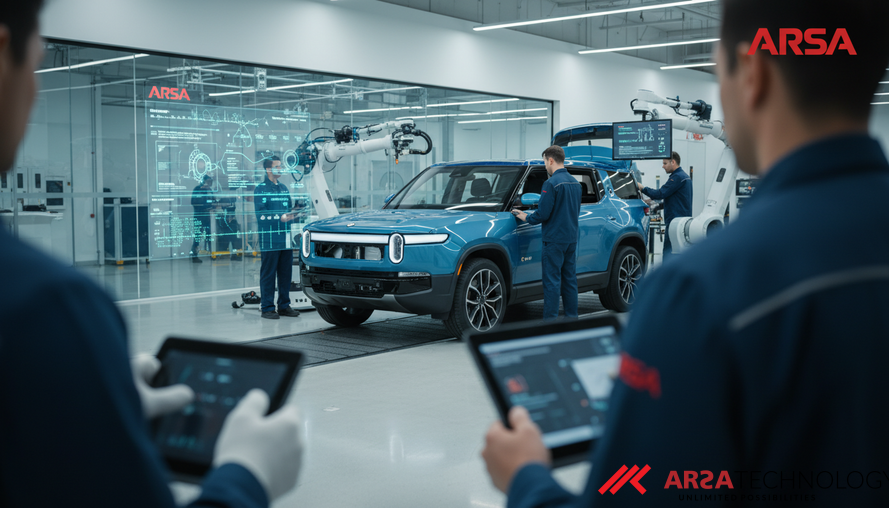
Rivian, a prominent player in the electric vehicle (EV) market, recently unveiled its first-quarter earnings for 2026, signaling a pivotal moment as it gears up for the mass production of its highly anticipated R2 electric SUV. These results provide critical insights into the company’s financial health and its strategic direction amid evolving market dynamics for EVs. The earnings report, as detailed by The Verge, underscores a significant shift towards leveraging software and advanced AI capabilities to secure future growth and achieve ambitious profitability targets.
Q1 2026 Performance and Revenue Dynamics
Rivian's first quarter saw a solid increase in both production and deliveries, demonstrating operational improvements. The company delivered 10,365 vehicles, marking a 20 percent year-over-year increase, while producing 10,236 vehicles at its Normal, Illinois factory, a robust 30 percent rise compared to the same period last year. Total revenue reached $1.38 billion, representing an 11.3 percent increase from $1.24 billion in Q1 2025. This growth is particularly notable given the current climate where overall EV sales have shown signs of slowing down.
While overall revenue grew, a deeper dive into the numbers reveals a strategic rebalancing. Automotive revenue for the quarter was $908 million, a slight decrease of 1.5 percent year-over-year. This dip was primarily attributed to a $100 million decrease in sales of automotive regulatory credits and lower production volumes for certain models. In contrast, revenue from software and subscription services surged to $473 million, an impressive 48.7 percent increase from Q1 2025. This significant jump highlights Rivian’s proactive strategy to diversify its income streams by capitalizing on digital products, such as its recently introduced Autonomy Plus package. This trend mirrors a broader industry move towards software-defined vehicles, where recurring revenue from digital services becomes a crucial profit driver.
The Strategic Importance of the R2 and Profitability Goals
The R2 electric SUV is central to Rivian’s long-term financial stability and market expansion. Positioned as a more affordable, mid-sized SUV, the R2 is designed to appeal to a wider consumer base, especially as government incentives for EV purchases, such as the federal $7,500 EV tax credit, become less impactful. The company is betting heavily on the R2 to boost sales and solidify its financial footing, simultaneously investing in a new manufacturing facility and groundbreaking autonomous driving projects. A timely launch is critical, with initial R2 deliveries expected to commence in June.
Rivian’s journey to profitability has seen significant efforts, including cost-slashing initiatives that led to its first-ever gross profit in 2025. The company remains committed to achieving positive gross profit margins by the end of 2026 and aims to sell over 20,000 R2 vehicles within the year, even after facing challenges like a tornado damaging a portion of its factory. This resilience and focus on strategic goals are indicative of the intense competition and high stakes within the advanced automotive sector.
Pioneering Autonomous Driving with AI and Lidar
Beyond vehicle production, Rivian is making substantial investments in the foundational technologies for autonomous driving. The company recently announced plans to design its own AI chips and integrate lidar sensors into future R2 models. These components are essential for powering fully autonomous driving capabilities, enabling vehicles to perceive their environment with exceptional accuracy and process complex data in real-time. This move towards proprietary AI hardware emphasizes the industry's drive for optimized performance, energy efficiency, and data control for advanced driver-assistance systems (ADAS) and autonomous vehicles.
The development of custom AI chips and the deployment of advanced sensors like lidar necessitate sophisticated AI Video Analytics and edge AI processing capabilities. These systems allow vehicles to make instantaneous decisions by analyzing vast amounts of sensor data directly on-board, rather than relying solely on cloud processing. This approach is critical for minimizing latency and enhancing safety, crucial factors for self-driving technology. Companies like ARSA Technology, with expertise in edge AI systems, play a vital role in enabling such real-world deployments by providing robust, on-premise, and hardware-agnostic solutions that ensure data privacy and operational reliability.
Expanding Ecosystem Through Partnerships and Robotaxis
Rivian's strategic growth is not limited to its own product line but extends to powerful partnerships that will shape the future of automotive software and mobility services. A significant milestone was achieved through its software joint venture with Volkswagen, unlocking an additional $1 billion investment from the German auto giant. Volkswagen has pledged a total of $5.8 billion in Rivian, contingent on meeting specific developmental goals. This collaboration is focused on developing a next-generation software platform, leveraging Rivian’s innovative zonal architecture, which will eventually be integrated into various Volkswagen Group brands, including Audi, Scout, and Porsche. This collaboration highlights the importance of scalable and integrated AI platforms in modern vehicle design.
Furthermore, Rivian secured a landmark deal with Uber to supply tens of thousands of R2 vehicles for use as robotaxis. Uber's commitment includes a $1.25 billion investment, with an initial $300 million at signing. This partnership positions Rivian at the forefront of the burgeoning robotaxi market, demonstrating the versatility of its vehicles and its growing influence in the autonomous mobility landscape. Deploying vehicles as robotaxis requires highly accurate and secure identification and verification systems, potentially leveraging solutions like the ARSA AI API for user authentication and fleet management.
The Broader Impact of AI and IoT in Automotive
Rivian's strategic moves—from ramping up R2 production and increasing software revenue to investing in AI chips for autonomous driving and forging significant partnerships—illustrate a clear vision for the future of the automotive industry. This future is deeply intertwined with the capabilities of Artificial Intelligence and the Internet of Things. As vehicles become increasingly intelligent, connected, and autonomous, the demand for robust, secure, and scalable AI and IoT solutions will continue to grow.
Enterprises across various sectors are recognizing the transformative potential of these technologies. From enhancing manufacturing efficiency with smart sensors and predictive analytics to ensuring the safety and intelligence of urban infrastructure, AI and IoT offer tangible benefits. For instance, edge AI systems, such as the ARSA AI Box Series, can be deployed in diverse environments to provide real-time insights without cloud dependency, preserving privacy and minimizing latency. These systems are crucial for applications ranging from industrial safety monitoring and traffic management to advanced robotics and autonomous fleets, ensuring that intelligence is deployed directly where it matters most.
ARSA Technology has been experienced since 2018 in developing production-ready AI and IoT solutions for various industries, translating complex technical capabilities into practical business outcomes for global enterprises. We understand that success in this rapidly evolving landscape hinges on strategic integration of cutting-edge technology with operational realities.
To explore how advanced AI and IoT solutions can transform your operations and drive measurable impact, we invite you to contact ARSA for a free consultation.
Source: The Verge