TEACar: Advancing Autonomous Driving Research with Modular Edge AI Platforms
Explore TEACar, an open-source autonomous driving platform designed for robust hardware-in-the-loop validation. Learn how its modular design and edge AI capabilities offer a scalable, cost-effective testbed for ITS research, mirroring enterprise-grade AI deployment principles.

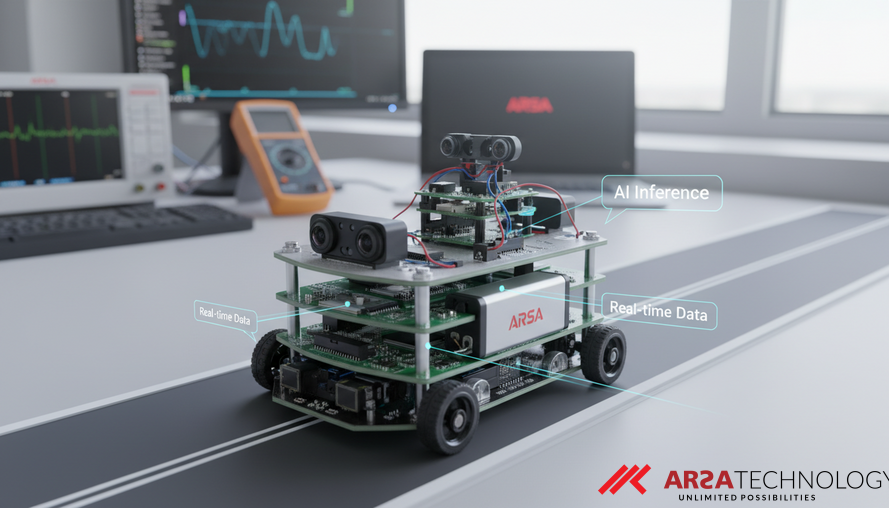
Intelligent Transportation Systems (ITS) are rapidly evolving, driven by advancements in artificial intelligence, particularly in areas like vision-based perception and learning-based control. To ensure these sophisticated algorithms function reliably in the real world, rigorous testing beyond simulations is paramount. This necessitates experimental platforms that facilitate "hardware-in-the-loop" validation, where algorithms are tested on actual physical hardware operating under realistic conditions. The TEACar platform emerges as a significant innovation in this space, offering a scalable, modular, and cost-effective solution for autonomous driving research and development, as detailed in the paper "TEACar: An Open-Source Autonomous Driving Platform" by Zhongzheng Zhang et al..
The Critical Need for Hardware-in-the-Loop Validation
While simulations offer a convenient and cost-effective starting point for developing autonomous algorithms, they cannot fully replicate the complexities and uncertainties of physical environments. Factors like sensor noise, subtle mechanical tolerances, real-world lighting changes, and unexpected interactions are often difficult to model accurately. Consequently, validating algorithms on physical hardware is crucial for ensuring robustness, evaluating true performance, and understanding system-level behaviors.
Building and maintaining full-scale autonomous vehicles for experimental verification, however, presents substantial challenges. It demands significant financial investment, extensive infrastructure, rigorous safety protocols, and considerable operational resources. This is where small-scale autonomous vehicle platforms become invaluable. Despite their smaller size, these platforms effectively replicate the essential sensing-computation-control feedback loop found in full-scale systems, providing a practical and accessible testbed for validating perception, planning, and control algorithms without the prohibitive costs and complexities of larger setups.
Limitations of Existing Small-Scale Platforms
Before TEACar, several small-scale platforms aimed to address the need for accessible autonomous vehicle research. RoboRacer (formerly F1TENTH), a 1/10-scale platform, is widely adopted and utilizes high-performance embedded computing units like NVIDIA® Jetson devices, along with sensors such as LiDAR. While powerful, its tight coupling to a specific chassis limits mechanical flexibility, its larger physical footprint restricts deployment in many lab environments, and its cost can be excessive for vision-focused research.
Another popular option, Donkeycar, is a low-cost, open-source platform primarily designed for vision-based tasks and offers high customization. It typically runs on lightweight embedded units like Raspberry Pi®. However, Donkeycar’s design often relies on separate power sources for computation and actuation, increasing hardware complexity. Its largely Python-based, non-modular software stack can also limit real-time performance for intensive workloads and reduce extensibility. Furthermore, adapting it to different chassis configurations often requires substantial redesign of 3D-printed structural components, hindering rapid mechanical reconfiguration.
Introducing TEACar: A New Paradigm for Autonomous Research
TEACar, a 1/14- to 1/16-scale autonomous racing platform, was specifically developed to overcome the limitations of previous designs by emphasizing modularity and hardware abstraction. Its design supports a wide array of experimental configurations, making it highly adaptable for various research needs. At its core, TEACar features a four-layer deck architecture that physically separates key subsystems: sensing, computation, actuation, and power. This intelligent decoupling not only enhances structural rigidity but also simplifies assembly, maintenance, and component replacement.
On the software front, TEACar utilizes the Robot Operating System (ROS) 2. ROS 2 provides a standardized, extensible middleware layer for managing sensing, communication, and control tasks. This modular software approach allows researchers to easily integrate new algorithms, sensors, or actuators without overhauling the entire system. Furthermore, a dedicated power distribution board ensures safe and reliable operation for all onboard components, accommodating varying voltage requirements and simplifying power management, a common challenge in smaller robotics platforms. For enterprises seeking to deploy real-world AI solutions with similar modularity and robust power management, ARSA Technology provides cutting-edge AI Box Series, specifically designed for edge deployment across various industries.
Engineering for Performance: Mechanical Stability and AI Capabilities
The TEACar prototype underwent comprehensive evaluation to quantify its mechanical characteristics and structural rigidity. The innovative four-layer design ensures that the platform remains stable even under dynamic racing conditions, a critical factor for accurate data collection and consistent algorithm performance. This physical decoupling allows for precise isolation and upgrades of individual components, greatly simplifying troubleshooting and future enhancements.
In terms of software performance, TEACar was tested by deploying three different Convolutional Neural Network (CNN)-based steering controllers. CNNs are a type of artificial neural network particularly effective for processing visual data, allowing the platform to learn how to steer by analyzing camera images. For each neural controller, key performance metrics were measured:
- Inference Latency: The time taken for the AI model to process camera input and generate a steering command. Low latency is crucial for real-time control in autonomous systems.
- Power Consumption: The amount of energy the system uses during operation, which directly impacts battery life and efficiency, especially for edge devices.
- System Operating Time: The duration the platform can run on its onboard power supply.
The experimental results definitively demonstrated that TEACar provides a mechanically stable structure while maintaining sufficient computational performance for demanding learning-based control tasks. This capability for efficient, on-device AI processing aligns with the principles of edge AI, minimizing reliance on cloud infrastructure for real-time decisions. ARSA Technology, for instance, offers AI Video Analytics solutions that leverage edge processing to deliver real-time insights for security, safety, and operational intelligence in critical environments, much like TEACar's on-board processing for autonomous control. ARSA has been experienced since 2018 in developing such practical AI applications.
Key Findings and Business Implications
The development and rigorous evaluation of the TEACar platform underscore several significant findings:
- Scalability: The modular design allows researchers to scale experiments from single components to complex multi-sensor setups.
- Modularity: Its decoupled architecture simplifies component integration, replacement, and system reconfiguration, reducing development time and effort.
- Cost-Effectiveness: Small-scale platforms significantly lower the barrier to entry for autonomous vehicle research and education compared to full-scale alternatives.
- Robustness: Demonstrated mechanical stability and computational performance for real-time AI control tasks.
For enterprises and institutions investing in AI and IoT, these findings hold substantial business implications. A platform like TEACar facilitates faster iteration in research and development, allowing engineers to rapidly prototype and validate new AI models in a controlled, realistic environment before committing to expensive full-scale deployments. The emphasis on modularity also translates to reduced maintenance costs and increased flexibility in upgrading or adapting systems to evolving needs. By focusing on efficient edge processing, TEACar highlights a future where AI solutions deliver instant insights with enhanced privacy and reduced network dependency, critical for applications ranging from industrial automation to smart city infrastructure.
Ready to explore how advanced AI and IoT solutions can transform your operations? Learn more about ARSA Technology's enterprise-grade AI video analytics, edge AI systems, and custom AI solutions that bring practical AI from research to profitable real-world deployment. Begin your strategic dialogue today and contact ARSA for a free consultation.
Source: "TEACar: An Open-Source Autonomous Driving Platform" by Zhongzheng Zhang et al.