The Evolving Face of Journalism: Who Controls the Narrative in the Digital Age?
Explore how the Luigi Mangione case highlights the blurred lines between journalists, influencers, and activists, and the challenges of narrative control in an AI-driven information ecosystem.

The Luigi Mangione Case: A Flashpoint for Media Ethics
In an increasingly digitized world, the lines between traditional journalism, independent content creation, and activism are becoming profoundly blurred. This ongoing transformation has been vividly underscored by the legal saga surrounding Luigi Mangione, who stands accused of the murder of United Healthcare CEO Brian Thompson. A recent pretrial hearing, as reported by Mia Sato on May 21, 2026, brought into sharp focus questions about who truly gets to “own” a public narrative and what constitutes legitimate press in an era of rapid information dissemination.
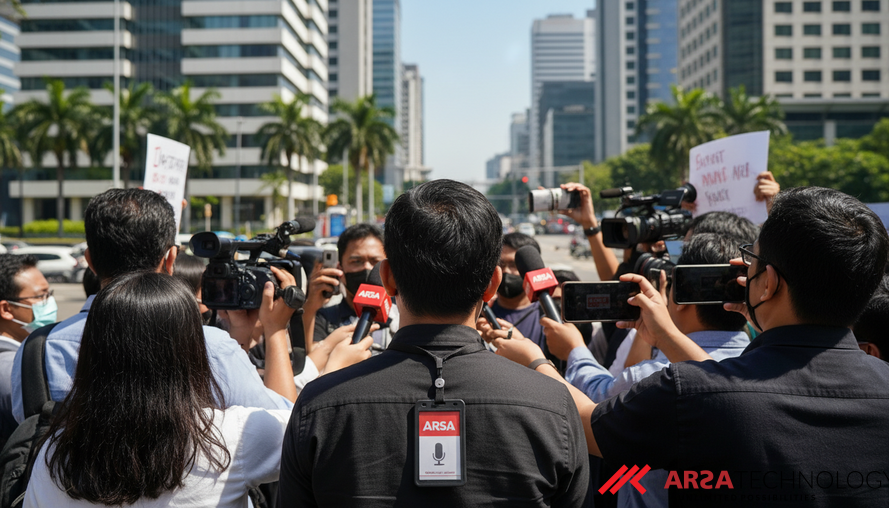
The incident that sparked this debate involved several vocal supporters of Mangione, dubbed "The Mangionistas," making inflammatory statements outside the New York courthouse. These individuals, some of whom disparaged the victim’s family and the for-profit healthcare industry, were observed wearing New York City-issued press credentials. This revelation quickly escalated what might have been a minor news item into a significant controversy, prompting a city-wide review of journalistic credentialing practices and highlighting the complex challenges of managing public discourse in the digital age.
The Blurring Lines of Modern Media
The core of the issue lies in the city's broad definition of a "member of the press," which includes anyone who "gathers and reports the news, by publishing, broadcasting, or cablecasting articles, commentaries, books, photographs, video, film, or audio by electronic, print, or digital media, such as radio, television, newspapers, magazines, wires, books, and the Internet." This inclusive definition, while intended to embrace evolving media formats, creates a significant "definitional quagmire." It challenges traditional notions of what separates a reporter from an eyewitness posting on social media, or a formal news story from a personal essay on a blog. The question of whether platforms like Substack essays hold the same journalistic weight as conventionally reported stories, and how to disentangle personal opinion from factual reporting, becomes critically important.
This ambiguity is not new; past incidents, such as a right-wing political candidate reportedly obtaining a press pass, underscore a pattern of lax credentialing that has troubled local reporters for some time. The problem is exacerbated by the rise of "news influencers" who often summarize or react to news without conducting original reporting. In an ecosystem where institutions and powerful figures sometimes engage directly with these non-traditional media personalities, the standards of journalistic rigor can easily be compromised. The incident with the Mangionistas, who appeared to be advocates rather than neutral observers, forced City Hall into the unenviable position of refereeing what constitutes acceptable conduct for credentialed media.
Technology's Role in Shaping and Controlling Narrative
The challenges of defining and authenticating media go hand-in-hand with technological advancements. In a world increasingly shaped by AI and vast digital networks, the ability to generate, disseminate, and control narratives has become more sophisticated yet also more vulnerable. From AI-powered content generation that can mimic journalistic styles to sophisticated deepfake technology, the veracity of online information is under constant scrutiny. This makes the task of distinguishing credible reporting from biased advocacy even harder.
For enterprises and public institutions, managing public perception and ensuring the integrity of information is paramount. Technologies that can help verify identities and secure access to sensitive information are more critical than ever. For instance, advanced ARSA AI API for face recognition and liveness detection can play a pivotal role in secure identity management, ensuring that only authorized individuals gain access to restricted areas or sensitive data. This is crucial not only for physical security, such as courthouse access, but also for digital authentication in an age where online identities are constantly being verified.
The "Internet's Favorite Defendant" and Public Participation
The Luigi Mangione case is particularly complex because it has transcended traditional legal proceedings to become a social phenomenon. Mangione has been dubbed "the internet's favorite defendant," attracting fervent support that manifests in substantial legal defense fund contributions and an inundation of letters. This widespread public participation, fueled by social media, transforms a trial into a battle for narrative control. Supporters view Mangione as anything from a folk hero to a symbol of the US healthcare system's failures, making a unified public understanding of the case nearly impossible.
This phenomenon highlights the inherent messiness when an individual on trial for murder becomes a public celebrity. The comments made by the Mangionistas, which were condemned by Mangione’s legal team and even by other supporters, reveal the internal tensions within this broad community. While many supporters advocate for healthcare reform and a fair trial, others appear more interested in sensationalism, diverting focus from the legal proceedings and potentially damaging Mangione’s public image. Organizations trying to monitor and understand public sentiment or ensure safety in public gatherings could leverage tools like AI Video Analytics to track crowd density and behavioral patterns, offering insights into real-time situations without compromising individual privacy.
Beyond the Headlines: Implications for Global Operations
The implications of this incident stretch far beyond a single courthouse in New York. The debate over press credentials and narrative control is a microcosm of larger shifts in how information is produced, consumed, and authenticated globally. For businesses, governments, and critical infrastructure operators, understanding and navigating this evolving media landscape is vital. It impacts everything from crisis communication and brand reputation to public safety and regulatory compliance.
As organizations adapt to these changes, the demand for robust and ethical technology solutions will only grow. Ensuring secure identity verification, monitoring public environments responsibly, and processing vast amounts of information for actionable intelligence become foundational elements of modern operations. ARSA Technology, an AI & IoT solutions provider experienced since 2018, designs and deploys AI solutions engineered for accuracy, scalability, privacy, and operational reliability in mission-critical environments.
The Luigi Mangione story, as it unfolds, serves as a potent reminder of the ever-evolving nature of media, the challenges of truth in a digital ecosystem, and the critical need for clear ethical boundaries in an increasingly complex world.
To explore how advanced AI and IoT solutions can help your organization navigate complex operational and informational challenges, we invite you to contact ARSA for a free consultation.
Source: Mia Sato, "Who gets to own the Luigi Mangione story?", The Verge, May 21, 2026. https://www.theverge.com/news/935598/luigi-mangione-new-york-case-press-credentials-supporters