Thermal-Only Crowd Counting: Advancing Privacy and Accuracy with AI
Explore ARSA Technology's insights into thermal-only crowd counting, leveraging AI and diffusion models to enhance accuracy while eliminating RGB data for superior privacy in surveillance.

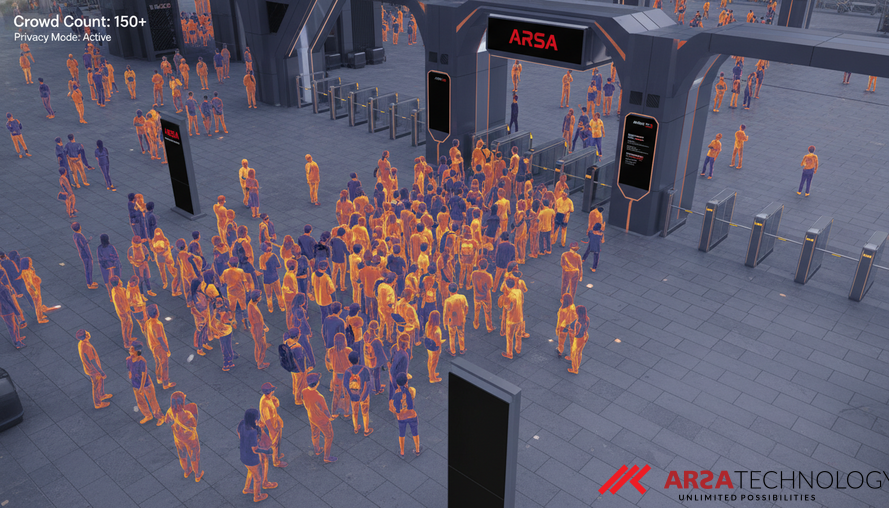
The Evolving Landscape of Crowd Counting: Challenges and Opportunities
Crowd counting, the process of estimating the number of individuals in images or videos, is a critical application for public safety, urban planning, and event management. Despite significant technological advancements, this field continues to face substantial challenges. High crowd density, occlusions where individuals block each other from view, and diverse environmental conditions like varying light levels all complicate accurate measurement. Traditional camera systems, relying on visible light (RGB), struggle particularly in low-light environments and at night. More importantly, they raise considerable privacy concerns by capturing identifiable features of individuals, such as faces, which can be stored and potentially misused.
To address the robustness issues of RGB cameras, many solutions have incorporated thermal imaging, leading to what is known as RGB-Thermal (RGB-T) crowd counting. Thermal cameras capture heat signatures, allowing them to function effectively regardless of lighting conditions. This combination initially appeared promising, with RGB providing rich visual details in well-lit scenarios and thermal offering consistent performance in darkness. However, the fusion of these two modalities introduces its own set of problems, primarily multi-modal misalignment. This occurs when RGB and thermal cameras, due to differences in sensor placement or acquisition timing, capture objects with spatial and temporal inconsistencies, degrading the overall performance. Furthermore, the fundamental privacy issue of continuous RGB data capture in public spaces remains unresolved.
Addressing Privacy and Performance with Thermal-Only Vision
The limitations of traditional RGB and complex RGB-T fusion methods have led researchers to explore a new hypothesis: can a single, well-optimized modality achieve performance comparable to or even surpass dual-modality systems, especially when augmented with intelligent processing? This question drives the development of thermal-only solutions for crowd counting, aiming to eliminate the need for RGB data during operational deployment. A thermal-only approach offers two crucial advantages. Firstly, thermal imaging operates consistently across all lighting conditions, overcoming the fundamental limitation of visible light cameras in darkness. While thermal images might exhibit ambiguities—struggling to differentiate between humans and other heat sources—these can be mitigated through advanced AI techniques.
Secondly, and most significantly for widespread adoption, thermal imaging substantially enhances privacy protection in public surveillance. By capturing only heat signatures, thermal cameras avoid recording visually identifiable features. This aligns with increasing global demands for privacy-conscious monitoring solutions. It’s important to distinguish between using RGB data during the training phase (in controlled, ethical environments) and capturing it continuously in public spaces during deployment. Thermal-only inference eliminates the latter, which is the primary source of privacy risk in real-world surveillance. While no system offers absolute privacy, thermal-only frameworks represent a substantial step forward in mitigating such risks.
TD-Count: A Novel Framework for Privacy-Preserving AI
A groundbreaking framework, named TD-Count, has been introduced as the first thermal-only solution specifically designed for RGB-T crowd counting scenarios (Yifei Qian et al., Thermal-Only Crowd Counting with Deployment-Time Privacy Protection). This innovative system directly tackles the inherent ambiguity of thermal representations by leveraging a sophisticated technique: a pretrained depth-to-RGB diffusion model. In simple terms, a "diffusion model" is a type of AI that can generate realistic images by gradually removing noise from a random starting point. In this context, the model uses inferred "depth maps" (information about the distance of objects) from thermal images to reconstruct or infer rich, structural "RGB-like" features, thereby acting as a powerful "cross-modal bridge."
The key insight is that by extracting these discriminative features from thermal data through the diffusion model, the system can enhance its understanding of a scene without ever requiring actual RGB input during real-time operation. Traditional diffusion models can be computationally intensive, requiring many "denoising steps." To overcome this, TD-Count employs Latent Consistency Models (LCMs), which are optimized to achieve meaningful feature extraction in very few steps, making them practical for deployment. Crucially, the researchers found that using only the initial denoising step provides features most faithful to the structural content, leading to higher counting accuracy. Multi-step denoising, while enhancing perceptual refinement, tends to decouple features from the original structural information, accumulating errors that degrade counting performance. ARSA Technology, with expertise gained since experienced since 2018, recognizes the value of such innovative AI deployments in enhancing operational intelligence.
Key Innovations and Business Advantages
The TD-Count framework represents a significant leap forward in AI-powered surveillance, offering three core contributions:
- Thermal-Only Inference: It provides the first framework for thermal-only crowd counting within the RGB-T paradigm, effectively using diffusion-based cross-modal priors to remove the dependency on RGB data during deployment. This directly translates to reduced infrastructure costs, simplified installation, and operational consistency across all lighting conditions.
- Efficient Feature Learning: By using an LCM-based feature learning framework and demonstrating the superiority of single-step denoising, the research highlights an optimized approach to extracting highly discriminative features from thermal images. This ensures accuracy while minimizing computational overhead, making it suitable for edge deployments. For enterprises looking for robust, on-premise solutions, platforms like ARSA's AI Box Series can integrate such advanced thermal analytics, ensuring data sovereignty and low latency.
- Enhanced Deployment-Time Privacy: The most critical advantage is the substantial reduction in privacy exposure for public surveillance. By eliminating continuous RGB data capture, the framework addresses a major ethical and regulatory concern in real-world deployments. This makes AI video analytics for crowd management, like those offered by ARSA AI Video Analytics, more compliant with data protection standards such as GDPR and other privacy regulations, reducing legal and reputational risks for organizations.
Real-World Impact and Future of Surveillance
The findings from the TD-Count research demonstrate that the RGB modality is not indispensable for accurate crowd counting. By achieving competitive performance against state-of-the-art RGB-T fusion methods using only thermal input during inference, this approach opens new avenues for privacy-conscious and highly reliable surveillance systems. Industries ranging from urban planning and public safety to retail and event management can benefit immensely. For example, in smart cities, thermal-only crowd counting can provide critical data for traffic flow optimization and emergency response without compromising citizen privacy. In industrial settings, it can monitor crowd density in hazardous areas or manage personnel flow efficiently.
This development underscores a broader trend in AI: the intelligent utilization of existing data and advanced models to overcome inherent sensor limitations and address societal concerns like privacy. By proving that robust, accurate crowd counting can be achieved with thermal cameras alone, this research paves the way for more ethical, efficient, and versatile AI deployments in various mission-critical environments.
To explore how advanced AI and IoT solutions can transform your operations with enhanced privacy and accuracy, we invite you to contact ARSA for a free consultation.