Unleashing Edge AI: How Optimized Neural Networks Transform Business Operations
Discover how optimized Deep Neural Networks, leveraging innovations like SparseLUT and FPGA technology, deliver faster, more efficient AI at the edge for businesses. Explore practical applications and real-world impact.

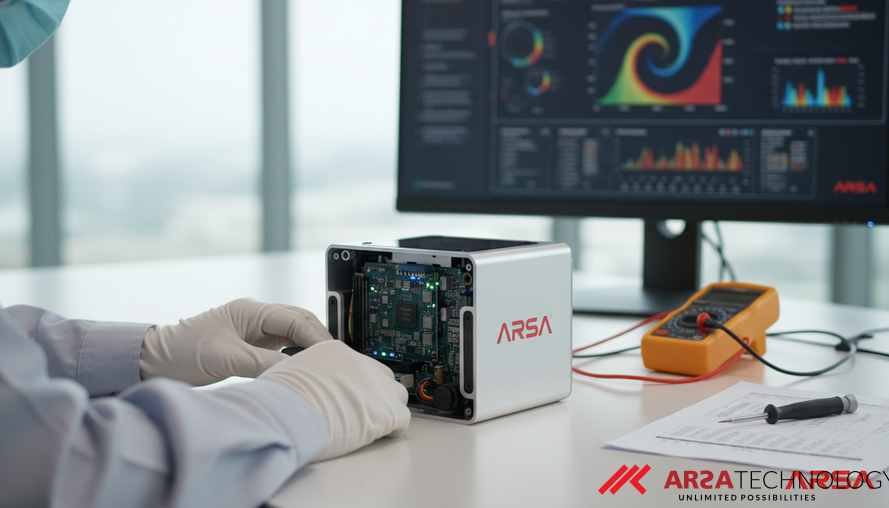
The Growing Need for Efficient AI at the Edge
Deep Neural Networks (DNNs) have revolutionized our approach to complex pattern recognition, making significant strides in areas from image and speech processing to predictive analytics. Their transformative potential, however, faces a critical challenge when deployed on resource-constrained "edge devices" – specialized hardware located closer to the data source, such as factory floor sensors, traffic cameras, or smart retail counters. These devices must deliver powerful AI capabilities while operating within strict limits for latency (speed), power consumption, and hardware resources, all without compromising accuracy.
Conventional DNN architectures, often designed for powerful cloud infrastructure, struggle to meet these demands. They typically require substantial computational power and memory, making them impractical for on-site, real-time applications. This limitation creates a significant bottleneck for industries seeking to harness the full potential of AI for immediate insights, enhanced security, and streamlined operations directly where the action happens.
Understanding Lookup Table (LUT)-Based DNNs and Their Bottlenecks
To address the limitations of traditional DNNs on edge devices, Field-Programmable Gate Arrays (FPGAs) have emerged as a compelling platform. FPGAs are reconfigurable chips that allow developers to custom-design hardware logic for specific tasks, offering superior energy efficiency and lower latency for real-time inference compared to general-purpose GPUs. Within FPGAs, Lookup Tables (LUTs) are fundamental building blocks – small memory units capable of implementing any logic function.
LUT-based DNNs (LUT-DNNs) leverage these native FPGA elements to consolidate complex neuron operations (like multiplication, summation, and activation functions) into highly efficient LUT structures. This approach significantly boosts hardware area efficiency and reduces processing delays. However, existing LUT-DNN models encounter two primary hurdles: the exponential growth of LUT size as network complexity increases, and the inherent inefficiency of using randomly assigned sparse connections between neurons. These issues restrict the network's capacity to represent intricate data and limit its overall accuracy, underscoring a clear need for innovative optimization strategies.
SparseLUT: A Dual-Approach to AI Optimization
Recent advancements introduce SparseLUT, a comprehensive framework specifically designed to tackle the scalability and accuracy limitations of LUT-DNNs through a unique combination of architectural and algorithmic optimizations. This framework represents a significant leap forward in making powerful AI more accessible and practical for edge deployment across various industries. By rethinking how neurons are structured and how connections are established, SparseLUT enhances performance without demanding excessive hardware resources, paving the way for more robust and efficient AI applications.
Architectural Innovation: Redefining Neuron Computation
At the architectural level, SparseLUT introduces a clever redesign for neuron computation. Instead of one large, complex LUT per neuron, it aggregates multiple smaller "PolyLUT sub-neurons" and combines their outputs using a specialized adder. This restructuring breaks down the computational burden, allowing for more efficient use of the FPGA's underlying logic. The result is a dramatic reduction in LUT consumption, making it feasible to implement more sophisticated networks on smaller, more cost-effective FPGAs. This optimization has been shown to reduce LUT usage by 2.0x–13.9x and lower inference latency by 1.2x–1.6x, all while maintaining comparable accuracy to less optimized methods. This architectural shift significantly improves the scalability of edge AI.
Intelligent Connectivity: The Non-Greedy Training Algorithm
Building upon its architectural foundation, SparseLUT further optimizes AI performance through a novel "non-greedy training algorithm." This isn't a hardware change, but a sophisticated software technique that intelligently refines the connections between neurons during the training phase. Unlike traditional methods that might randomly select or greedily prune connections, this algorithm actively prunes less significant inputs and strategically "regrows" more effective ones. This dynamic approach ensures that each neuron benefits from the most impactful connections, maximizing its representational power. Crucially, this advanced training process incurs no additional hardware area or latency overhead, yet consistently delivers accuracy improvements, achieving gains of up to 2.13% on benchmarks like MNIST and 0.94% on Jet Substructure Classification when compared to conventional LUT-DNN approaches that rely on random sparsity.
Business Impact: Realizing the Potential of Edge AI
These technical innovations translate directly into tangible business benefits, making advanced AI deployment at the edge more viable and impactful for enterprises across various industries.
- Cost Reduction: By significantly reducing LUT consumption and lowering power demands, businesses can deploy powerful AI solutions on more affordable and energy-efficient FPGAs. This minimizes operational expenditure and hardware investment, enabling wider adoption of AI-driven strategies.
- Enhanced Performance & Real-time Insights: Faster inference latency means immediate responses to events, which is critical for applications like real-time security monitoring, industrial anomaly detection, or dynamic traffic management. This enables proactive decision-making and rapid operational adjustments.
- Scalability and Flexibility: The ability to implement complex DNNs efficiently on resource-constrained edge devices opens up new possibilities. Businesses can scale their AI deployments across numerous distributed locations, gathering vital data and insights directly where they are generated, rather than relying solely on centralized cloud processing.
- Broader Application Scope: Optimized edge AI facilitates robust solutions for a diverse range of applications, from enhanced quality control in manufacturing with Industrial IoT & Heavy Equipment Monitoring to precise customer analytics in retail. For example, ARSA's AI BOX - Smart Retail Counter leverages such optimizations to provide real-time visitor insights and queue management without heavy cloud reliance. Similarly, for traffic management, solutions like AI BOX - Traffic Monitor benefit from highly efficient, accurate edge processing.
Beyond the Lab: Practical Deployment with ARSA Technology
The academic breakthroughs in AI optimization, such as those demonstrated by SparseLUT, form the bedrock for developing practical, high-impact solutions for businesses. At ARSA Technology, we are committed to bridging the gap between cutting-edge research and real-world application. As an organization experienced since 2018 in AI and IoT, we continuously evaluate and integrate advanced techniques, including highly optimized neural network architectures and efficient training algorithms, into our proprietary solutions.
Our focus is on delivering AI-powered digital transformation that generates measurable ROI for our clients. Whether it's enhancing operational efficiency with AI Video Analytics, optimizing resource allocation, or bolstering security measures, ARSA designs and deploys robust, privacy-compliant, and high-performance edge AI systems tailored to specific industry challenges. We transform existing infrastructure, such as CCTV systems, into intelligent data assets, ensuring businesses receive instant, actionable insights without the typical overheads associated with complex AI deployments.
The future of AI lies increasingly at the edge, where immediate processing, low latency, and enhanced privacy are paramount. By leveraging optimized neural network inference, businesses can unlock unprecedented levels of efficiency, security, and innovation.
Ready to explore how optimized AI solutions can transform your business operations? Discover ARSA's innovative AI and IoT offerings and contact ARSA for a free consultation.