Unlocking Complex Patterns: How Neural Networks Learn the Mandelbrot Set and Its Business Implications
Explore how neural networks learn the intricate Mandelbrot Set, revealing their power in recognizing complex, non-linear patterns crucial for AI-driven business solutions in various industries.

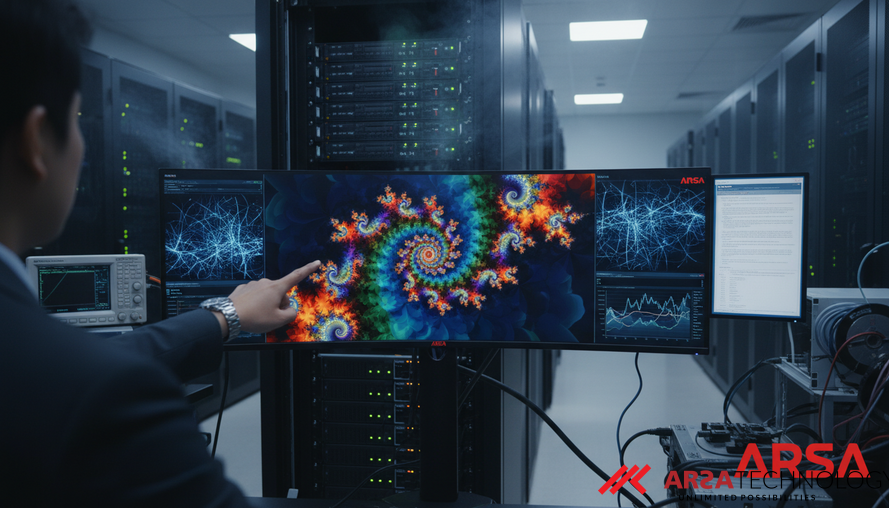
The Intricate Beauty of the Mandelbrot Set: A Challenge for AI
The Mandelbrot Set, a cornerstone of fractal geometry, is renowned for its infinite complexity and mesmerizing self-similarity. This mathematical set generates stunning visual patterns that reveal new intricacies upon endless zooming. For humans, appreciating its beauty is one thing, but for a computer program, understanding and replicating its rules is a profound challenge. This is where the power of neural networks comes into play. By attempting to teach these algorithms the "rules" of the Mandelbrot Set, we gain invaluable insights into their capacity for learning complex, non-linear patterns, a capability directly transferable to sophisticated business applications.
At its core, the Mandelbrot Set is defined by a simple iterative equation, but its visual manifestation is anything but simple. Each point in the complex plane is either part of the set or not, depending on whether a sequence generated from that point remains bounded or escapes to infinity. Traditional programming approaches struggle to capture this boundary's infinite detail concisely. For artificial intelligence, especially deep learning, interpreting such an abstract, non-linear boundary serves as an excellent benchmark for understanding how these systems infer rules from data, even when those rules defy straightforward linear logic.
How Neural Networks Unravel Fractal Logic
Teaching a neural network the Mandelbrot Set typically involves feeding it a vast dataset of points in the complex plane, each labeled as either "in" or "out" of the set. The network, composed of interconnected layers, then attempts to learn the underlying function that maps input coordinates to these binary classifications. This process is akin to how modern AI systems learn to recognize objects in images or predict market trends: by finding subtle, non-linear relationships within vast amounts of data. The elegance of using a neural network lies in its ability to approximate highly complex functions without explicit programming of the fractal's exact mathematical formula.
Modern deep learning architectures, particularly those with numerous hidden layers, can effectively model the intricate boundaries of the Mandelbrot Set. This requires careful selection of network architecture, activation functions, and extensive training with optimized datasets. The success in replicating the fractal's boundary highlights the neural network's remarkable capacity for pattern recognition and non-linear mapping, pushing the boundaries of what was once thought to be purely a mathematical domain. Such capabilities are essential for advanced AI video analytics applications, where systems must discern nuanced behaviors and objects in dynamic environments.
From Abstract Math to Real-World Business Value
The exercise of teaching a neural network the Mandelbrot Set, while seemingly abstract, has profound implications for businesses facing complex data challenges. Organizations across diverse sectors are constantly grappling with data that exhibits non-linear relationships, hidden patterns, and subtle anomalies. Understanding how neural networks can capture the essence of a fractal demonstrates their potential to:
- Enhance Anomaly Detection: Just as a network learns the "normal" boundary of the Mandelbrot Set, it can learn normal operational parameters in industrial equipment or financial transactions. Deviations, like a machine's irregular vibration pattern or an unusual transaction sequence, can be quickly identified as anomalies. ARSA Technology provides solutions for Industrial IoT and Heavy Equipment Monitoring that leverage similar principles to predict maintenance needs and prevent costly downtime.
- Optimize Resource Allocation: Businesses often deal with resource allocation problems influenced by many interdependent variables. Neural networks can model these complex interdependencies, leading to more accurate predictions and optimized decision-making, whether it’s for supply chain logistics or workforce scheduling.
- Improve Predictive Analytics: The Mandelbrot Set, despite its deterministic origin, appears chaotic. Similarly, market behaviors, customer churn, or asset failures often seem chaotic until a deeper, non-linear pattern is uncovered. Neural networks excel at discovering and leveraging these hidden patterns for more accurate forecasting.
The Role of Edge AI in Processing Complex Data
One critical aspect of deploying advanced AI solutions, especially those dealing with complex, real-time data, is the processing environment. While cloud computing offers immense power, certain applications benefit significantly from edge computing, where data is processed closer to its source. The computational intensity required for intricate pattern recognition, like that seen with the Mandelbrot Set, can be efficiently handled by specialized edge devices.
Edge AI devices, such as the ARSA AI Box Series, bring the power of deep learning directly to the operational environment. This approach ensures maximum data privacy by processing locally and delivering instant insights without reliance on constant cloud connectivity. For businesses, this means faster response times for anomaly detection, real-time operational optimization, and enhanced data security, particularly vital in sensitive industries like manufacturing, smart cities, and healthcare where immediate decisions and data sovereignty are paramount.
The Future of Pattern Recognition with ARSA Technology
The ability of neural networks to learn and replicate the complex, non-linear patterns of phenomena like the Mandelbrot Set underscores their transformative potential for industries worldwide. From sophisticated predictive maintenance in factories to advanced behavioral analytics in retail, the underlying principles of deep pattern recognition are driving a new era of efficiency, security, and innovation. Companies that embrace these AI capabilities can gain a significant competitive edge, turning complex data into actionable intelligence.
ARSA Technology is an experienced since 2018 provider that specializes in translating these advanced AI principles into practical, scalable solutions for various industries. By offering robust AI Vision and Industrial IoT solutions, ARSA empowers enterprises to harness the full potential of complex pattern recognition for tangible business outcomes.
Ready to transform your operations with intelligent, data-driven insights? Explore how ARSA's AI and IoT solutions can address your unique challenges and provide a free consultation to discuss your specific needs.