Unlocking Enterprise Knowledge: The Power of Retrieval-Augmented Generation (RAG) for Modern AI Systems
Explore Retrieval-Augmented Generation (RAG) systems: how they enhance LLMs with real-time data, reduce costs, and build trust for enterprise AI applications.

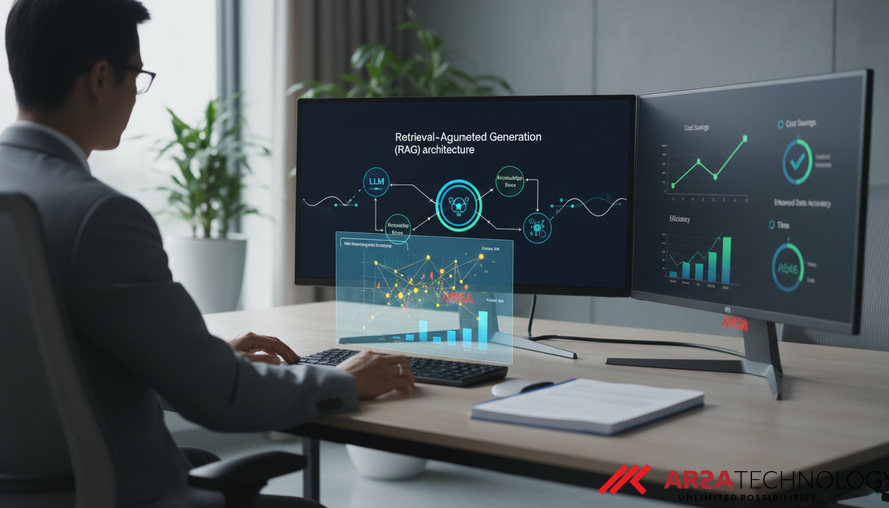
The Evolution of Enterprise AI: Beyond Monolithic Language Models
In the dynamic landscape of natural language processing (NLP), Large Language Models (LLMs) have demonstrated astonishing generative capabilities. However, these powerful models inherently face limitations such as restricted memory, potential for outdated information, and occasional factual inaccuracies. Relying solely on a model's pre-trained knowledge can be insufficient for enterprises that require real-time, precise, and verifiable information to drive critical business decisions. This challenge is particularly acute in fast-moving industries where data changes constantly, and every piece of information must be trustworthy.
To circumvent these constraints and unlock the true potential of AI for business, a transformative approach known as Retrieval-Augmented Generation (RAG) has emerged. RAG allows AI systems to access and integrate dynamic, external information sources during real-time processing, effectively distinguishing between memorization (what the model knows intrinsically) and reasoning (what it can infer by fetching external data). This systematic review of RAG architectures, encompassing studies and real-world deployments from 2018 to 2025, offers a practical guide for building resilient, secure, and domain-adaptable AI solutions.
Why RAG Transforms Business Operations
RAG systems offer significant advantages over traditional, monolithic LLM structures by introducing architectural flexibility. One of the most compelling benefits for enterprises is the elimination of costly and time-consuming model retraining. Instead of rebuilding an entire LLM whenever new information emerges, RAG systems maintain information currency by accessing updated databases or structured knowledge bases in real-time. This dynamic retrieval mechanism can lead to substantial savings in knowledge updating expenses, a critical factor for businesses managing vast and frequently changing data.
Furthermore, the modular nature of RAG architectures facilitates plug-and-play compatibility among its components. This means organizations can precisely optimize and customize various stages—such as the retriever (how information is found), reranker (how information is prioritized), and generator (how the final response is formed)—to suit specific domain needs. This modularity not only reduces technology refresh expenses but also enables quicker integration of new features and functionalities, offering a flexible and future-proof approach to AI deployment. For businesses looking to integrate advanced AI functionalities into existing software platforms or develop new smart applications, solutions like ARSA AI API suites can provide the necessary tools for seamless integration and accelerated development cycles.
Building Trust and Transparency in AI Interactions
Beyond efficiency and cost savings, RAG significantly enhances the trustworthiness and interpretability of AI outputs through citation traceability. By linking generated responses to specific evidence passages from reliable sources, RAG systems improve credibility and accountability—a paramount concern for businesses in an era of increasing AI regulation and ethical considerations. Enterprise implementations that integrate robust citation frameworks consistently report higher user trust ratings and fewer support escalations, demonstrating the tangible impact of transparency on user confidence.
In sectors where empirical accuracy, timeliness, and verifiable evidence are non-negotiable—such as legal analytics, biomedical research, or regulatory compliance—RAG's ability to ground its responses in verifiable sources is especially critical. The emphasis on trust and safety is a recurring theme in RAG research, underscoring the demand for AI systems that are not only intelligent but also reliable and accountable. This focus on verifiable data aligns with ARSA Technology's commitment to delivering AI and IoT solutions that address complex operational challenges with precision and impact.
Deconstructing RAG Architectures: Key Dimensions
The versatility of RAG systems stems from their customizable architecture, which can be defined across several critical dimensions. Understanding these components is crucial for designing AI solutions that meet specific business requirements.
Retrieval Strategies
Retrieval defines how information relevant to a user's query is found from external knowledge sources. Variants include single-pass (one-time search), multi-hop (sequential searches refining results), and iterative (feedback-driven refinement). The choice of strategy directly impacts the breadth and depth of information retrieved, influencing the accuracy and completeness of the AI's response. For instance, in dynamic environments like traffic management or smart retail, efficient retrieval is key to real-time insights, a capability leveraged by ARSA's AI Box Series for immediate on-site analytics.
Fusion Mechanisms
Fusion refers to how the retrieved information is combined with the Large Language Model's inherent knowledge. Early fusion integrates retrieved data before the LLM generates a response, while late fusion allows the LLM to generate an initial response and then rerank or refine it based on retrieved context. Marginal fusion represents a hybrid approach. These mechanisms critically modulate the factuality and coherence of the output, directly impacting the suppression of "hallucinations" (AI-generated inaccuracies).
Modality of Knowledge
RAG systems are not limited to processing text alone. They can operate across various modalities, including mono-modal (text-only), multi-modal (text, images, audio), and structured knowledge graphs. This capability allows RAG to access and integrate diverse forms of enterprise data, enabling more flexible and deeper factual grounding. For example, in manufacturing or construction, integrating visual data from CCTV through AI Video Analytics can enhance safety and operational monitoring by providing rich context to textual data.
Adaptivity and Control Flow
The adaptivity dimension addresses how dynamically a RAG system can adjust its operation. Static pipelines follow predefined steps, whereas agentic systems (like AutoRAG or Self-RAG) can dynamically plan retrieval strategies, correct errors, and adapt their control flow based on the complexity of the query or evolving context. This level of adaptability ensures the AI solution remains robust and effective even in unforeseen scenarios, crucial for mission-critical deployments where flexibility is paramount.
Building Trust and Safety Layers
A dedicated trust layer is vital for reliable RAG deployments. This involves mechanisms like automatic citation generation to verify sources, abstention strategies where the model refuses to answer if confidence is low, and source filtering/scoring to prioritize authoritative information. These layers are paramount for enhancing interpretability, reducing bias, and mitigating the risk of inaccurate or misleading information, contributing significantly to the overall trustworthiness of AI systems in enterprise settings.
Addressing Fragmentation: Towards Standardized Deployment
Despite RAG's growing adoption, the field currently faces significant architectural fragmentation. The proliferation of diverse retrieval methods, fusion strategies, and orchestration approaches has resulted in a complex ecosystem with limited standardization. This fragmentation creates several challenges for businesses:
- Evaluation Inconsistency: The lack of standardized benchmarks for RAG systems makes it difficult to compare different solutions and assess their true performance across diverse contexts. This hinders systematic progress and complicates architectural choices for practitioners.
- Implementation Diversity: Enterprise case studies reveal a wide array of distinct implementation patterns, often with minimal knowledge sharing between organizations. This leads to redundant efforts, common pitfalls being rediscovered, and suboptimal resource allocation within the industry.
- Trust Framework Gaps: While extensive literature addresses trust and safety, comprehensive frameworks and quantitative evaluations of trust mechanisms are still scarce. This gap is particularly concerning given the mission-critical nature of many RAG deployments in sectors like healthcare, finance, or government.
Pioneering Robust AI: ARSA's Approach to Advanced RAG
ARSA Technology, experienced since 2018 in delivering AI and IoT solutions, recognizes the challenges and opportunities presented by the evolving RAG landscape. Our commitment to innovation, precision, and measurable impact aligns perfectly with the need for robust and trustworthy RAG systems. We integrate best practices from academic research and industrial deployments to provide solutions that are:
- Architecturally Flexible: Leveraging a comprehensive architectural taxonomy that considers retrieval logic, fusion topology, modality, adaptivity, and trust calibration, ARSA designs extensible and implementation-agnostic RAG systems.
- Empirically Driven: Our solutions are built upon exhaustive evaluations of architectural trade-offs and performance characteristics across diverse organizational contexts, ensuring optimal performance and reliability.
- Engineered for Excellence: Through a deep understanding of engineering best practices and common pitfalls, ARSA identifies and implements proven patterns that ensure robustness, factuality, and low latency in production environments.
- Trust and Safety Focused: We apply formal analyses of trust surfaces in RAG systems, incorporating citation grounding, abstention strategies, and quantitative trust evaluation methods verified through real-world implementations.
- Future-Ready: By actively exploring frontier directions in multi-agent coordination, autonomous assessment, and differentiable training, ARSA Technology is poised to continuously deliver cutting-edge RAG solutions that anticipate future business needs.
Empower Your Enterprise with Intelligent Knowledge Retrieval
The future of enterprise AI lies in its ability to quickly and accurately access, integrate, and interpret vast amounts of information, all while maintaining trust and transparency. RAG systems are instrumental in this transformation, enabling businesses to leverage AI not just for generating content, but for making informed, fact-based decisions.
Ready to explore how advanced RAG architectures can revolutionize your operations, enhance decision-making, and build stronger trust with your stakeholders? Discover ARSA Technology’s range of AI and IoT solutions and let our experts guide you through the process. For a personalized discussion on integrating RAG into your enterprise, contact ARSA today for a free consultation.