Zero-Shot UAV Navigation in Forests: The Power of Relightable 3D Gaussian Splatting
Explore how Relightable 3D Gaussian Splatting enables zero-shot, high-speed UAV navigation in complex forests, overcoming lighting challenges for robust autonomous flight.

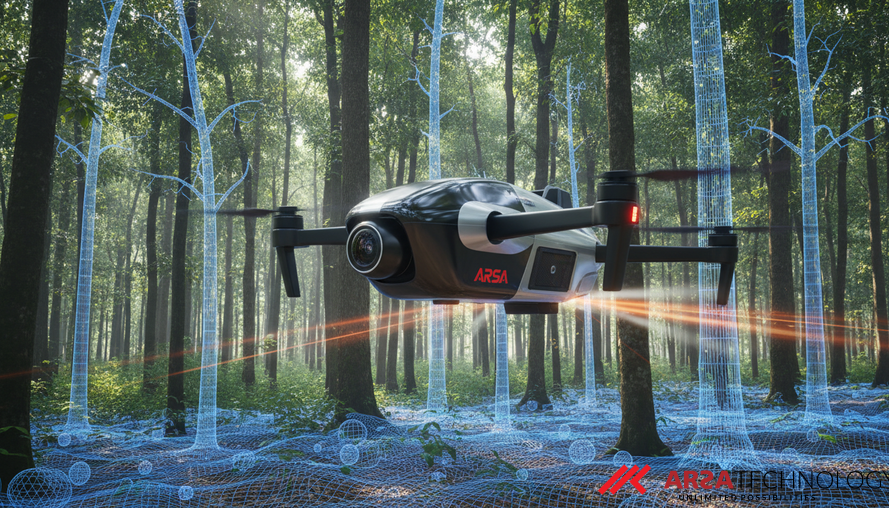
The Challenge of Autonomous UAV Navigation in Complex Outdoors
Unmanned Aerial Vehicles (UAVs), commonly known as drones, are transforming industries from disaster response to infrastructure inspection. However, enabling these drones to navigate autonomously in complex, unpredictable outdoor environments, especially dense forests, presents significant challenges. Traditional navigation systems often rely on active sensors like LiDAR or depth cameras. While these provide accurate depth information, they add weight, consume more power, introduce computational delays, and can even fail in bright sunlight, hindering the agility and speed crucial for many applications. This reliance on active sensors prevents drones from achieving the nimble, bird-like flight seen in nature.
The scientific community has therefore been exploring whether a lightweight, passive monocular RGB camera – essentially a standard video camera – could replicate this high-speed agility. While learning-based approaches have shown promise in structured environments like racing circuits or indoor corridors, extending these capabilities to chaotic outdoor settings like forests has been difficult. The core issue lies in accurately modeling the irregular geometries and dynamic visual conditions of such environments. Simply put, traditional simulations struggle to mimic the real world's complexity, leading to a "domain gap" between simulated training and real-world deployment.
Relightable 3D Gaussian Splatting: Bridging the Sim-to-Real Gap
A recent breakthrough in 3D scene reconstruction, known as 3D Gaussian Splatting (3DGS), offers an unprecedented level of photorealism from real-world data. This technology can essentially create highly detailed "digital twins" of physical environments. While powerful for static scene representation, existing 3DGS methods typically "bake in" the lighting conditions from when the data was captured. This means a digital twin created under sunny skies cannot easily simulate an overcast day or varied shadow patterns, severely limiting an autonomous agent's ability to generalize to dynamic real-world illumination.
To overcome this, researchers have introduced Relightable 3D Gaussian Splatting. This innovative approach explicitly separates the geometric properties of a scene from its lighting, allowing for dynamic and physically accurate manipulation of environmental illumination within the digital twin. Imagine creating a virtual forest where you can precisely control the sun's position, cloud cover, and ambient light, all while maintaining photorealistic quality. By training a drone's navigation policy in simulations augmented with diverse synthesized lighting conditions—from harsh directional sunlight to soft, diffuse overcast skies—the AI is compelled to learn robust visual features that are invariant to illumination changes. This capability significantly narrows the visual "sim-to-real domain gap," ensuring that a policy trained in simulation can transfer seamlessly to the real world without requiring costly and time-consuming real-world fine-tuning.
End-to-End Reinforcement Learning for Robust Control
This research leverages an end-to-end deep reinforcement learning (RL) framework. In this paradigm, the drone's AI policy learns directly to map raw monocular RGB camera observations (what the camera sees) to continuous control commands (how the drone moves). This "end-to-end" approach is highly beneficial because it bypasses the need for traditional modular pipelines that typically involve separate steps for mapping, localization, and trajectory planning. Each step in a modular pipeline can introduce errors, which then accumulate and propagate, leading to brittle system performance, especially in unpredictable environments.
Reinforcement learning further enhances robustness by allowing the AI agent to learn from trial and error within the simulated environment. The policy can experience and recover from near-collision scenarios in the digital twin, building a comprehensive understanding of safe navigation behaviors. Combined with the photorealistic and dynamically relightable simulation environment, this training methodology enables the drone to acquire robust, illumination-invariant visual features. The result is a navigation policy that is remarkably resilient to drastic lighting variations and can perform effective zero-shot transfer—meaning it works in the real world immediately after simulation training, without any further adjustments.
Real-World Validation and Future Implications
The efficacy of this advanced framework has been rigorously validated through extensive real-world experiments. Lightweight quadrotors demonstrated robust, collision-free navigation in complex forest environments at impressive speeds of up to 10 meters per second (approximately 22 miles per hour). Crucially, this performance was achieved using only a passive monocular RGB camera, highlighting the system's lightweight and low-cost advantages. The drones maintained their operational integrity and navigation accuracy even under significant real-world lighting variations, proving the effectiveness of the Relightable 3D Gaussian Splatting training approach. This groundbreaking work, detailed in "Zero-Shot UAV Navigation in Forests via Relightable 3D Gaussian Splatting" Zinan Lv et al., 2026, marks a significant step towards truly autonomous and agile UAVs.
This innovation has far-reaching implications. Imagine drones capable of inspecting remote infrastructure, delivering supplies in disaster zones, or monitoring ecological changes, all without the need for heavy, power-hungry sensors or constant human supervision. The ability to simulate diverse lighting conditions and achieve zero-shot transfer is a game-changer for deploying autonomous systems in dynamic, unstructured settings. It not only reduces deployment time and cost but also enhances the safety and reliability of drone operations in environments previously deemed too challenging for monocular vision.
The Path Forward: From Research to Real-World Impact
The capabilities demonstrated by Relightable 3D Gaussian Splatting and end-to-end reinforcement learning highlight the accelerating pace of innovation in AI and robotics. This research paves the way for sophisticated vision AI applications that can operate with unprecedented adaptability and autonomy. For enterprises looking to integrate advanced visual intelligence into their operations, solutions leveraging such deep learning and computer vision techniques are becoming increasingly critical.
At ARSA Technology, we are committed to transforming complex operational challenges into strategic advantages through practical, precise, and adaptive AI and IoT solutions. Our expertise in AI Vision and Industrial IoT, including robust AI Video Analytics, is designed to enhance security, efficiency, and operational visibility across various industries. While this specific UAV navigation technology is a research advancement, it underscores the potential of sophisticated computer vision. Our AI Box Series, for example, provides edge AI capabilities that can transform existing CCTV infrastructure into intelligent monitoring systems, offering real-time insights and privacy-first data processing, much like the on-device processing required for agile drones. Similarly, our custom AI development services can tailor advanced vision AI solutions for various industries facing unique environmental or operational complexities.
The future of autonomous systems relies on solutions that are not only powerful but also adaptable and resilient to the unpredictability of the real world.
To learn more about how cutting-edge AI and IoT can accelerate your digital transformation and provide measurable impact for your business, we invite you to contact ARSA for a free consultation.