Advancing AI Video Realism: Disentangling Physics for Plausible Generations
Explore DiReCT, a breakthrough framework that addresses semantic-physics entanglement in AI video generation, creating physically accurate and visually coherent videos for critical applications without extra training time.

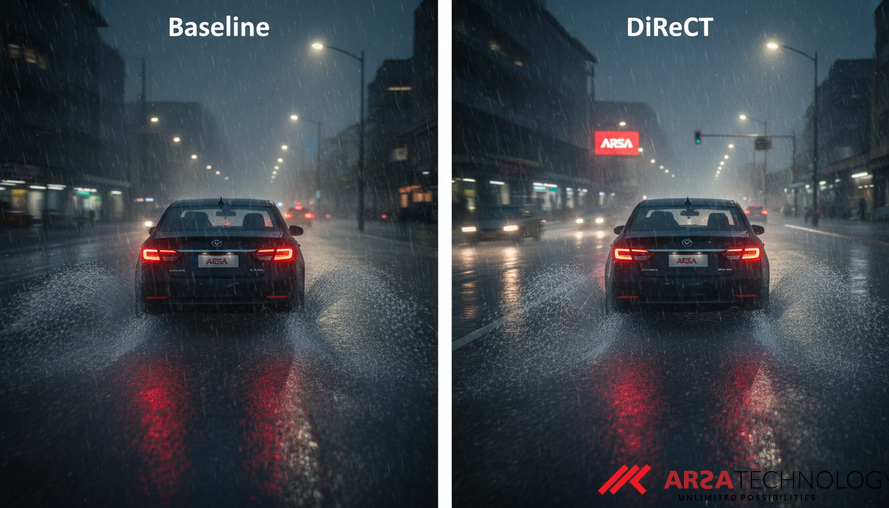
AI-generated videos have reached remarkable levels of visual fidelity, producing scenes that are often indistinguishable from real footage in their aesthetic quality. However, a significant challenge persists beneath this polished surface: the struggle for physical plausibility. Many advanced video generation models routinely produce outputs that violate fundamental laws of physics, leading to scenarios where cars drive backward, objects merge unnaturally, or materials defy gravity or buoyancy. This gap between looking real and behaving real can severely limit the utility of AI in critical applications.
The Limitations of Current Video Generation Models
The prevailing methods in AI video generation, particularly flow-matching architectures, excel at creating temporally coherent and high-resolution visuals. These models are typically trained using reconstruction-based objectives, which primarily focus on minimizing pixel-level or latent deviations between generated and real frames. While effective for visual quality, this approach treats all errors equally, failing to differentiate between a slight visual artifact and a blatant violation of physical laws. Consequently, a bouncing ball might inexplicably accelerate after impact, or colliding objects might inter-penetrate as if they were ghosts. Benchmarks consistently show that a majority of AI-generated videos depicting physical interactions contain at least one implausible event, highlighting a systematic failure in how these models understand and simulate the real world. This deficiency is not merely an aesthetic concern; in applications like predictive "world models" for autonomous systems, a single physics violation can cascade into catastrophic errors and incorrect downstream decisions.
Addressing the Physics Gap: Past Approaches and Their Challenges
Researchers have explored several avenues to instill a better understanding of physics into AI video generators. One common strategy involves augmenting training data with synthetic physics simulations. For instance, some methods are confined to simulating specific material types, such as rigid bodies, cloth, or liquids, that can be modeled by physics engines. While these simulation-guided approaches inject explicit physical priors, they often face limitations. They are typically restricted to the phenomena their simulators can cover, and introducing synthetic data can create a "distribution shift" – a mismatch between the training data and real-world data – which can hinder generalization. Other attempts involve embedding explicit physical priors directly into the AI model's loss function or architecture. While this can improve targeted phenomena, it often struggles to generalize across a diverse range of physical dynamics.
The Entanglement Problem in Text-Conditioned AI
A more fundamental issue arises from the way current AI models learn from textual descriptions. A deep analysis of the "velocity-field landscape" – essentially how objects move within the video – reveals a core structural problem. As conditioning prompts (e.g., "A car drives through the rain") become semantically or physically similar, the AI's learned movement patterns tend to converge, often collapsing towards a generic, physically ambiguous behavior.
A natural solution to this problem is contrastive learning, where the AI is trained to distinguish between different types of outputs. In the context of video generation, this would mean pushing apart the velocity fields of distinct conditions. However, a major obstacle emerges in text-conditioned video generation: semantic-physics entanglement. A single natural language prompt inevitably couples the semantic content (what is depicted, e.g., "car," "rain") with the physical dynamics (how it moves, e.g., "drives," "pouring"). When a naive contrastive objective is applied, simply pushing a positive sample (the correct video for a prompt) away from a randomly chosen negative sample (an incorrect video), it can inadvertently conflate two distinct goals: distinguishing visual concepts (which reconstruction objectives already handle) and differentiating physical behaviors (the actual target). This leads to a "gradient conflict," where the contrastive learning signal directly opposes the primary flow-matching objective, degrading overall performance. This happens when the positive and negative conditions, despite being different, share substantial underlying velocity-field structure due to their semantic proximity.
Introducing DiReCT: Disentangled Regularization of Contrastive Trajectories
To resolve this critical gradient conflict, researchers have introduced DiReCT (Disentangled Regularization of Contrastive Trajectories). DiReCT is a lightweight post-training framework designed to inject physical commonsense into video generation models without incurring additional training costs beyond standard supervised fine-tuning (SFT). The core innovation of DiReCT lies in its entanglement-aware, multi-scale contrastive learning approach within the "velocity space" – the space representing how things move.
DiReCT intelligently decomposes the contrastive objective into two complementary scales:
- Macro-contrastive term: This component focuses on broad distinctions. It draws "partition-exclusive negatives" from semantically distant regions. For example, if the positive sample describes a "car driving," a macro-negative might describe "a surfer on a wave." This ensures a clear, global separation signal between vastly different scenarios, free from the gradient interference caused by semantic overlap.
Micro-contrastive term: This is where DiReCT makes fine-grained physics distinctions. It constructs "hard negatives" that share the exact same scene semantics with the positive sample but differ along a single, controlled axis of physical behavior*. These subtle yet critical physical perturbations are generated through minimal, LLM-guided changes to the original prompt, spanning aspects like kinematics (speed, direction), forces (gravity, friction), materials (rigid, liquid), interactions (collision, buoyancy), and magnitudes (small vs. large impact). For example, if the positive prompt is "a car drives forward," a micro-negative might be "a car drives backward."
Additionally, DiReCT incorporates a "velocity-space distributional regularizer." This crucial element helps prevent "catastrophic forgetting" – a common issue where an AI model, upon learning something new, forgets its previously acquired knowledge. In this case, the regularizer ensures that while the model learns improved physical realism, it does not degrade its existing high visual quality. The ability to enhance physical understanding without compromising visual fidelity is paramount for practical deployment.
Real-World Impact and Benchmarked Superiority
The effectiveness of DiReCT has been rigorously validated on physics-oriented benchmarks, demonstrating significant improvements in physical plausibility without sacrificing visual quality. When applied to advanced video generation models like Wan 2.1-1.3B, DiReCT improved the physical commonsense score on VideoPhy by 16.7% compared to the baseline model and 11.3% compared to standard SFT. This remarkable gain was achieved without increasing training time, highlighting DiReCT's efficiency and practicality.
The framework also achieved the highest total score (5.68) on WorldModelBench among all compared models, surpassing even much larger models like CogVideoX-5B (5.33), despite DiReCT's underlying model having significantly fewer parameters (3.8 times less). This showcases DiReCT's ability to drive superior performance through intelligent architectural and training refinements rather than relying solely on brute-force scaling of model size. For instance, in real-world tests, where baseline models would show a car driving backward against a prompt of "A car drives through the pouring rain," DiReCT produced videos with accurate forward kinematics. Similarly, for "A piece of wood floats down a flowing canal," DiReCT generated realistic downstream motion consistent with buoyancy and flow dynamics, unlike baselines that left the wood stationary. These concrete examples underscore DiReCT's capability to deliver truly plausible physical interactions.
Future Implications for Enterprise AI
The innovations brought by DiReCT have profound implications for enterprises leveraging AI-powered video technologies. Accurate physics simulation is not just for entertainment; it's vital for reliable predictive models, virtual prototyping, and robust automation systems. Industries such as smart cities, manufacturing, and logistics can significantly benefit. For example, in traffic monitoring, understanding the correct physics of vehicle movement is critical for predicting congestion or identifying unusual events. ARSA AI Video Analytics solutions, which already provide real-time operational intelligence from CCTV streams, could be further enhanced by such physics-refined generation capabilities for more accurate anomaly detection and predictive modeling. Similarly, for industrial safety applications, where AI BOX - Basic Safety Guard monitors PPE compliance and restricted area intrusions, integrating a deeper physical understanding would allow for more robust scenario analysis and preventative action. The ability to generate physically coherent videos opens doors for more sophisticated AI-driven simulations for training autonomous vehicles, developing robotics, or creating immersive VR training environments. By ensuring that AI understands not just what things look like, but also how they behave according to physical laws, DiReCT bridges a critical gap towards truly intelligent and dependable AI systems that can operate effectively in the real world.
Source: Meyarian, A., Monsefi, A. K., Ramnath, R., & Lim, S.-N. (2026). DiReCT: Disentangled Regularization of Contrastive Trajectories for Physics-Refined Video Generation. https://arxiv.org/abs/2603.25931
Ready to transform your operations with AI and IoT solutions that deliver real, measurable impact? Explore how ARSA Technology can build custom AI solutions for your specific needs, or contact ARSA today for a free consultation.