Advancing Enterprise AI: Physics-Guided Diffusion Models for Robust PDE Solutions
Explore how physics-guided diffusion models decouple AI training from physical laws to solve complex PDEs with high accuracy and generalization, offering a powerful alternative for enterprise applications.

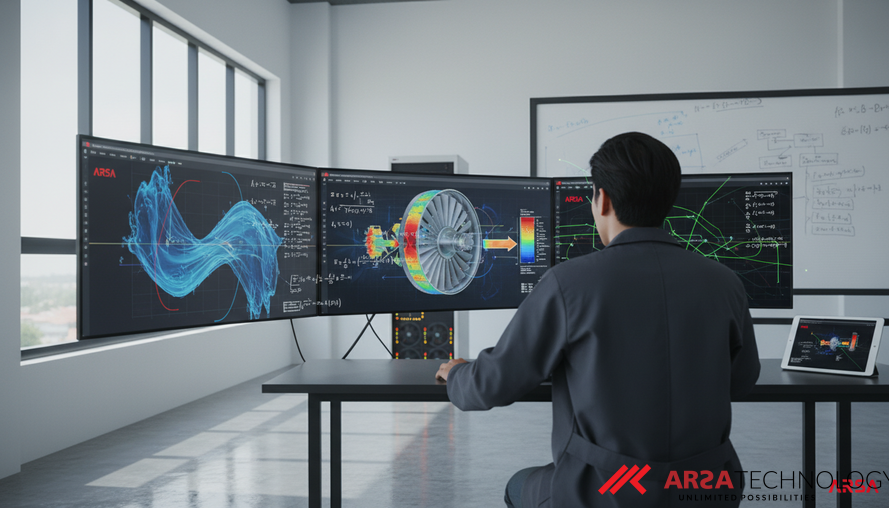
Revolutionizing Scientific Computing with Physics-Guided AI
In the world of engineering and applied sciences, Partial Differential Equations (PDEs) are the bedrock for modeling fundamental physical processes, from heat transfer and fluid dynamics to wave propagation and electrochemical systems. Accurately and efficiently solving these complex equations is crucial for innovation across diverse industries. However, traditional numerical methods, while robust, often come with significant computational costs. Meanwhile, emerging Artificial Intelligence (AI) techniques offer speed but have struggled to maintain physical consistency or adapt to changing conditions without extensive retraining. A new academic paper, "Diffusion models with physics-guided inference for solving partial differential equations" (Source: arxiv.org/abs/2604.01242), proposes a groundbreaking approach that marries the generalization power of diffusion models with the strict adherence to physical laws. This innovation promises to unlock a new era of highly accurate, adaptable, and computationally efficient AI solutions for complex real-world problems.
The Evolving Landscape of PDE Solvers
For decades, classical numerical methods like Finite Difference, Finite Element, and Finite Volume Methods have been the gold standard for solving PDEs. These methods are built on rigorous mathematical principles, ensuring high accuracy and reliability, which is paramount for industrial and safety-critical applications. However, their precision often demands intensive computational resources, making them slow and expensive, especially for scenarios involving repeated simulations, optimizations, or real-time control. This computational burden becomes particularly restrictive when dealing with high-dimensional or multi-physics systems.
The advent of AI brought forth data-driven learning methods, offering a paradigm shift by leveraging large datasets to accelerate PDE solving. Techniques such as Deep Operator Networks (DeepONet) and Fourier Neural Operators (FNO) have shown impressive performance in learning parametric PDE families. These methods significantly reduce solution time by shifting the bulk of computation from online inference to offline training. Yet, they are heavily dependent on the availability of vast, high-quality training data—often generated by those very same expensive numerical solvers—and can struggle with generalization when encountering unseen parameters or boundary conditions.
Bridging the Gap: Physics-Informed and Generative Models
To address the data dependency and lack of physical consistency in purely data-driven models, Physics-Informed Neural Networks (PINNs) emerged. PINNs embed PDE residuals and boundary conditions directly into their training process, theoretically eliminating the need for labeled data. While a significant step forward, PINNs frequently face challenges like slow convergence, optimization difficulties, and sensitivity to hyperparameters. Crucially, any change in physical parameters typically requires a complete retraining, hindering their adaptability in dynamic environments.
Generative diffusion models, a powerful class of stochastic models, have recently gained prominence for their ability to handle high-dimensional data and exhibit stable training with strong generalization. These models generate data by gradually denoising a random input, a process governed by stochastic differential equations. They are less sensitive to limited or noisy data than supervised learning approaches and can capture complex data distributions. However, a key limitation has been the difficulty in explicitly incorporating strict physical laws, such as differential operators and boundary conditions, directly into their generative process, often relying on implicit data-driven guidance which doesn't guarantee physical consistency.
Physics-Guided Diffusion Inference: A Unified Solution
The research presented in the paper addresses this critical gap by proposing a novel framework: a diffusion model with physics-guided inference for solving PDEs. The core innovation lies in decoupling the AI model's training from the physics itself. Instead of physics-informed training, the diffusion model is trained using standard data-driven procedures. The physical laws are then exclusively integrated during the reverse inference stage. This means the model learns to generate potential solutions from data, and then, during the actual problem-solving phase, it uses the governing physical equations to refine and guide that generation process towards a physically consistent solution.
This reverse diffusion process is guided by a PDE residual energy function—a mathematical metric that quantifies how well a candidate solution satisfies the PDE—along with Gaussian smoothing and explicit boundary enforcement. Gaussian smoothing helps to ensure the generated solution is smooth and physically plausible, while explicit boundary enforcement guarantees that the solution respects real-world constraints. From a computational perspective, this framework acts as a diffusion-inspired implicit solver. It can converge to the correct PDE solution even when starting from random noise and tolerating stochastic fluctuations, showcasing remarkable robustness and generalization. This approach offers a powerful, unified alternative to both computationally heavy classical numerical solvers and the often-inflexible physics-informed neural networks, without requiring retraining for varying coefficients or boundary conditions.
Practical Applications Across Industries
The implications of this physics-guided diffusion inference for solving PDEs are far-reaching, promising significant advancements across various industries. For enterprises, this means:
- Manufacturing & Industrial: Faster and more accurate simulations for material stress, heat distribution in machinery, or fluid flow in industrial processes. This can accelerate product design cycles, optimize operational efficiency, and enhance predictive maintenance. For instance, robust AI Video Analytics Software could integrate such models to predict structural fatigue or analyze complex gas flows in a factory.
- Smart Cities & Infrastructure: Improved models for traffic flow, air pollution dispersion, or structural integrity of buildings and bridges. This allows city planners and infrastructure operators to make more informed decisions rapidly, reducing costs and enhancing public safety. ARSA’s AI Box - Traffic Monitor could leverage such advanced PDE solvers for real-time traffic prediction and optimization.
- Healthcare & Life Sciences: More precise simulations for drug delivery, blood flow dynamics, or heat transfer during medical procedures. This could lead to breakthroughs in personalized medicine and medical device design.
- Energy Sector: Better modeling of subsurface fluid dynamics for oil and gas exploration, or heat transfer in nuclear reactors, leading to optimized resource management and enhanced safety.
The ability of these models to generalize without retraining, even with varying coefficients, is a game-changer. It drastically reduces the development and deployment overhead for complex systems, allowing businesses to adapt quickly to new operational parameters or design requirements. Such capabilities align perfectly with the practical, enterprise-grade AI solutions that ARSA Technology has been delivering, with a commitment to measurable impact since our founding in 2018. Our experienced since 2018 team is focused on bringing such cutting-edge intelligence into real-world operations.
The Future of AI in Scientific Discovery
This research marks a significant stride in integrating advanced AI with fundamental scientific principles. By cleverly decoupling the data-driven learning phase from the physics-guided inference phase, diffusion models can now solve complex PDEs with unprecedented accuracy, generalization, and physical consistency, even when initialized with arbitrary noise. This framework offers a robust, adaptable, and computationally efficient alternative to existing methods, poised to accelerate discovery and innovation in computational science and engineering. For enterprises seeking to harness the power of AI for mission-critical operations, this new generation of physics-guided AI holds immense potential for unlocking new levels of efficiency, precision, and strategic insight.
To explore how advanced AI and IoT solutions can transform your enterprise operations, contact ARSA today for a free consultation.
Reference:
Yi, B., Liu, J., Fu, J., & Peng, X. (n.d.). Diffusion models with physics-guided inference for solving partial differential equations. Retrieved from https://arxiv.org/abs/2604.01242