Advancing Fusion Energy: How AI-Powered Simulations Revolutionize Plasma Physics
Explore how a new AI-powered simulation method, Neural Score-Based Transport Modeling (SBTM), is accelerating nuclear fusion research by efficiently modeling complex plasma behavior, offering superior accuracy and speed over traditional methods.

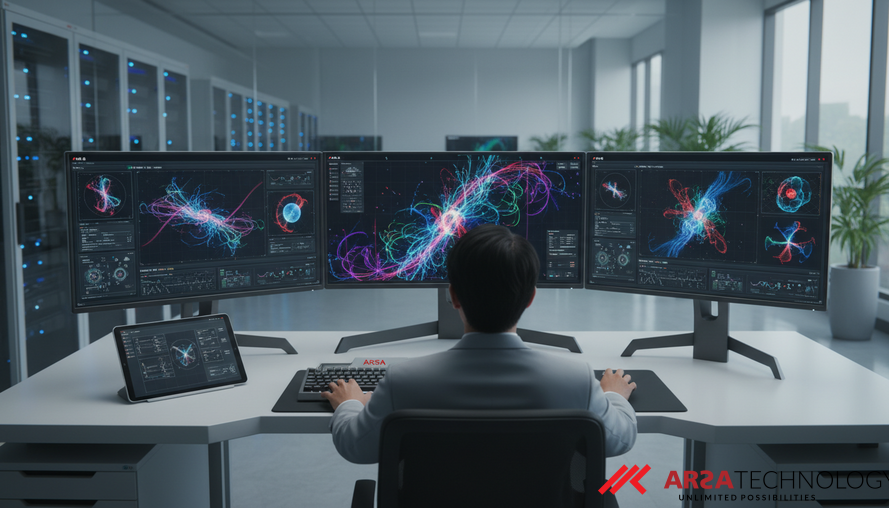
The Quest for Clean Energy: Simulating Plasma for Nuclear Fusion
The dream of limitless, clean energy hinges significantly on controlled nuclear fusion. This ambitious goal requires confining plasma—an incredibly hot, ionized gas of electrons and ions—at temperatures exceeding 100 million Kelvin. At such extreme conditions, charged particles constantly collide and interact with self-generated electromagnetic fields. Accurately simulating this complex behavior from first principles is not just a challenge but a cornerstone for designing future fusion reactors. These simulations are fundamental to understanding how to effectively contain and harness fusion energy, making advancements in computational physics crucial for the energy future.
Understanding the Vlasov–Maxwell–Landau (VML) System
At the heart of accurately modeling these intricate plasma dynamics lies the Vlasov–Maxwell–Landau (VML) system. This comprehensive framework provides a first-principles kinetic description, coupling the six-dimensional phase-space transport of particles (their position and velocity) with the self-consistent electromagnetic fields they generate, and a critical component: the Landau collision operator. The Landau operator mathematically describes the frequent Coulomb collisions between charged particles. Solving these VML equations is notoriously difficult due to the system's high dimensionality, the diverse scales of physical phenomena involved, and the necessity to uphold fundamental conservation laws for mass, momentum, and energy, as well as the principle of entropy dissipation.
Evolving Plasma Simulation: From "Blob" to Neural Networks
For decades, Particle-in-Cell (PIC) methods have been the dominant approach for high-dimensional kinetic simulations, tracking particles in a Lagrangian frame while solving fields on a grid. However, integrating the nonlinear Landau collision operator into PIC methods has always been a hurdle. Traditional Monte Carlo methods, while offering a statistical approach, introduce noise and aren't directly compatible with standard PIC, leading to discretization errors.
A significant step forward came with deterministic particle methods, which reformulated the Landau collision operator as a transport equation driven by a "velocity score function." Early deterministic methods, such as the "blob method," estimated this score using a kernel-based approximation. While innovative, the blob method came with considerable computational drawbacks. It required regularization with a kernel and often struggled to accurately estimate scores in low-density plasma regions, leading to systematic errors over long simulation times. Critically, its computational cost scaled quadratically (O(n²)) with the number of particles, becoming prohibitively expensive for large-scale, high-fidelity simulations. This necessitated compromises, like random batch methods, which introduced statistical errors back into the deterministic approach.
Neural Score-Based Transport Modeling (SBTM): A Paradigm Shift
The field of computational physics is now witnessing a breakthrough with Score-Based Transport Modeling (SBTM). This innovative approach replaces the computationally intensive kernel-based score estimation with a neural network-driven process. In SBTM, a neural network is trained on-the-fly, during the simulation, to approximate the velocity score function by minimizing an implicit score matching loss. This fundamental shift reduces the computational cost dramatically to a linear scale (O(n)) per gradient step, making complex simulations far more feasible.
This advancement is particularly impactful for spatially inhomogeneous systems like the full VML system, which couples with electromagnetic fields and handles diverse velocity distributions across different spatial cells using a single neural network. The implementation of this neural score estimator into existing collisional PIC frameworks, such as those that ARSA Technology leverages for advanced AI Video Analytics, is seamless, requiring only the replacement of the score estimation module. Such integration allows for the deployment of sophisticated AI models that can process millions of data points in real-time, transforming passive infrastructure into intelligent decision engines, a core aspect of ARSA's custom AI solutions.
Key Innovations and Verified Outcomes
Research into SBTM has yielded several crucial advancements and verified outcomes, marking a significant leap for plasma modeling (as detailed in the paper "A Neural Score-Based Particle Method for the Vlasov–Maxwell–Landau System" by Vasily Ilin and Jingwei Hu, published on arXiv: arXiv:2603.25832). The method rigorously proves that its approximated collision operator precisely preserves momentum and kinetic energy, crucial physical properties for accurate simulation. Furthermore, it accurately dissipates an estimated entropy, aligning with fundamental thermodynamic principles.
The research also provides a theoretical "ground truth" by characterizing the unique global steady states for both the full VML system and its electrostatic reduction, the VPL system. This theoretical framework is vital for validating numerical results, ensuring the simulations accurately reflect long-term physical behavior. Experimentally, SBTM has outperformed the traditional blob method across canonical benchmarks like Landau damping, two-stream instability, and Weibel instability. It achieves correct long-time relaxation to Maxwellian equilibrium, where the blob method often fails, and delivers approximately 50% faster runtime with two to four times lower peak memory usage. These efficiencies are critical for running the extensive and long-duration simulations required for fusion reactor design.
Real-World Impact: Accelerating Nuclear Fusion Research and Beyond
The implications of AI-powered simulation methods like SBTM extend far beyond academic research. For enterprises and government institutions involved in highly regulated and security-critical environments, the ability to conduct complex simulations with higher accuracy, speed, and lower computational overhead translates directly into reduced costs, accelerated development cycles, and more robust decision-making. The improved long-time relaxation capabilities mean researchers can model plasma behavior over extended periods, which is essential for understanding the stability and efficiency of fusion confinement.
ARSA Technology, with its experience since 2018 in delivering production-ready AI and IoT systems, sees the immense potential of such advanced computational physics. While this specific method is at the cutting edge of plasma science, the underlying principles of AI optimization, efficient data processing, and physics-informed neural networks are highly relevant to other complex industrial and governmental applications. The ability to simulate and predict behavior with such precision can transform various sectors, from materials science to environmental modeling, by turning operational complexity into a competitive advantage.
A Leap Forward in Kinetic Plasma Simulation
The introduction of Neural Score-Based Transport Modeling (SBTM) represents a significant leap in the field of kinetic plasma simulation. By leveraging the power of neural networks, this method overcomes the computational limitations of previous approaches, offering superior accuracy, faster execution, and reduced memory requirements. For the challenging endeavor of achieving controlled nuclear fusion, SBTM provides an indispensable tool, accelerating the path toward a future powered by clean, abundant energy. This innovation underscores the transformative potential of AI when applied to some of humanity's most complex scientific and engineering problems.
To explore how ARSA Technology's AI and IoT solutions can transform your operational challenges into intelligent advantages, we invite you to contact ARSA for a free consultation.