Advancing Geospatial AI: EarthSpatialBench and the Future of Spatial Reasoning in MLLMs
Explore EarthSpatialBench, a new benchmark evaluating Multimodal Large Language Models (MLLMs) on complex spatial reasoning using Earth imagery. Understand its significance for enterprise AI.

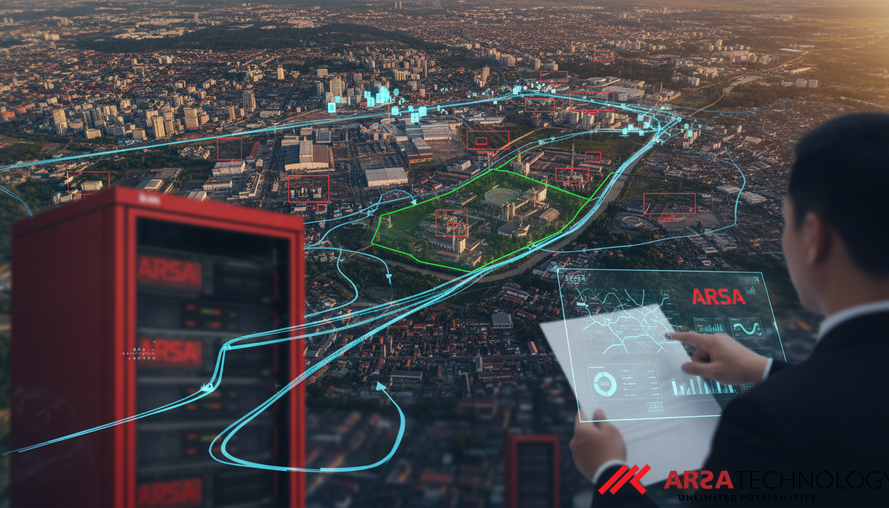
The Critical Need for Advanced Spatial Reasoning in AI
Multimodal Large Language Models (MLLMs) are revolutionizing how artificial intelligence interacts with the world, moving beyond text to interpret visual information. A key aspect of this evolution is spatial reasoning—the ability to understand and interpret the positions, orientations, and relationships of objects within a given space. This capability is paramount for the development of embodied AI and other intelligent systems that need to interact precisely with physical environments, from robots navigating a warehouse to autonomous vehicles on city streets. While significant progress has been made in benchmarking MLLMs on natural images, evaluating their spatial reasoning capabilities on Earth imagery has presented unique challenges.
Earth imagery, encompassing data from satellites, aerial platforms, and drones, offers a bird's-eye view of our planet. This pervasive data source holds immense potential for addressing critical global challenges, including natural disaster response, sustainable urban planning, optimizing precision agriculture, and meticulous ecological monitoring. For example, in the wake of a devastating flood, MLLMs equipped with robust spatial reasoning could quickly pinpoint affected communities, assess economic damage, and help plan rescue operations by identifying damaged structures within specific proximity to critical infrastructure. However, fully leveraging this potential requires MLLMs that can go beyond basic object identification to perform sophisticated spatial analysis.
Unlocking Complex Geospatial Intelligence with MLLMs
Traditional approaches to AI analysis of Earth imagery have often fallen short in complex spatial reasoning. Unlike natural images where objects are typically large and seen at eye-level, Earth imagery presents a "God's-eye" view with often tiny, numerous, and noisy objects—imagine trying to count houses where only roofs are visible. Furthermore, objects in Earth imagery can be referenced in diverse ways: through descriptive text (e.g., "the largest building near the river"), visual overlays, or precise geometric coordinates like 2D bounding boxes, polylines (for roads or rivers), and polygons (for parks or large buildings). The requirement for quantitative analysis, such as exact distances or precise azimuth angles between objects, and the ability to discern complex topological relationships (e.g., "is this building within that park polygon?") far exceed the capabilities of existing benchmarks, which mostly focus on simple directional cues or basic object grounding.
Recognizing these limitations, a new initiative has emerged to create a comprehensive benchmark that truly pushes the boundaries of MLLM spatial reasoning on Earth imagery. The goal is to move beyond mere object detection to enable sophisticated quantitative and qualitative spatial analysis, bridging the gap between basic computer vision and genuine geospatial intelligence. This shift is crucial for enterprises and government bodies that rely on precise, real-time insights from vast amounts of aerial and satellite data.
Introducing EarthSpatialBench: A New Frontier for Geospatial AI Evaluation
To address the aforementioned gaps, researchers have proposed EarthSpatialBench, a groundbreaking benchmark designed to rigorously evaluate the spatial reasoning capabilities of Multimodal Large Language Models on Earth imagery, as detailed in an academic paper from the University of Florida and Indiana University Bloomington (Xu et al., 2026, EarthSpatialBench: Benchmarking Spatial Reasoning Capabilities of Multimodal LLMs on Earth Imagery). This comprehensive benchmark contains over 325,000 question-answer pairs, meticulously crafted to test various facets of spatial intelligence.
EarthSpatialBench introduces several key innovations:
- Qualitative and Quantitative Reasoning: It assesses both descriptive spatial understanding (e.g., "north of") and precise quantitative metrics for distance and direction (e.g., "42.35 pixels" or specific azimuth angles).
- Systematic Topological Relations: The benchmark evaluates complex relationships such as "within," "intersects," or "touches," moving beyond simple proximity.
- Diverse Query Types: It includes queries for single objects, pairs of objects, and compositional aggregate groups (e.g., "count all houses within 100 meters of the river").
- Rich Object Geometries: Unlike previous benchmarks limited to bounding boxes, EarthSpatialBench incorporates polylines and polygons, allowing for more nuanced spatial interactions.
- Flexible Object References: Objects can be referred to via textual descriptions, visual overlays, or explicit geometry coordinates, mirroring real-world application scenarios.
By testing MLLMs against these complex criteria, EarthSpatialBench aims to identify current limitations and guide the development of more robust, real-world-ready geospatial AI. Early experiments conducted on both open-source and proprietary models reveal significant areas for improvement in existing MLLM spatial reasoning capabilities.
Practical Implications for Enterprise and Public Sector
The advancements driven by benchmarks like EarthSpatialBench have profound implications for enterprises and public sector organizations across various industries. Consider the critical need for precise spatial understanding in fields such as:
- Natural Disaster Response: MLLMs capable of precise spatial reasoning can analyze post-disaster satellite imagery to quickly map damaged areas, estimate the number of affected buildings, and identify safe routes for emergency services, leading to faster and more effective humanitarian aid.
- Urban Planning & Smart Cities: For city planners, MLLMs can analyze urban growth, identify optimal locations for new infrastructure, or monitor zoning compliance by understanding the spatial relationships between different city elements. For instance, an AI could precisely determine how many green spaces fall within a certain district. ARSA Technology, for example, offers solutions like AI BOX - Traffic Monitor that leverage advanced video analytics for intelligent traffic management and planning, demonstrating real-time insights for smart infrastructure.
- Environmental Monitoring & Precision Agriculture: In environmental applications, MLLMs can monitor deforestation, track changes in water bodies, or detect illegal construction with high accuracy. In agriculture, they can analyze crop health across vast fields, identify specific areas needing irrigation or pesticide application, and calculate precise yields based on plant density and distribution.
- Security & Defense: For perimeter security and surveillance, the ability to understand complex spatial relationships in real-time is indispensable. MLLMs can identify unauthorized intrusions into restricted zones, track anomalous movements across large facilities, or help manage access control based on precise location data. Solutions such as ARSA Technology's AI BOX - Basic Safety Guard are designed to provide safety and compliance monitoring for industrial environments, enabling real-time alerts for restricted area violations.
ARSA Technology's Commitment to Production-Ready Geospatial AI
At ARSA Technology, we understand that effective AI deployment moves beyond theoretical benchmarks into measurable, real-world impact. Our experienced since 2018 approach to developing AI and IoT solutions emphasizes engineering for accuracy, scalability, privacy, and operational reliability—qualities directly addressed by the rigorous demands of benchmarks like EarthSpatialBench. Our AI Video Analytics solutions are specifically designed to process complex visual data from various environments, including challenging bird's-eye views, to deliver actionable intelligence without reliance on external cloud services unless explicitly chosen.
We focus on building mission-critical systems that can handle the nuanced spatial reasoning required for sophisticated applications. Whether it's enhancing safety and compliance in industrial settings, optimizing traffic flow in urban environments, or providing real-time operational insights for diverse industries, ARSA's proprietary AI and IoT platforms are engineered to perform under real industrial constraints. The advancements in MLLM spatial reasoning, as highlighted by EarthSpatialBench, underscore the continuous evolution of AI capabilities that ARSA Technology integrates into its production-ready solutions.
As MLLMs continue to evolve, fueled by comprehensive benchmarks like EarthSpatialBench, their capacity for understanding and interacting with our physical world will grow exponentially. This will open new avenues for innovation, efficiency, and safety across every sector.
To explore how advanced AI and IoT solutions can transform your operations with intelligent spatial reasoning, we invite you to connect with our experts for a free consultation.
Source: Xu, Z., Zhang, Y., Adhikari, S., Islam, S., Xiao, T., Liu, Z., Chen, S., Yan, D., & Jiang, Z. (2026). EarthSpatialBench: Benchmarking Spatial Reasoning Capabilities of Multimodal LLMs on Earth Imagery. arXiv preprint arXiv:2602.15918.