Advancing Lung Cancer Screening: How Clinical-Inspired AI Networks Enhance Diagnostic Accuracy and Trust
Explore M3Net, an AI-powered 3D network revolutionizing pulmonary nodule classification in CT scans. Discover how its clinically-inspired, multi-scale approach enhances explainability and diagnostic accuracy for early lung cancer detection.

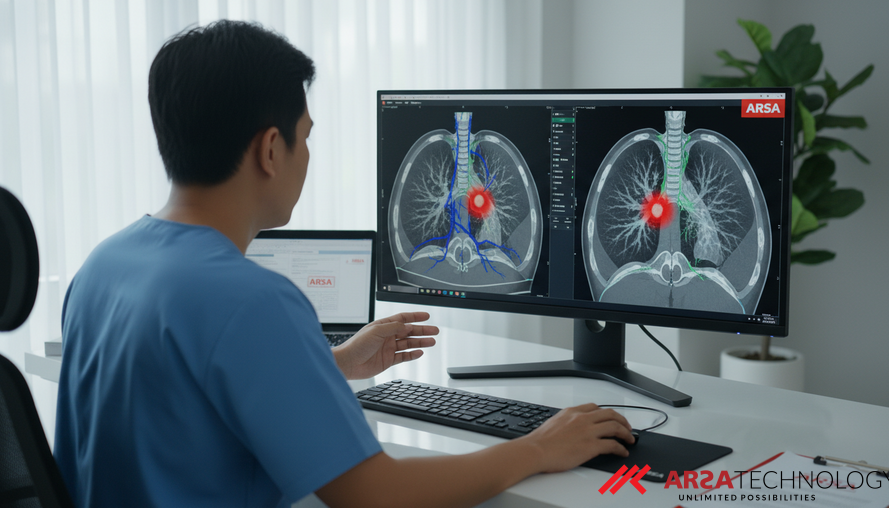
Lung cancer remains a leading cause of cancer-related mortality globally. Early and accurate detection of pulmonary nodules in CT scans is paramount for improving patient outcomes. However, the task of differentiating between benign and malignant nodules is inherently challenging due to their varied sizes, shapes, and complex locations. Radiologists often navigate a meticulous, multi-step process, examining nodules from fine-grained details to their broader anatomical context. This demanding workflow highlights a critical need for advanced auxiliary diagnostic systems that can not only achieve high accuracy but also provide transparent, clinically relevant explanations for their decisions.
While deep learning has shown immense promise in medical image analysis, many existing AI models operate as "black boxes," offering predictions without insight into their reasoning. This lack of explainability significantly hinders their adoption in high-stakes clinical environments, where trust and accountability are non-negotiable. To bridge this gap, researchers have developed M3Net, a novel 3D network designed for pulmonary nodule classification that mirrors the hierarchical diagnostic process of human radiologists, enhancing both accuracy and clinical trustworthiness. This innovative approach integrates multi-scale contextual information, providing a more robust and clinically relevant solution (J. Li et al., M3Net: A Macro-to-Meso-to-Micro Clinical-inspired Hierarchical 3D Network for Pulmonary Nodule Classification, 2026).
The Imperative for Explainable AI in Medical Diagnostics
In healthcare, diagnostic decisions carry profound consequences, involving intricate attribution, accountability, and the potential for life-altering interventions. Consequently, any AI-powered auxiliary diagnostic system must transcend mere statistical accuracy. It must offer transparency and explainability, allowing medical professionals to understand the rationale and key evidence underpinning its decisions. An interpretable system for pulmonary nodule classification, for instance, can connect its predictions to observable imaging characteristics. This ranges from subtle features like the lobulation or spiculation of a nodule to its relationship with surrounding blood vessels, and even its spatial impact within the entire lung lobe.
This ability to translate internal AI feature representations into clinically recognizable imaging features provides physicians with a vital evaluation interface. It empowers them to grasp the model’s prediction process from a pathophysiological perspective, fostering effective human-machine cross-verification. Essentially, explainability serves as a crucial bridge, connecting sophisticated data-driven models with established clinical diagnostic practices, paving the way for more trustworthy and effective AI-assisted tools. Technologies like those offered by ARSA AI Video Analytics can be customized and deployed to meet such stringent requirements in various critical environments.
M3Net's Clinical Inspiration: A Hierarchical Macro-Meso-Micro Approach
The core innovation of M3Net lies in its deep inspiration from the hierarchical diagnostic workflow employed by radiologists. When assessing a pulmonary nodule, a radiologist doesn't just look at it in isolation; they systematically examine it at different levels of detail and context. M3Net emulates this cognitive process by constructing a progressive multi-scale input that encompasses:
- Micro-scale: Focusing on the fine-grained internal structures and textures of the nodule itself, such as its density, heterogeneity, and subtle margin characteristics.
- Meso-scale: Incorporating local semantic context, which involves the immediate surrounding lung tissue, adjacent vessels, and bronchi. This helps determine the nodule's interaction with its environment.
- Macro-scale: Capturing global spatial relationships, assessing the nodule's position within the entire lung lobe or even the full lung scan, considering its overall anatomical impact.
By systematically evaluating the impact of these input scales on classification performance, M3Net establishes a clear hierarchical structure. This ensures that the model integrates complementary information from diverse spatial contexts, moving from minute local features to broad anatomical relationships, mirroring a physician's comprehensive examination.
Technical Innovations for Enhanced Explainability and Robustness
To implement this clinically-inspired hierarchy, M3Net employs several sophisticated technical mechanisms. It utilizes dedicated scale-specific encoders for each of the micro, meso, and macro scales. These encoders are designed to efficiently extract and represent distinct feature sets relevant to their respective scales. For instance, the micro-scale encoder would be highly attuned to subtle texture variations within the nodule, while the macro-scale encoder would focus on larger anatomical patterns.
A critical aspect of M3Net is ensuring cross-scale semantic consistency. This means that even as different encoders process information at varying resolutions, the model ensures that these different "views" are coherently related to the same underlying medical condition. This is achieved through advanced techniques like latent space projection and mutual information maximization. In simpler terms, these mechanisms help the model confirm that the fine details it observes at the micro-level are indeed part of the larger context understood at the macro-level, preventing fragmented or contradictory reasoning. Furthermore, the network integrates hierarchical cross-attention mechanisms, enabling it to progressively refine its understanding by correlating local cues with global context. This internal consistency is key to producing reliable and interpretable outcomes, a capability that ARSA Technology emphasizes in its own enterprise deployments and AI Box Series solutions.
Demonstrated Performance and Clinical Impact
M3Net's approach has been rigorously validated through extensive experiments on two prominent datasets: the public LIDC-IDRI dataset and a self-collected clinical dataset named USTC-FHLN. The results demonstrate state-of-the-art classification performance, achieving impressive accuracies of 86.96% on LIDC-IDRI and 84.24% on USTC-FHLN. Critically, these figures represent a significant improvement, outperforming the best existing baselines by 3.26% and 2.17% respectively.
These robust results not only validate M3Net’s strong performance but also highlight its superior generalization ability, an essential characteristic for reliable clinical deployment. The publicly available code (github.com/jylEcho/M3-Net) underscores the transparency and replicability of this research. Such advancements are crucial for organizations like ARSA Technology, which has been experienced since 2018 in developing and deploying high-accuracy, production-ready AI systems across various industries, including healthcare. The ability to integrate such sophisticated AI models into real-world medical workflows promises to significantly reduce diagnostic uncertainty and improve early intervention rates for lung cancer patients.
The Future of Trustworthy Medical AI
The development of M3Net marks a significant step forward in the field of AI-assisted medical diagnosis. By moving beyond the limitations of "black box" models, it offers a framework that not only achieves high accuracy but also provides a hierarchical, clinically logical explanation for its decisions. This capability is vital for building trust among medical professionals, fostering wider adoption of AI in healthcare, and ultimately improving patient care. The principles of M3Net—integrating multi-scale data, ensuring semantic consistency, and generating explainable insights—can serve as a blueprint for developing trustworthy AI solutions across other complex medical imaging tasks and beyond.
Implementing such advanced AI systems requires robust infrastructure and deployment expertise. Enterprises and public institutions seeking to integrate state-of-the-art AI for critical applications benefit from partners capable of delivering secure, scalable, and customizable solutions.
To explore how advanced AI and IoT solutions can transform your operations and to request a free consultation, please contact ARSA.